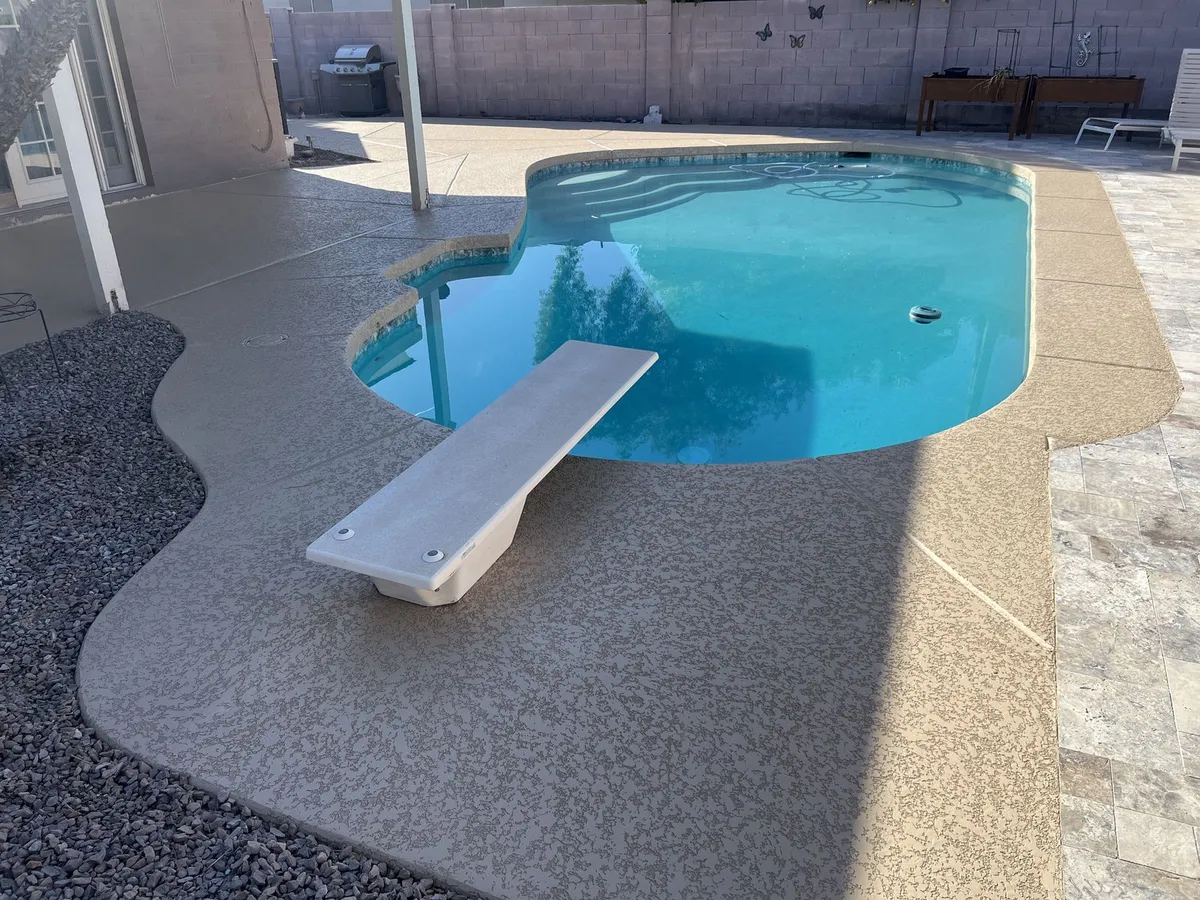
Many Phoenix homeowners say "Kool Deck repair" for any fix to a textured pool deck, and the phrase hides an important difference. Here's the truth most sales pitches skip: genuine Kool Deck only bonds to bare, clean concrete, so it can't simply go over the finish already on your deck. We think you should know exactly what you're buying before anyone quotes you a price, so this is the honest version.
What Kool Deck Actually Is
Kool Deck® is a trademarked cement-based topping made by Mortex, developed in Tucson in the 1960s. Its defining characteristic is how it's installed: the mix is splashed onto the slab with a dash brush and troweled to about 1/8 inch, either on the day of the original pour or later on bare existing concrete with Mortex's PTA bonding agent. It is a cement layer bonded straight to the slab, not a paint-like coating. That's what gave mid-century Arizona pool decks their distinctive rippled, cool-underfoot surface.
That installation requirement is also its limitation. Mortex's instructions for existing concrete say the system will only adhere to solid concrete that is free of dirt, oil, paints, stains, loose toppings, deteriorated concrete and curing compounds. On a deck that already carries a coat or a worn Kool Deck layer, that means scarifying all of it off, acid-etching, pressure-washing and a bonding agent, then two days under plastic, normal foot traffic after about two weeks and furniture after about four. Mortex recommends a trained crew of four to five. It can be done, but it is a strip-to-bare-concrete job, not a re-coat.
So What Happens When Your Kool Deck Fails?
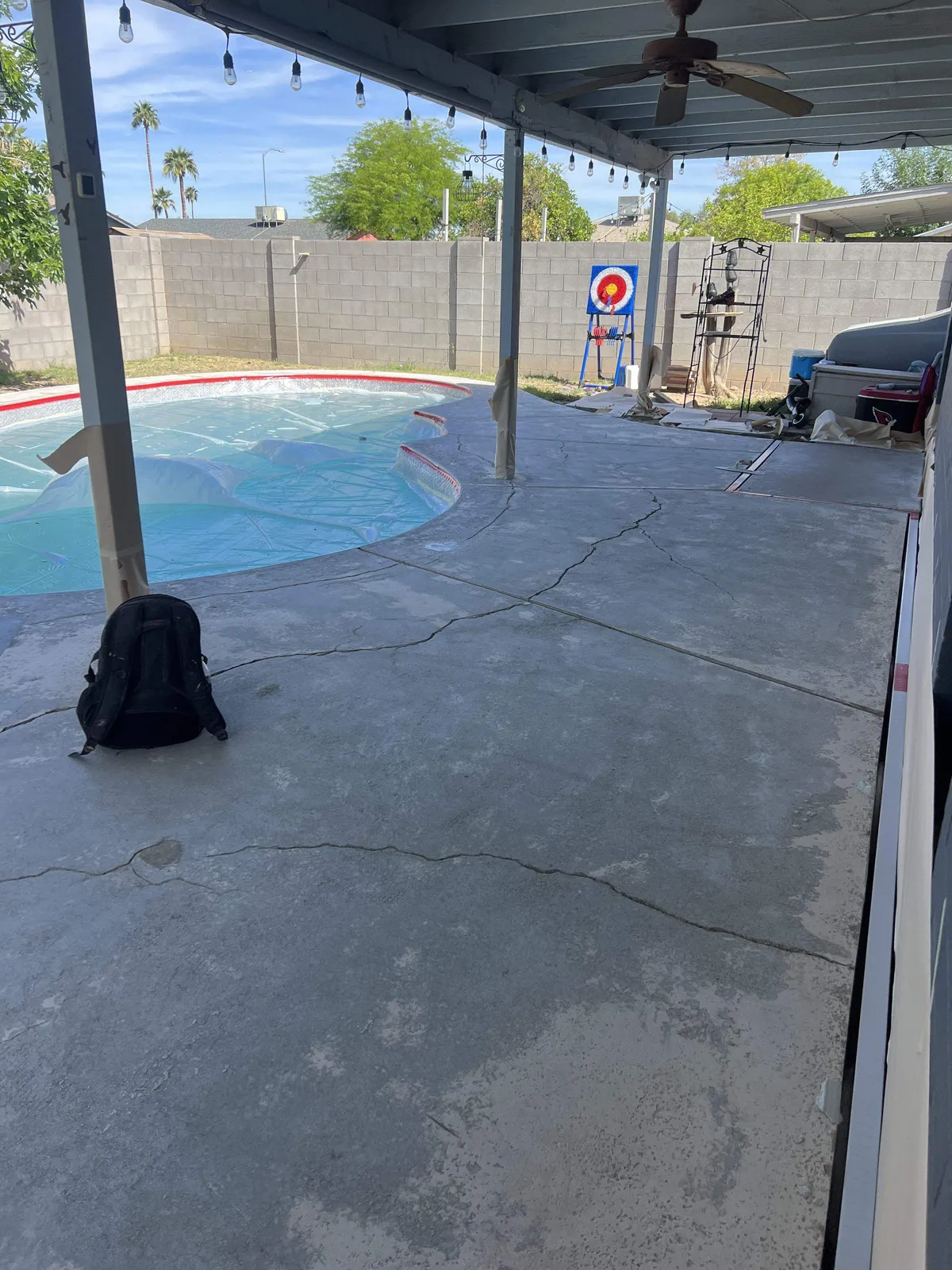
Original Kool Deck from the 70s, 80s, and 90s is now well past its service life all over Phoenix. It cracks, chips, fades to blotchy patches, and wears smooth in traffic lanes. When that happens, the honest repair path is:
- Repair the substrate. Cracks are ground out and filled, delaminated patches are removed, and damaged areas are leveled. (Our cool deck repair service covers this in detail, and our guide to whether you can patch Kool Deck yourself covers what a homeowner can safely fix.)
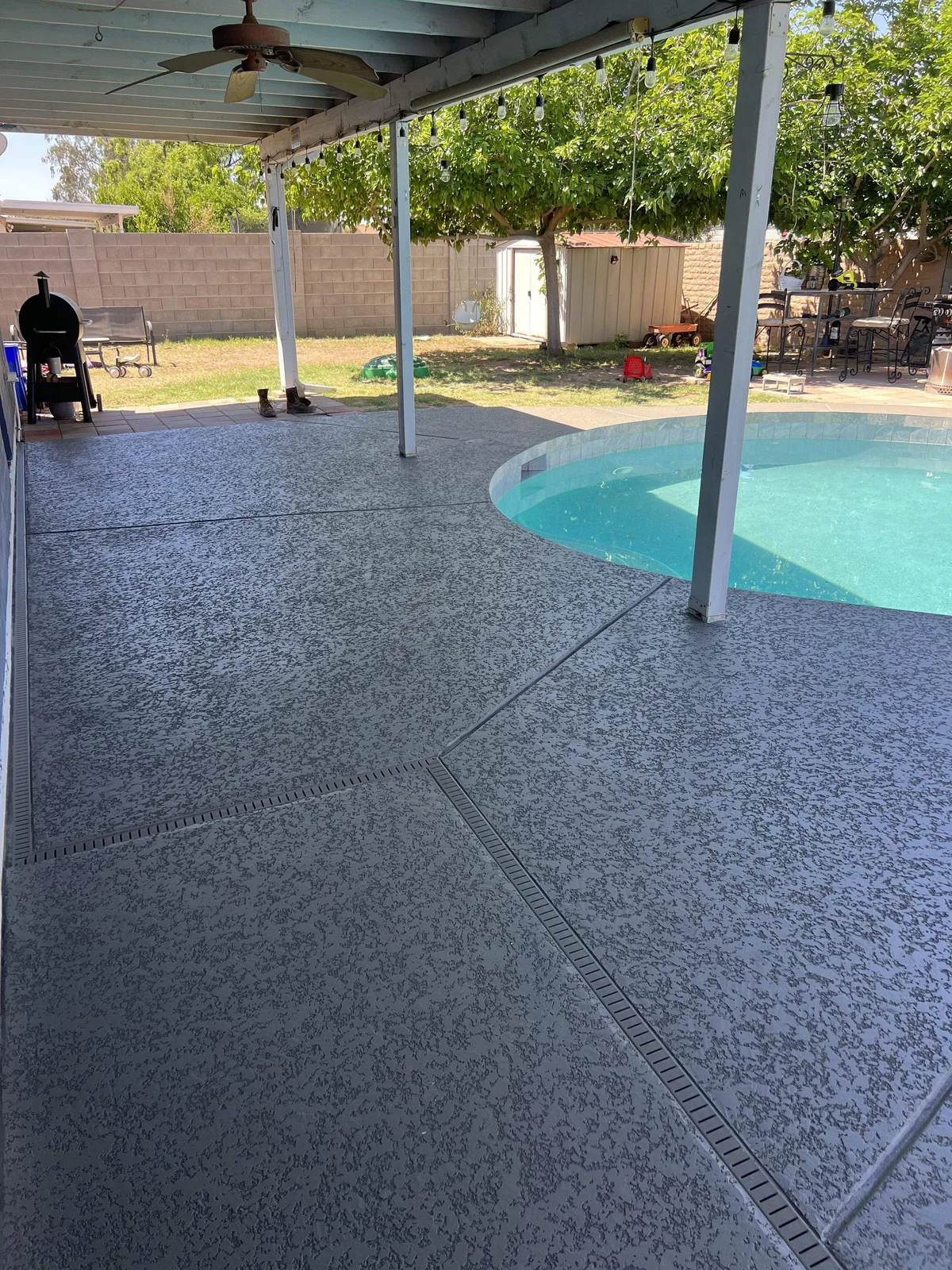
- Re-coat with a texture coating system. A lace texture or knockdown coating is sprayed and troweled over the whole deck, recreating the classic texture, or upgrading to a stamped pattern if you want a different look.
The result looks like Kool Deck, feels like Kool Deck, and cools like Kool Deck. Technically, it's a cool deck coating. Unless a quote includes stripping the whole deck to bare concrete, what goes down is a coating, whatever the ad copy calls it.
How to Tell If Your Deck Is Genuine Kool Deck
You can't settle it from a photo, and neither can we. But four clues get you most of the way before anyone comes out, and together they tell you which kind of repair you are actually shopping for.
- The age of the house and the pool. Kool Deck was the standard Valley pool deck topping for decades, so a pool built in the 1970s, 80s or 90s that has never been resurfaced is a good candidate for the original material. If the deck has been redone since, it almost certainly carries a coating now, and that is what any repair will be working with.
- The texture. Original Kool Deck has a soft, rippled, splashed-and-troweled look and a sandy, cement-like feel. A sprayed lace or knockdown coating tends to show sharper, more regular "islands" of texture and a slightly rubbery or painted feel where it has worn.
- The water test. Pour a little water on a worn, sunny spot. A bare cement topping darkens and soaks it up within a minute or so; a sealed acrylic coating tends to let water sit or bead before it dries. Treat it as a clue, not proof: an old sealer on real Kool Deck can make it bead, and a coating worn down to its base can soak water too.
- The edges and the chips. Look where the surface has chipped near the coping or a drain. A cement topping breaks off as a thin gray-white flake of the same material all the way through. A coating often shows layers: a colored film on top of an older texture, sometimes two or three coats deep, which is the history a contractor has to deal with.
Paperwork helps when it exists. A pool contract or a home inspection report sometimes names the topping. If you are still unsure, that is part of a normal estimate: we tap the deck to find hollow spots, look at the chipped edges, and tell you in writing what is on your slab and what that means for the repair.
What a Repair and Re-coat Looks Like, Step by Step
On a deck that already carries a coating, this is the sequence that makes the repairs disappear and keeps the new surface bonded. Skipping the first three steps is how a deck ends up peeling by the second summer.
- Find what is loose. We tap the whole deck, mark every hollow-sounding area, and check the cracks for movement: a hairline is surface work, while a crack with one side higher than the other points to the slab.
- Remove it. Hollow, flaking and delaminated patches come off down to material that is firmly bonded, and any old paint-like film that has lost its grip is ground away.
- Open and fill the cracks. Cracks are ground out into a clean channel and filled with a flexible crack compound, then feathered so the line does not telegraph through the new texture.
- Patch and level. Spalled spots at the coping, the skimmer and the drains are patched, and low areas that hold water are corrected where the slope allows.
- Clean and prime. The deck is pressure-washed, left to dry and primed so the new system bonds to the old surface and to the repairs evenly.
- Texture and topcoat. A lace or knockdown texture is sprayed and troweled over the whole deck, then the color coat goes on. The full re-coat is what hides the patches, which a spot repair on a faded deck never does.
- Cure. Most residential decks take 1–2 days of work. Light foot traffic returns after 24–48 hours; furniture, pets and pool service wait for the 3–7 day cure, longer in cool or humid weather.
Original Kool Deck vs. Modern Coating
| Original Kool Deck® | Modern Cool Deck Coating | |
|---|---|---|
| What it goes on | Bare, clean concrete only (fresh, or existing with every old coating stripped) | A sound slab or a properly prepared existing coating |
| Surface temperature | Cooler than bare concrete | Up to 30°F cooler than a dark surface (source: LBNL Heat Island Group, measured on pavement) |
| UV & stain resistance | Fades and wears with age | UV-stable coatings, sealed finish |
| Color/texture options | Limited classic palette | Wide color range, lace, knockdown, stamped |
| Repairability | Patches rarely match | Full re-coat hides repairs seamlessly |
| Typical lifespan | Long-lived, but most decks from the 1970s–90s are now worn out | 10–12 years, then re-coat |
Why We Tell You This
Because the question "is this real Kool Deck?" is the single best honesty test in this trade. We'd rather pass that test in writing, on our own website, than have you find out the difference after the deposit. What we install is a cool deck system, chosen because on an existing deck in Arizona heat it goes over a properly prepared surface instead of requiring the whole deck be stripped to bare concrete. Comparing it with a brand-name dealer system? Read our cool deck coating vs SUNDEK comparison, and for what moves the price, our Phoenix cost guide. Our process page shows every step of a repair and re-coat, and the two-year workmanship warranty that comes with it. For the full side-by-side, see Kool Deck vs cool deck coating.
Frequently asked questions
Can real Kool Deck be applied to my existing pool deck?
Only after every coating on it comes off. Genuine Kool Deck is a Mortex cement-based topping, and Mortex's own instructions for existing concrete say it bonds only to solid concrete that is free of paints, loose toppings, curing compounds and deteriorated concrete. That means scarifying off the old surface, acid-etching, pressure-washing and a PTA bonding agent before the Kool Deck mix is splashed on, troweled and kept under plastic for two days. It will not bond over an existing coating or painted surface. Most existing decks already carry one, so the usual re-coat is a knockdown texture or lace texture coating, which can go over a properly prepared existing surface and reproduces the same look and cooling performance.
Then what does 'Kool Deck repair' actually mean?
On an already-coated deck it means repairing cracks and damaged areas, then re-coating the deck with a texture coating system that matches the original Kool Deck finish. Done properly, the result looks and performs like the original surface, and the repairs disappear under the new coating.
Is a coating as good as original Kool Deck?
For most Arizona homeowners, yes. Modern coating systems offer comparable surface temperatures (a light cool deck coating can stay up to 30°F cooler than a dark surface in direct sun) (source: LBNL Heat Island Group, measured on pavement), better UV and stain resistance than older formulas, and far more color and texture options. Lifespan is typically 10–12 years in the Phoenix Valley, or 5–7 in harsh sun and water exposure, before a re-coat.
Why is my Kool Deck cracking and flaking?
Usually age plus the slab underneath. A cool deck surface follows the concrete it sits on, so cracks from soil movement, settling, or heat cycling show through, and decades of sun, pool chemicals, and water wear the topping thin until it flakes or lets go. Hairline cracks and worn spots are normal repair work before a re-coat. Wide cracks with one side higher than the other, or sections that have sunk, point to a slab problem that a coating will not fix.
Can I repair Kool Deck myself?
Small cracks and chips can be patched with a cool deck patch kit, and that is a reasonable stopgap. The catch is matching: patches on an old, faded surface rarely blend in, and a patch only lasts as long as the bond underneath it. If cracks are spreading or the surface is flaking in several places, a full repair and re-coat is what makes the repairs disappear.
How can I tell if my deck is real Kool Deck?
Look at four things: the age of the pool (a 1970s to 1990s deck that was never resurfaced is a good candidate for the original material), the texture (soft, splashed ripples and a sandy feel versus sharper sprayed islands), a water test (bare cement topping darkens and soaks up water; a sealed coating tends to bead) and the chipped edges (a cement topping is the same material all the way through, while a coating shows layers). None of these is proof on its own, so we confirm it at the estimate and put what we find in writing.
How long does a Kool Deck repair and re-coat take?
Most residential decks take 1–2 days of work: finding and removing loose areas, filling the cracks, patching, priming, then the texture and color coat. Light foot traffic returns after 24–48 hours, and furniture, pets and pool service wait for the 3–7 day cure, longer in cool or humid weather. A genuine Kool Deck reinstall on bare concrete is a longer job, because Mortex calls for two days under plastic and about two weeks before normal foot traffic.
How do I know if a contractor is being honest about this?
Ask them directly: 'Is this real Kool Deck or a re-coat?' A trustworthy contractor will explain the difference without hesitation. Be cautious with anyone who claims to put genuine Kool Deck over your existing coating - Mortex requires every old topping removed down to clean, sound concrete first, so an honest Kool Deck quote includes stripping the whole deck.
Not sure whether your deck needs a repair, a re-coat, or nothing yet? Our guide to the signs your pool deck needs resurfacing is a good start, or get a straight answer in person: Master Pool Decks answers these questions honestly and in person. Call (623) 521-1096 for a free inspection.