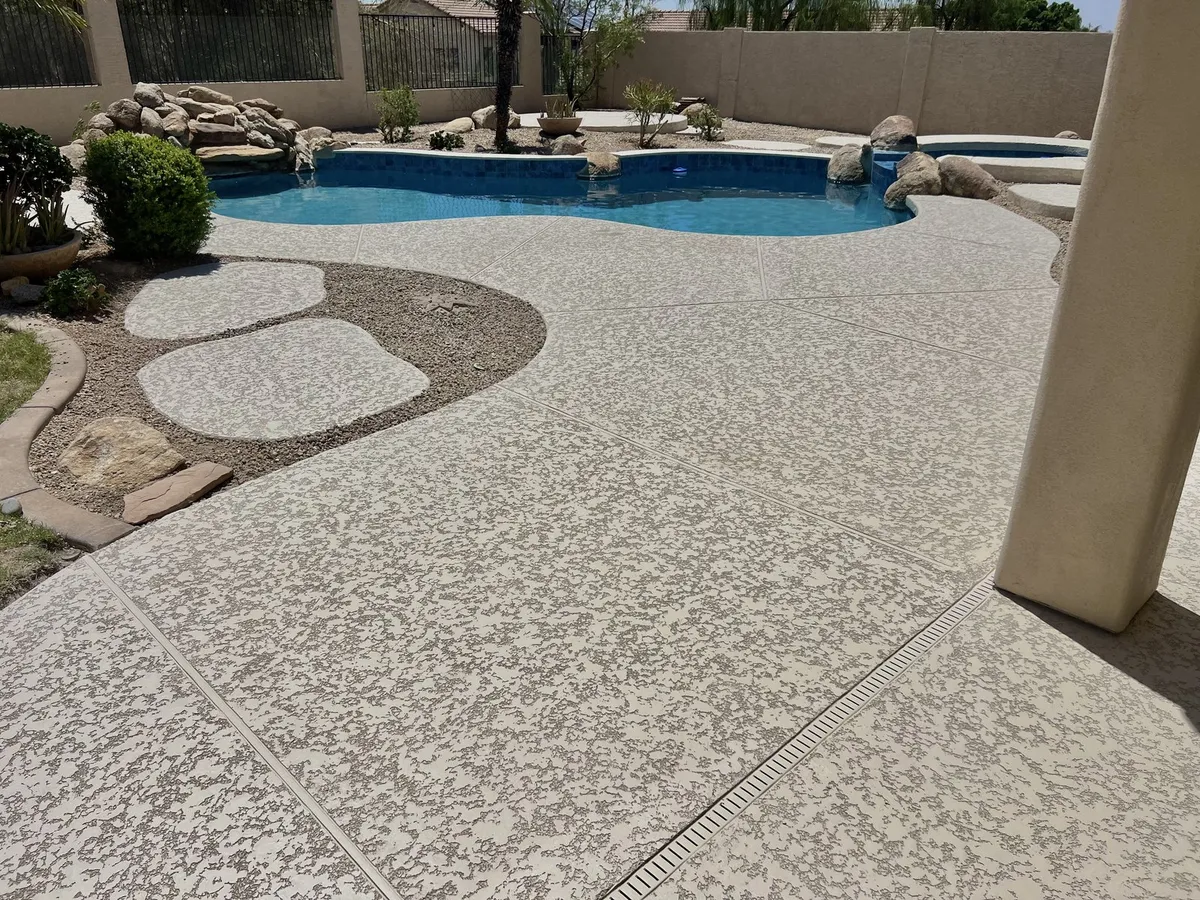
The comparison, side by side
| Factor | Cool deck coating | Travertine pavers |
|---|---|---|
| What it is | Textured coating over your existing slab | Natural stone assembly: base, setting bed, stone, coping |
| Installed cost | Lower — a coating over your existing slab Value | A multiple of coating cost — it's a construction scope |
| Heat underfoot | Light colors stay up to 30°F cooler than bare concrete | Light stone can feel comfortable; varies by stone and color |
| Installation | 1–2 days work, 3–7 days cure Fastest | Days to weeks; excavation/base work on renovations |
| Slip resistance | Engineered texture, consistent everywhere | Tumbled finishes grip well; polished do not belong poolside |
| Maintenance | Clean; recoat as wear appears | Joint sand, sealing, stain and settling care |
| Repairability | Repair + recoat renews the whole surface Easiest | Individual stones replaceable; settling needs base repair |
| Lifespan | 10–12 years per coating cycle | Stone lasts decades; joints and base need periodic work |
| Look | Practical, clean, many colors/textures | Premium natural stone — the look people pay for Premium |
Why the costs aren't comparable line-by-line
A coating quote and a travertine quote describe different projects. Cool deck reuses your slab: preparation, repair, texture, color, done. Travertine replaces the walking surface entirely — base preparation, a setting bed, the stone itself, new coping transitions, elevation changes at every door and step, and drainage designed for the new height. Neither number is wrong; they answer different questions. Ours answers “what can my existing deck become?” — see the full cost guide.
The heat question, without the marketing
Both camps make cooling claims, and both are conditionally true. Light travertine is a dense stone that can feel comfortable in the same conditions where light texture coating does. Color matters more than material: a dark surface of either kind gets hot in Phoenix sun. Our standing advice from the five-surface heat comparison: pick the lightest color you like and judge physical samples outside at 3 PM, not in a showroom.
When we'd point you to each
Choose cool deck when…
The slab is sound, you want the deck cooler and safer this month, budget matters, or you're renewing a deck that already works.
Choose travertine when…
You're doing a full backyard renovation or new build, the stone look drives the design, and the budget carries a construction scope.
Be careful when…
Someone proposes travertine over an existing deck without addressing height, thresholds, coping, and drainage — that's an assembly, not an overlay.
The honest disclosure
We install coating systems, not travertine. That's exactly why this comparison tells you when travertine is the right call — credibility is worth more than one job.
Frequently asked questions
Is travertine or cool deck better for Phoenix pools?
For an existing sound concrete deck, a light cool deck coating usually wins on installed cost, speed, and repairability. Travertine wins on premium natural-stone appearance and suits full renovations or new construction.
Is travertine cooler than cool deck?
Light travertine can feel comfortable underfoot, but temperature depends on stone, color, and exposure. Light texture coating is engineered to stay up to 30°F cooler than dark or bare concrete. Neither guarantees one number in every yard.
Why does travertine cost so much more than cool deck?
Different scopes: cool deck is a coating over your existing slab; travertine is a full assembly — base, setting bed, stone, coping, and drainage design — so its installed cost is a multiple of a coating's.
Can travertine be installed over an existing pool deck?
Sometimes, but it raises the finished height, affecting thresholds, coping, expansion joints, and drainage. It must be designed as a complete assembly, not laid over a slab as an afterthought.