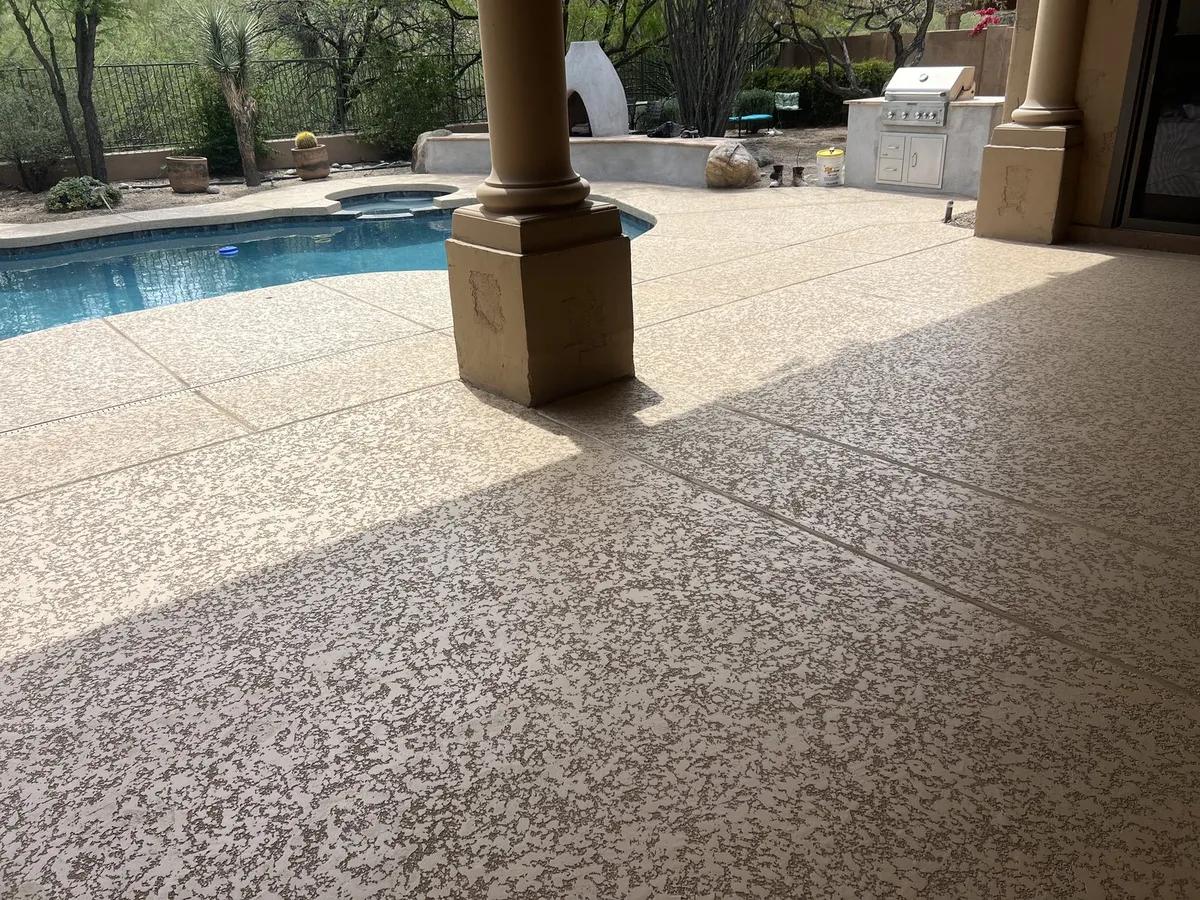
Cool deck or pavers on an existing Phoenix pool deck?
If your existing pool deck slab is sound and you mainly want it cooler, cleaner, and safer, a cool deck coating is the lighter, faster, and less expensive fix: it goes over the slab you already have, adds only a thin layer, and leaves your doors, coping, and drains at the heights they are now. Pavers turn the job into construction. Thin overlay (“veneer”) pavers set on a sand or mortar bed over the old slab raise the surface roughly 1 to 3½ inches, which has to work at every door, step, drain, and the coping. A tear-out to pavers on a compacted base costs the most and takes the longest, but it is the honest answer when the slab is heaving or broken, and pavers can be lifted and relaid where the ground moves. Heat depends on color for all three: light surfaces stay cooler, dark pavers get hot.
If you have talked to a paver installer, you have heard the pitch: coatings crack and peel, patches never match, pavers last. Homeowners on local forums put it more simply: veneer pavers, or just redo the cool deck? Some of the paver pitch is fair. Some of it skips the parts that matter most on a deck that already exists: the height of the new surface, where the water goes, and what is under the slab.
A disclosure first. We install cool deck coatings and decorative overlays (flagstone coating and stampable overlays) over existing concrete. We do not install pavers, so we are one side of this comparison, and we say plainly when pavers are the better call. Paver construction details come from the Interlocking Concrete Pavement Institute and paver manufacturers’ own guides, linked in place. Weighing natural stone instead? That is a different decision, covered in cool deck vs travertine. This guide is about concrete and porcelain pavers on a deck you already have.
Three projects, not two materials
On an existing deck you are choosing between three different jobs.
Coat the slab you have. A cool deck coating: the crew repairs cracks, preps the surface, sprays a texture coat, knocks it down for grip, then color-coats and seals. It is thin, it follows the slab, and the slab stays in charge of the structure. Genuine Keystone Kool Deck, the cement-based Mortex product, can also go on an existing deck, but only once every old coating is stripped to bare, sound concrete, per Mortex’s existing-concrete instructions.
Lay thin pavers on the slab. Overlay or “veneer” pavers are set on top of the old deck. Belgard’s guide to laying pavers over concrete lists three setting methods (sand set, bituminous set, and mortar set) and overlay styles from 20 mm to 60 mm thick, with porcelain the lowest profile at 20 mm. Its rule for the slab: “As long as the concrete slab is still sound, it can be overlaid with pavers,” and “Cracks are ok, as long as there’s no shifting or heaving.”
Tear out and lay pavers on a base. The old deck is broken out and hauled away, the ground is compacted, and pavers go down on a bed of sand over a compacted base. ICPI Tech Spec 10 recommends 2⅜-inch (60 mm) pavers for pedestrian areas, a 4 to 6 inch aggregate base for walks, and about an inch of bedding sand, and notes that a 4-inch concrete base is typically used around pools when the backfill or base cannot be compacted well.
Side by side on an existing Phoenix deck
| Question | Cool deck coating | Overlay (veneer) pavers | Tear-out to pavers |
|---|---|---|---|
| The old slab | Repaired and reused | Reused as the base; must be sound | Demolished and hauled off |
| Height added | A thin layer Least change | Roughly 1 to 3½ in., paver plus bed | Set from scratch |
| Doors, coping, drains | Stay where they are | Every one needs a plan; new coping is common | Redesigned with the new deck |
| Fixes a moving slab? | No | No | Yes, with a new base Only option |
| Heat underfoot | Light colors up to 30°F cooler than bare concrete | Color decides; light pavers can be comfortable, dark blends run hot | |
| Joints | Saw-cut control joints only | Sand joint around every paver; weeds and ants possible; periodic top-up | |
| Monsoon water | Sheds on the existing slope | Needs drain holes at low spots of the old slab | Base, slope, and drains built new |
| Spot repair | Patch and recoat the section | Lift and replace single pavers Easiest | |
| Time on site | 1–2 days; 3–7 day cure Fastest | Longer: cutting, edging, drains, joint sand | Longest: demolition and base work first |
| Relative cost | Lowest Value | Typically a multiple of a coating | Highest |
Height: the question that decides most overlays
This is where overlay bids succeed or fail, and it is the part a coating mostly avoids. Add up the layers. Per ICPI, bedding sand is screeded 1 to 1½ inches before compaction and is about an inch thick after. Belgard’s dry mudset goes down ¼ to ½ inch. Pavers run from 20 mm (about ¾ inch) for porcelain to 60 mm (about 2⅜ inches) for a standard concrete paver. So an overlay raises the deck by roughly an inch at the thinnest to about 3½ inches with a standard paver on sand. Belgard’s own instruction to installers: “Before installation, verify that the distance from the top of the slab to the doorsill will accommodate the proposed paver and setting bed thickness.”
- Sliding doors and thresholds. Measure the step from your door track down to the patio. If the overlay uses up most of it, water that used to stop at the step has a shorter path to the door. Sometimes the fix is a thinner paver; sometimes the pavers stop short of the house and a transition gets built.
- Pool coping. Your coping sits at a height that relates to the deck today. Add an inch or three and the relationship changes: a raised edge can end up nearly flush, and a flush edge can end up below the deck. That is why many paver overlay jobs include new coping. ICPI also calls for a urethane or neoprene sealant and backer rod between the pavers and the coping, to keep water out of that joint while letting the pool and the deck move separately.
- Deck drains. The grate and slot drains in a typical Valley deck sit at today’s surface. An overlay buries them unless they are raised or replaced, and ICPI says drains in a paver deck need holes or slots at the bedding-sand level so the bed itself can drain.
- Steps, spa edges, and gates. Raise the deck and the first and last step change height while the rest do not; gates that swing over the deck may need trimming.
A coating keeps all of those where they are. On many existing decks, height is what turns a “simple paver overlay” into new coping, raised drains, and a door transition.
Base, weight, and what is under the slab
Every paver system is only as good as what it sits on. An overlay makes your old slab the base: the pavers and bed sit on it, and any crack that is still moving keeps moving under the pavers. That is Belgard’s point about shifting and heaving, and the same rule applies to a coating. Neither one fixes a slab that is still on the move. Belgard’s base guide allows thin pavers over an existing slab on a sand or dry-mudset bed, and notes that a sand bed needs an edge restraint to hold it. ICPI recommends geotextile over the joints and cracks in a concrete base so the bedding sand does not migrate into them.
If your deck already has cool deck on it, ask what happens to that coating. A bonded bed (mortar or dry mudset) is only as strong as what it bonds to, and a flaking old coating is a weak link. Get the answer in writing.
A tear-out lets the installer fix the ground, and that is its real advantage: a new compacted base, new slopes, a chance to move drains and correct a deck that drains toward the house.
Heat: color beats material
Both sides claim to be cooler. Color decides most of it. The Heat Island Group at Lawrence Berkeley National Laboratory explains that dark pavements get hot because they absorb 80–95% of sunlight, lists new cement concrete at 30–50% solar reflectance and aged concrete at 20–35%, and shows a light segment about 30°F cooler than a dark one in its thermal image. That is road pavement, not a pool deck, but concrete pavers are concrete: a light tan paver behaves like light concrete, and a charcoal or red blend runs hot.
A light cool deck coating can stay up to 30°F cooler than bare concrete in direct sun, and its knocked-down texture puts less surface against your foot. A light paver can be comfortable too. We know of no published side-by-side test of pavers and cool deck coating in the same color on a pool deck, so test samples: leave each one in full sun until 3 PM and stand on it barefoot. Our guide to the coolest pool deck colors in Arizona covers the pick.
Joints: sand, weeds, ants, and movement
Joints are the difference you live with. A coated deck is one continuous surface with saw-cut control joints in the slab. A paver deck has a joint around every unit, filled with sand, and that sand is part of the structure: ICPI explains that it locks the pavers together and spreads loads from one to the next.
Loose sand washes out, and open joints invite weeds and ants. The industry answer is polymeric sand, which hardens in the joint. Unilock’s polymeric sand guide says it “creates a nearly airtight seal, significantly reducing the risk of weed growth,” makes it harder for ants to get in, and “can last for several years” when properly applied and maintained. Note the words: reducing, several years. Plan on topping up or redoing joints over the life of the deck. Around pools, ICPI recommends sealing the pavers and joints to keep the sand in place.
The upside of joints is movement. Pavers are a flexible pavement: when the ground settles, they move with it instead of cracking, and the installer can lift the affected pavers, re-level the bed, and put the same units back. ICPI calls this reinstatement and notes that no paving material is wasted. A coated slab that settles cracks; the crack can be repaired and blended, but it will come back if the slab keeps moving.
Monsoon water
The National Weather Service runs Phoenix’s monsoon season from June 15 to September 30 and notes that in some areas more than half the year’s rain falls in it, often as torrential downpours. That is the test for any pool deck.
A coated deck sheds water on the slab’s existing slope into its existing drains. That is good if the slopes are right and bad if they are not: a coating does not fix a deck that holds water or drains toward the house. Our monsoon drainage guide shows how to read your deck after a storm.
A paver deck takes water two ways: off the surface, and down through the joints into the bed. ICPI says that water needs a way out: slope the pavers and base toward drains, give those drains holes or slots at the bedding-sand level, and core weep holes, typically 2 inches across, at the low points of a concrete base. Belgard is blunt about overlays: “Drain holes are required at low spots,” and without proper slope, “water can accumulate between the pavers and concrete.” Ask any overlay bidder where the drain holes go. If the answer is that they are not needed, get another bid.
Repairs, ten years in
Both decks need something along the way. A coated deck gets a color and seal refresh, plus crack repair where the slab moved. We tell customers to expect 10–12 years from a cool deck coating in the Valley, or 5–7 in harsh conditions such as daily sprinkler overspray, with refreshes along the way. Patches blend because the section gets recoated.
Pavers win on spot repair, and it is the strongest part of the paver argument. A stained, cracked, or sunken paver can be lifted out and replaced. Ask the installer to leave a box of spares from the same production run; a replacement from a later batch may not match after years of sun. The paver units themselves are durable. The upkeep is in the joints, the sealer, and any settling in the bed.
HOA approval, timeline, and disruption
HOA. Many Valley HOAs want to review exterior surface and color changes before work starts. Recoating in a similar color is usually a simpler review than a change of material, new coping, or a raised deck. Check your CC&Rs and get approval in writing before you sign either contract.
Timeline. Our cool deck coating is 1–2 days of work, light foot traffic after 24–48 hours, and a 3–7 day cure before furniture goes back. An overlay paver job runs longer: cutting, edge restraint, drains, coping, and joint sand all add days. A tear-out adds demolition, haul-off, base work, and compaction on top of that, with equipment coming through the side gate and the yard a job site until it is done. Ask every bidder for a written schedule that includes cure and joint-sand time, and see our guide to the best time of year to resurface.
Cost, in relative terms
We do not publish prices; we quote per project from the actual surface, with a free written estimate. In relative terms the order is consistent. A coating over the existing slab costs the least, because the slab is reused and the materials are thin. Overlay pavers typically cost a multiple of a coating once coping, drains, and edging are included. A tear-out costs the most, because it adds demolition, disposal, and a new base. Compare cost per year of service, including upkeep: color refreshes for a coating, joint sand and sealer for pavers. Our cost guide explains what drives a coating quote.
When pavers genuinely win
Pavers have real strengths around a pool. ICPI points to their “high slip-resistance and rapid drainage of water,” individual units can be replaced, and a tear-out is the only one of these three options that fixes the ground. Here is how we would sort it.
Pavers are the better call when…
the slab is heaving, broken through, or drains toward the house and has to come out anyway, or the paver look is the point and the budget carries a construction project.
Overlay pavers can work when…
the slab is sound, there is room under every door, the coping and drains are part of the plan, and the bid names the setting method, the drain holes, and the edge restraint.
A coating usually wins when…
the slab is sound, the goal is a cooler, cleaner, safer deck this season, door and coping heights are tight, or you want the work done in days instead of weeks.
Want the stone look without the height?
An flagstone coating or stamped overlay goes over the slab, reads as laid stone from a few feet away, and adds very little height at doors and coping.
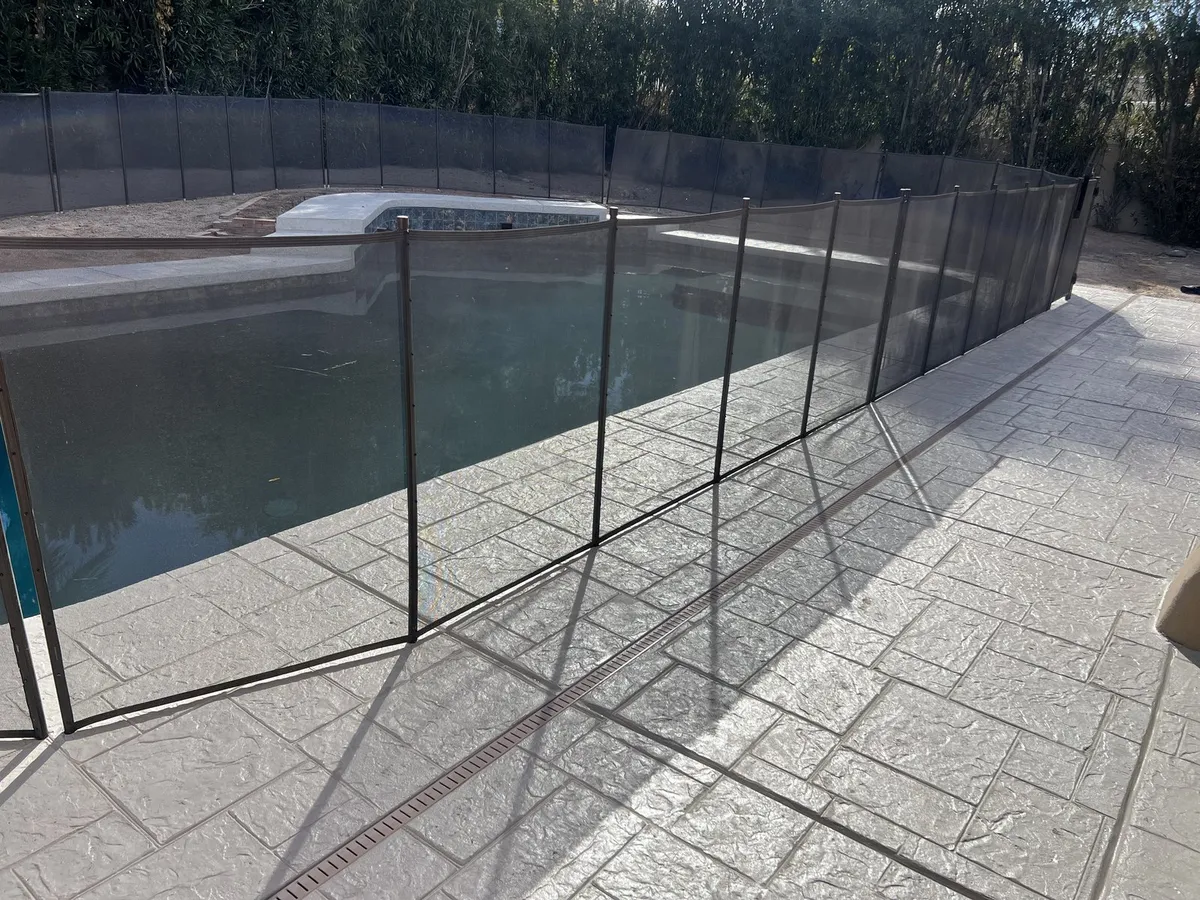
Questions to ask a paver bidder
- Overlay or tear-out? Which paver, how thick, on what bed?
- What will the finished height be at each door, the coping, and every drain?
- Where do the drain holes go, and how do the existing deck drains change?
- Is new coping included, and what seals the joint between pavers and coping?
- What goes in the joints, what upkeep does it need, and will you leave spare pavers from the same run?
- What is your ROC license number? Then check it at roc.az.gov, for any contractor, including us.
The long version of that list is in our guide to choosing a pool deck contractor in Phoenix. If your slab is cracked and you are not sure whether it is still moving, start with resurface vs replace.
Frequently asked questions
Is cool deck or pavers better for an existing pool deck in Phoenix?
If the slab is sound, a light cool deck coating is usually the better value: it goes over the existing concrete in 1–2 days of work, keeps door, coping, and drain heights where they are, and costs a fraction of pavers. Pavers are the better call when the slab is heaving or broken and has to come out anyway, or when the paver look is worth a construction-sized project. Color decides heat for both.
Can pavers be installed over an existing cool deck?
Often, if the slab underneath is sound. Paver manufacturers allow thin pavers over existing concrete on a sand, bituminous, or mortar bed, as long as the slab is not shifting or heaving. The catch is height: pavers plus the bed raise the deck by roughly 1 to 3½ inches, which has to clear every door, drain, and the coping, and the bed needs drain holes at the low spots. Ask whether the old coating has to come off for a bonded bed.
Are pavers hotter than cool deck in Arizona?
Color matters more than material. Concrete pavers behave like concrete: light colors stay cooler and dark blends get hot. A light cool deck coating can stay up to 30°F cooler than bare concrete in direct sun, and a light paver can be comfortable too. We know of no published side-by-side test of the two on a pool deck, so test samples barefoot in afternoon sun.
Do pavers get weeds and ants in Phoenix?
They can, through the joints. Polymeric joint sand hardens in place and significantly reduces weeds and ants, and one major paver maker says it can last several years when properly applied and maintained, so plan on periodic joint work. Around pools, the paver industry recommends sealing the pavers and joints to keep the sand in place. A coated deck has no sand joints, only the saw-cut control joints in the slab.
How much will pavers raise my pool deck?
It depends on the paver and the bed. Porcelain overlay pavers start at about 20 mm (¾ inch) on a dry-mudset bed of ¼ to ½ inch; a standard 2⅜-inch concrete paver sits on about an inch of compacted sand. That works out to roughly 1 to 3½ inches over the existing slab. A tear-out resets the height from scratch, and a coating adds only a thin layer.
Which costs less, cool deck or pavers?
A coating over the existing slab costs the least, because the slab is reused. Overlay pavers typically cost a multiple of a coating once coping, drains, and edging are included, and a tear-out costs the most because it adds demolition, disposal, and a new base. We quote per project from the actual surface, with free written estimates; ask every bidder to put the expected lifespan and upkeep in writing.
Does Master Pool Decks install pavers?
No. We install cool deck coatings and decorative overlays, such as flagstone coating and stampable overlays, over existing concrete, with a two-year workmanship warranty in writing. We do not install pavers or travertine. If your slab needs to come out, we will tell you, and that is when a paver installer is worth calling.
More answers in our full FAQ. For how we install the coating side, see our cool deck coating page or cool deck resurfacing in Phoenix.
Belgard, Unilock, and Keystone Kool Deck are trademarks of their respective owners, named here only to identify their published guidance. Master Pool Decks is independent and is not affiliated with, endorsed by, or a dealer for any of them.