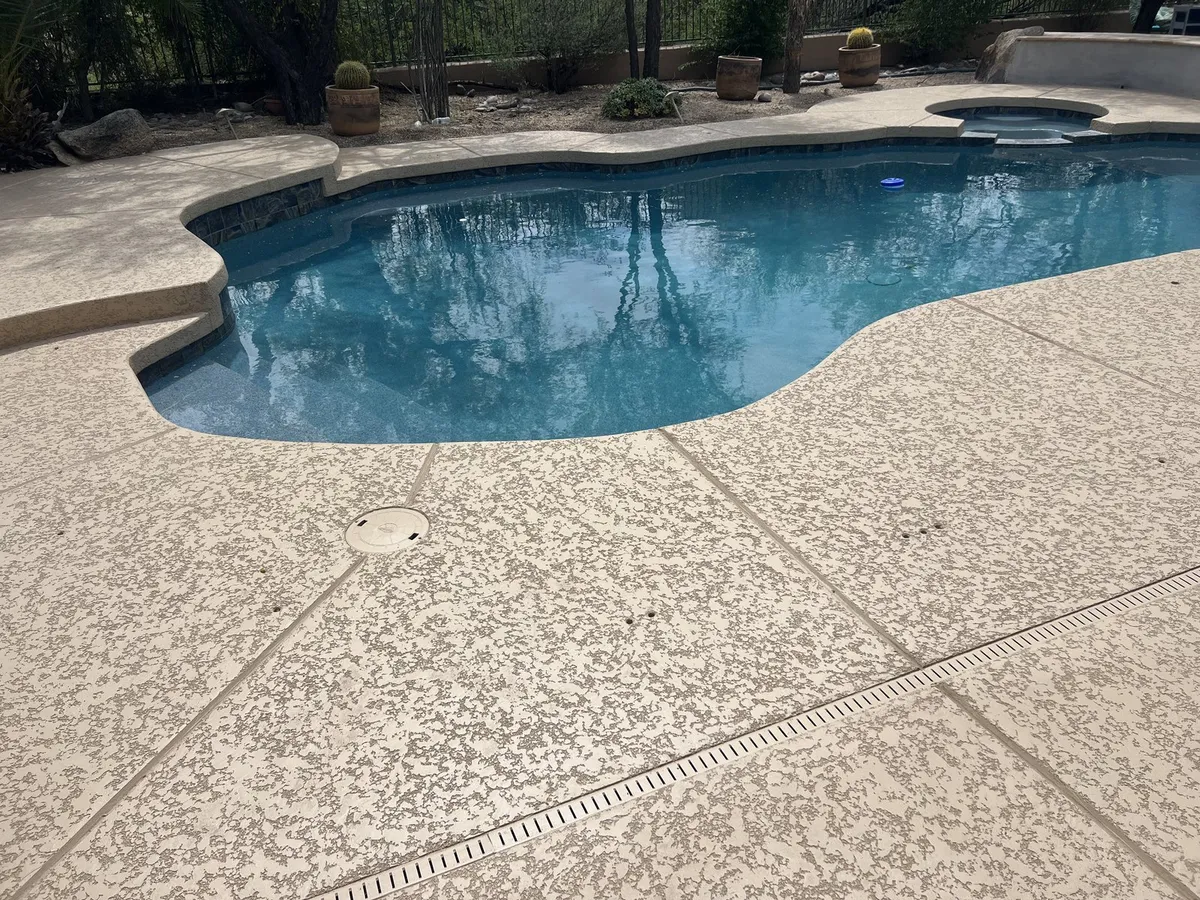
How do I choose a pool deck resurfacing contractor in Phoenix?
Choose a Phoenix pool deck resurfacing contractor by checking three things before you compare anything else: their status on the Arizona Registrar of Contractors portal at roc.az.gov, a current certificate of liability insurance issued to you by their carrier, and a written scope that spells out exactly how the existing surface will be prepared. Surface prep is where resurfacing jobs fail, so a contractor who can describe grinding loose coating back to a bonded edge, chasing cracks, and priming bare concrete is telling you more than any photo gallery can. Ask what coating system is going down and what it realistically lasts in the Valley — an acrylic cool deck runs about 10–12 years here, or 5–7 in harsh conditions — and get the workmanship warranty and what voids it in writing. Insist the quote is measured from your actual deck; a firm price given over the phone sight unseen is a guess. Then compare quotes on scope, not on the number at the bottom.
Most homeowners call three contractors, get three numbers, and pick one. That works if all three are quoting the same job, and they almost never are. One is grinding the failed coating off and priming bare concrete; another is spraying texture over a surface that is already letting go. Both quotes say "resurface pool deck." Only one lasts.
So the useful skill is not haggling. It is asking questions a good contractor answers easily and a bad one answers vaguely. Here are the ten we would ask as the homeowner.
The two checks that take ten minutes
1. What is your ROC license number?
The Arizona Registrar of Contractors licenses residential contractors and runs the complaint process homeowners use when a job goes wrong. That process only covers contractors who hold an ROC license, which is the practical reason to check: a contractor outside that system is outside your recourse.
Verifying takes five minutes. Go to roc.az.gov, open the contractor search, and look up the business name or the number you were given. Confirm the status is active, the classification covers your work, and the name matches your quote. Read any complaint history.
A good answer sounds like: the number, immediately, plus the classification, plus "go look it up."
Worry if you hear: "we work under someone else's license," "a license isn't required for coatings," or a number that does not match the name on the quote.
We tell you to run that check knowing you will run it on us, and you should. Verify licensing and insurance yourself for every contractor you are considering, including this one, rather than taking any company’s website at its word. What we will tell you directly: we carry liability insurance, we put the scope and a two-year workmanship warranty in writing, and every photo on this site is our own completed work. Ask us anything on that list before the deposit, not after. More about who we are.
2. Can you send a certificate of insurance with my name on it?
Not a photo of a card. A certificate issued by their agency showing general liability coverage, the policy dates, and you as the certificate holder. Ask about workers' compensation if they have employees. If someone gets hurt on your property or a pressure washer takes out your pool pump, that distinction stops being paperwork.
A good answer sounds like: "I'll have my agent email it today" — and it arrives from the agency.
Worry if you hear: "we're bonded" offered as a substitute, an expired date, or a certificate with somebody else's name on it.
The question that actually predicts whether it lasts
3. Walk me through exactly how you will prep my deck.
This is the one. Coatings rarely fail because the coating was bad; they fail because they went onto something they could not bond to. We wrote a whole guide on why pool deck coatings peel, and most of the causes trace back to prep or to water nobody stopped.
Pressure washing is not prep. Real prep means tapping the deck to map hollow areas, grinding loose material back to a bonded edge and feathering it, chasing and filling cracks, profiling bare concrete so the new material can grip, and priming before any texture goes down. On a damp deck it means finding the water source first. Garage-floor contractors measure slab moisture with probes under ASTM F2170; on a pool deck the practical version is a contractor who asks where your sprinklers hit.
Cracks belong in the same answer. Hairline cracking is normal prep and should be included; a crack that is moving — wider at one end, offset in height, reopening every year — will telegraph back through any coating, and an honest contractor says so. Low spots get addressed during the resurface, because nobody regrades a deck afterward. Our cool deck repair page covers what is repairable.
A good answer sounds like: specifics, in order, with the caveat that they will know more once the grinder is running.
Worry if you hear: "we power wash it and coat it," "we can go right over what's there," "the coating will fill the cracks," or any promise that a structural crack will never come back.
What is going on my deck, and how long does it last?
4. What system are you installing, and what does it realistically last here?
Ask for the system and the finish by name. A textured acrylic cool deck typically lasts 10–12 years in the Phoenix Valley, or 5–7 in harsh conditions such as constant irrigation overspray or a dark color baking all summer; our lifespan guide covers what pushes a deck to each end of that range. A light textured finish also stays up to 30°F cooler than bare concrete in the sun.
One detail worth knowing: if your deck is original Keystone Kool Deck, Mortex's product bonds only to clean, bare concrete. It can go on an existing slab, but only after every old coating and topping is removed; it will not bond over an acrylic or painted surface. Anyone promising "new Kool Deck" over your current surface is using the phrase loosely or does not know the product.
A good answer sounds like: a named system, a range rather than one number, and what shortens it on your particular deck.
Worry if you hear: "lifetime coating," "never needs recoating," or a product nobody will name.
5. What does the warranty cover, what voids it, and is it in writing?
A workmanship warranty covers the crew's work — bond failures from prep, mostly — and is separate from anything the manufacturer says about the material. Ours is two years, deliberately: the first two summers are when a prep failure shows. Ask what voids it and expect a real list, like painting over the finish yourself or moving an irrigation head to spray the deck.
A good answer sounds like: a document you can read before you sign, with a term, exclusions, and what to do if something fails.
Worry if you hear: a verbal "we stand behind our work," a lifetime claim, or a warranty that appears only after payment.
How the number was built
6. Did you measure my deck, or estimate it?
Every deck is a different size, condition, and access problem. Work should be quoted per project from the actual surface, with a free written estimate. A firm price given over the phone is a guess, and guesses get corrected once the crew arrives — usually upward, usually mid-job. Our guide to what drives a resurfacing quote explains the factors that move it.
A good answer sounds like: they measured, they wrote down the condition they found, and the scope reflects both.
Worry if you hear: a firm number sight unseen, or a "starting at" figure used to collect a deposit before anyone visits.
7. Who is actually doing the work — your crew or a sub?
Subcontracting is not automatically bad. Not knowing is. The real question is who carries the insurance, who is on site when something goes sideways, and who comes back if the deck fails in year two.
A good answer sounds like: "my crew, same lead from prep through final coat, here's his name" — or an honest "I sub the concrete repair, and here is how the warranty works."
Worry if you hear: they cannot tell you until the morning of, or whoever sold the job does not know who is showing up.
8. How many days, and when can I use the deck again?
Most residential decks are 1–2 days of work followed by a 3–7 day cure. Light foot traffic is usually fine at 24–48 hours; furniture, pool equipment, and anything with wheels wait for the full cure.
Worry if you hear: "one day, walk on it that night." Acrylic cures on its own schedule, and Phoenix heat moves that schedule in both directions.
9. What happens if a storm hits mid-job?
The National Weather Service's official monsoon season for Arizona runs June 15 through September 30, and a storm can arrive faster than a crew finishes a color coat. Fresh acrylic and rain do not mix.
A good answer sounds like: they watch the forecast, stop and protect the work rather than race it, reschedule at no charge, and say up front who pays if a fresh coat gets rained on.
Worry if you hear: "we'll push through it," or no answer at all.
10. Are those your photos?
Ask directly. Then ask for a job in your zip code from the last year, an address you can drive past, and — the one most people forget — a deck they finished five years ago. Everything looks good the week it is done. Ask for prep photos too: a contractor proud of their prep has pictures of a ground-down, half-finished deck on their phone.
Every photo on this site, including the one at the top of this page, is our own completed work in the Phoenix Valley. That is a claim you are entitled to test on anyone, us included.
Worry if you see: only glossy wide shots, no in-progress work, backyards that are obviously not Arizona, or a gallery with no local address behind it.
Red flags worth walking away from
Any one of these is a reason to slow down
- A deposit-heavy payment schedule. A modest deposit to hold the date is normal. Most of the job up front, before anyone has touched your deck, is not.
- Door-to-door pressure. "We have leftover material from a job down the street" is a script, and leftover material was mixed for somebody else's deck.
- A discount that expires today. Real crews are booked out and do not need you to decide in the driveway.
- "Lifetime" coating claims. Nothing outdoors in Phoenix is lifetime. Whoever says it is counting on you not reading the exclusions.
- No written scope of work. A number on a business card is not a contract. If the prep is not written down, it is not promised.
- A price quoted sight unseen. See question 6.
- No physical address, no name on the truck, cash only. Somebody you cannot find in year two cannot honor a warranty then either.
- Dodging the license question. Not holding one is a fact you can weigh. Refusing to discuss it is a different problem.
Reading two quotes that do not match
When two quotes come back far apart, it is rarely the same job priced differently. It is two different jobs. Line the scopes up side by side before you look at the bottom line:
How much is coming off
The biggest swing. Is the old coating ground back where it failed, stripped entirely, or left alone? A quote silent on the existing surface is quoting a different job.
Crack and repair scope
Which cracks are included, which are flagged as extras, and what happens if the crew finds more once grinding starts. Vague here means change orders.
System, coats, and finish
Product named, number of texture and color coats, and the finish. Two coats and three coats are not the same deck in year eight.
The edges and the paperwork
Joints, drains, step nosings, coping, masking, cleanup, warranty term and exclusions, and what final payment is tied to. These are the lines quietly left out.
Once the scopes match, compare. If one is still noticeably lower, ask that contractor what they are doing differently. Sometimes the answer is a smaller crew and lower overhead. Sometimes it is that they are skipping the part you cannot see from the patio. Cheaper is not the problem; cheaper because of less prep is.
Frequently asked questions
Does a pool deck resurfacing contractor in Arizona need an ROC license?
The Arizona Registrar of Contractors licenses residential contractors and runs the homeowner complaint process, and that process only covers contractors who hold an ROC license — so a contractor outside the system is outside your recourse. Look up anyone you are considering on the ROC's contractor search before you sign. Ask any contractor directly about licensing, insurance and warranty rather than assuming, and verify what they tell you. Master Pool Decks carries liability insurance and puts the scope and a two-year workmanship warranty in writing on every job.
How do I check a contractor's license in Arizona?
Go to roc.az.gov, open the contractor search, and look up the business name or the number they gave you. Confirm the status is active, the classification covers the work, and the name matches your quote, then read any complaint history. The ROC also lists unlicensed violators. The whole check takes about five minutes.
How many pool deck resurfacing quotes should I get in Phoenix?
Two or three, and only from people who walked your deck and measured it. Written scopes you can compare line by line tell you more than numbers over the phone. If one is far below the others, read its prep section first, because that is almost always where the difference lives.
Should I pay a large deposit for pool deck resurfacing?
A modest deposit to reserve the date and cover materials is normal. A schedule that asks for most of the job before anyone has touched your deck is not. Ask what the deposit buys, when the next payment is due, and what final payment is tied to — it should come after you have walked the finished deck, not on the day the crew packs up.
What should a pool deck resurfacing quote include?
Measured square footage, the condition the crew found, what is being ground back or removed and what stays, how cracks and low spots are handled, the coating system and finish by name, the number of coats, the color, working days and the cure window, cleanup, the warranty term, and the payment schedule. If a line is missing, ask for it in writing before you sign.
More answers in our full FAQ, and if you are in the city itself, our Phoenix pool deck resurfacing page covers service area and process.