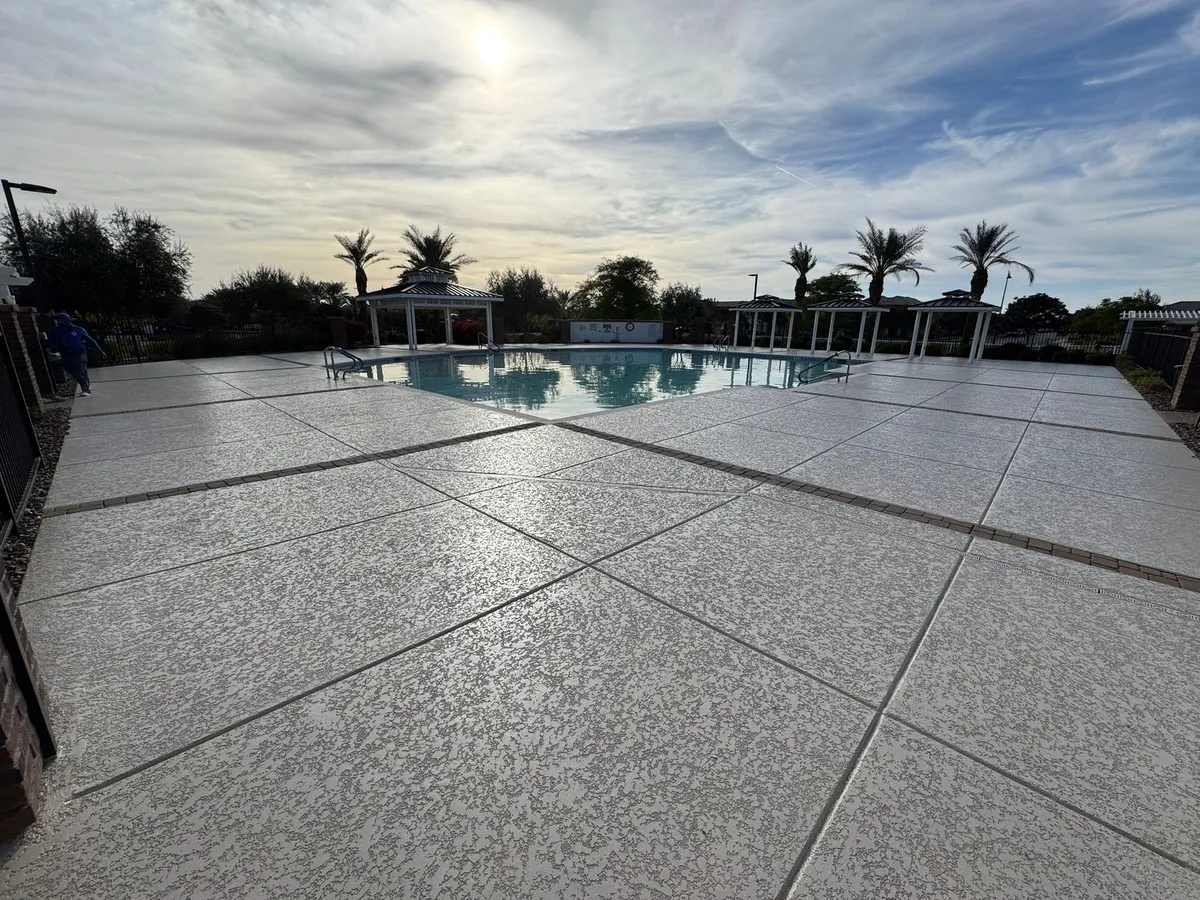
What should an HOA or property manager check before resurfacing a pool deck?
Check seven things before you sign: whether Maricopa County Environmental Services needs to approve the work, slip resistance backed by a test report on the actual coating system, drainage with no standing water, a color the architectural committee has approved from a sample, a written phase and reopening schedule, comparable written bids, and the contractor’s ROC license status, insurance certificate, and warranty. For a public or semipublic pool in Maricopa County, the county’s pool code lists resurfacing the deck among the changes that need design approval before work starts, and the plans are due at least 30 days ahead, so start that conversation first. A typical section takes 1–2 working days and cures over 3–7 days, which is what your schedule and your resident notice should be built around.
Boards and managers who get through a pool deck resurfacing smoothly did the same thing: they settled approvals, slip and drainage questions, and paperwork before anyone mixed coating. This checklist is in that order. It is written for Phoenix Valley HOAs, apartment communities, and commercial pools, and it applies to whoever you hire, including us. We point to primary sources, the county code, ADA.gov, the standards bodies, and the state contractor board, so you can check every claim. Where a rule depends on facts we do not have, we say who to ask. Our commercial pool deck page describes how we run these jobs.
1. Start with the county: does the deck need design approval?
Public and semipublic pools in Maricopa County are regulated by Maricopa County Environmental Services under the Environmental Health Code, Chapter VI. A public pool is open to the general public; a semipublic pool serves a defined group such as an HOA or apartment community.
The part that surprises boards: the code requires design approval before major modifications to an existing public or semipublic pool, and its list of major modifications includes “resurfacing the pool interior or deck.” Plans go in with fees at least 30 days before the date you want to act, prepared by or under an Arizona professional engineer, an architect, or a pool contractor holding the ROC classification the county lists for that project type (Chapter VI, Section 1, Regulation 2).
Two caveats. We are reading a code document, not giving legal advice, and the copy we read was marked revised August 2026. And whether a coating-only job is handled as a major modification in practice is the county’s call, not a bidder’s. Contact Environmental Services pool inspection before you pick a start date and ask: is approval required, who submits, and how long is review? Then ask every bidder who prepares the submittal and under which ROC classification. If approval applies, the 30 days is the first item on your calendar.
2. Slip resistance: what DCOF and ANSI A326.3 mean
The county code gives no friction number. For deck walkways it says “constructed of concrete or other inorganic material, with a slip-resistant, easily cleanable finish.” Public pool walkways must be at least 10 feet wide and semipublic walkways at least 4 feet (Section 6, Regulation 14; Section 7, Regulation 3).
So when a bid says “slip-resistant,” ask: measured how? The standard you will see cited is ANSI A326.3, a test method for the dynamic coefficient of friction (DCOF) of hard surface flooring, published by the Tile Council of North America (TCNA). A test foot is pulled across the wetted surface, and a higher number means more grip under those test conditions.
The 2021 edition added five “product use classifications.” One manufacturer’s summary lists Exterior, Wet at manufacturer-declared or above 0.55 wet DCOF, with exterior pool decks among its uses, and Interior, Wet at 0.42. The same summary notes that manufacturers pick their own test methods for declarations and that a classification “does not prevent slip/fall events” (Creative Materials Corp. technical bulletin). Read the standard itself before you write a number into a bid spec. On a real bid:
- Ask for a wet test report on the actual system: coating, texture, and sealer together, with method and date. A number for another product describes another deck.
- Ask where the texture changes. Steps, ramps, the gate entry, and areas by showers and drains stay wet longest.
- Ask about the sealer. Some make a textured surface slick when wet.
We do not publish a DCOF figure for our systems and do not certify compliance with any safety or accessibility standard. If your insurer has a written slip requirement, send it with the bid request.
3. Accessibility: the route, the slope, and who is covered
ADA.gov’s pool guidance says the 2010 Standards cover pools at government facilities and places of public accommodation, such as hotels, resorts, and swim clubs, and that Title III requires removing barriers at existing pools where readily achievable. Pools with less than 300 linear feet of wall need one accessible means of entry (a lift or sloped entry); larger pools need two (ADA.gov, Accessible Pools). Whether your HOA or apartment pool is a public accommodation depends on facts like who can use it and whether non-residents can join or rent it. That is a question for your counsel, not a contractor.
What a resurfacing job can touch, on any pool, is the walking surface. The 2010 Standards treat a running slope steeper than 1:20 as a ramp and cap cross slope at 1:48, about a quarter inch per foot (U.S. Access Board). The practical checks are physical:
- The route from parking to the gate, and gate to water, stays continuous during phasing and has no new lip or ridge after.
- The coating creates no new edge at drains, transitions, or the coping.
- Any pool lift or sloped entry keeps its clear floor space.
Ask each bidder how they handle transitions, and have your accessibility consultant mark up the proposal.
4. Drainage, slope, and joints
The county’s drainage wording is the clearest in the code: decks must drain to perimeter areas or deck drains, removing “splash water, deck cleaning water, and rainwater without leaving standing water.” The numeric rule is a minimum slope of a quarter inch per foot and a maximum of one inch per foot, except ramps. A 2015 county policy statement (since archived, so confirm current practice) says the department applies the no-standing-water test at inspection (WW-2015-005). A deck that puddles is a county problem, an accessibility problem, and a slip hazard.
The code also covers joints: gaps between slabs capped at three-sixteenths of an inch, height differences at a quarter inch, and a watertight joint where the coping meets the deck. A coating does not repair a slab that has moved, so bring your own observations to the walk:
- Where does water sit after a storm? Photograph it; bidders can only see it when it is wet. Our monsoon drainage guide shows how to read the slab.
- Which cracks are moving? See our cracked pool deck guide.
- How will the bidder treat control joints, expansion joints, the coping joint, and drains: kept open, cut back, or coated over?
5. Color and architectural approval
Most associations treat a deck color change like any exterior change, and your CC&Rs decide who signs off. The committee’s meeting calendar, not the contractor’s, usually sets the real start date, so build it in before you ask for bids.
- Approve from a physical sample at the actual texture, seen outside, wet and dry, in sun and shade, next to the coping, pavers, and fence.
- Mind the heat. Our light cool deck colors run up to 30°F cooler than bare concrete in direct sun. See coolest pool deck colors and cool deck coating.
- Put the approved color, texture, and sheen in the minutes and the contract.
6. Resident notice, closure scheduling, and cure time
Most of what goes wrong on a commercial deck is scheduling, not coating. Require a written schedule from every bidder.
| Item | What to ask for |
|---|---|
| Phase map | A drawing dividing the deck into sections, with working days each. A home-size deck takes 1–2 working days; a community deck is the same work repeated across phases. |
| Open path | Which sections and which gate-to-water path stay open each phase, and any full-closure days stated up front. |
| Cure windows | Light foot traffic in 24–48 hours, a full cure over 3–7 days, furniture back only after, and a reopening date for each section. |
| Weather rule | What happens when a monsoon storm or extreme heat moves a day, and who tells management first. |
Season. October through April is the easiest time to close a community pool in the Valley. Summer jobs work with early starts and tighter phases; see our best time to resurface guide. If county approval applies, count the 30 days back from your target date.
Resident notice. Residents take a closure better when they heard about it a week ago. Say which areas close, on which days, where the open path is, and when each section reopens, and post it at the gate and by email. Reopening. Do not reopen a section early to relieve pressure; a wet foot or a dragged lounge chair on an uncured coating is how warranty disputes start.
7. Getting comparable bids
Bids that describe different jobs cannot be compared. Write one scope, send it to everyone, and ask each bidder to answer the same list:
- Measured area, concrete condition, and how each problem (cracks, hollow spots, spalled coping, low spots) will be fixed.
- Coating system, texture, colors, and sealer, by name, plus the surface preparation steps.
- Phase map, working days, and reopening dates.
- The slip-resistance question from section 2, answered with documents.
- Warranty term, exclusions, and payment schedule, plus the ROC number and a certificate of insurance.
Line up the answers before you look at totals. A bidder who will not put preparation steps in writing is the one to question. Our guide to choosing a pool deck contractor has more questions. We quote every project from the actual surface, and the estimate is free and in writing.
8. Verify the contractor’s Arizona ROC license
The Arizona Registrar of Contractors keeps a public record of contractor licenses at roc.az.gov. Look up the number each bidder gives you and check that the name matches, the status is active, and the classification covers the work. Keep a printout in the board packet; it is the cheapest due diligence on the list. On a pool, classifications matter: the county’s plan-approval table ties different project types to different pool-contractor classifications, and some HOA, commercial, and municipal contracts require an ROC license in their own documents.
That goes for us too. Master Pool Decks was founded in 2025, and we would rather you check our record than take our word. If your association or the county requires a specific classification, put it in the bid request and ask every bidder, us included, to show how it will be met.
9. Insurance certificates
Ask every bidder for a current certificate of insurance, and have your insurance agent read it. Check the coverage types (general liability and workers’ compensation at least), the limits against your governing documents, and the dates, which should span the whole job including cure. Ask whether your association can be named as certificate holder or additional insured, and whether subcontractors are covered. We are insured for commercial work, and a certificate comes with our proposal on request. Insurance and a license are separate checks; one does not replace the other.
10. Warranty terms
A warranty is only as useful as its exclusions, so read it before you sign. Compare the term, what is covered, what is excluded, and who maintains what. Ours is a two-year workmanship warranty covering defects in materials and workmanship under normal use, such as peeling, flaking, or delamination of the coating we applied. It does not cover structural movement or cracking of the slab, or damage from close-range pressure washing. Cool deck coating runs 10–12 years in normal conditions and 5–7 in harsh ones, so budget cleaning and resealing in the reserve study. Details are on our warranty page.
The checklist on one page
- Asked Maricopa County Environmental Services whether approval applies, who submits, and how long review takes.
- Sent one written scope to every bidder.
- Asked for a wet slip-resistance report on the actual system.
- Walked the route and drains with bidders; photographed wet spots.
- Approved color and texture from a physical sample.
- Got a phase map, reopening dates, weather rule, and resident notice in writing.
- Checked every bidder at roc.az.gov and collected a certificate of insurance.
- Compared warranties and exclusions side by side.
If you want us in the comparison, start on our commercial pool deck resurfacing page.
Frequently asked questions
Does a pool deck resurfacing need county approval in Maricopa County?
For a public or semipublic pool, the county's pool code lists resurfacing the pool interior or deck among the major modifications that need design approval before work starts, with plans due at least 30 days ahead. Whether a coating-only job is treated that way is for Maricopa County Environmental Services to answer, so ask them before you set a start date.
What is DCOF and what number does a pool deck need?
DCOF is the dynamic coefficient of friction measured by the ANSI A326.3 test method for hard surface flooring. One manufacturer's summary of the 2021 edition lists Exterior, Wet at 0.55 wet DCOF or manufacturer-declared, with exterior pool decks as a use. The county's pool code gives no number, only a slip-resistant, easily cleanable finish, so ask bidders for a wet test report on the actual coating, texture, and sealer.
Does the ADA apply to an HOA or apartment pool?
It depends on whether the pool is a place of public accommodation, which turns on who can use it and how it is run. ADA.gov says the 2010 Standards cover pools at government facilities and places of public accommodation. Your association's counsel should decide whether your pool is covered. Either way, keep the route to the pool clear and the deck free of standing water.
How long is a community pool closed for resurfacing?
A typical section takes 1-2 working days, takes light foot traffic in 24-48 hours, and finishes curing over 3-7 days, so each section's reopening date should be in the written schedule. A community deck is usually phased so part stays open, but some layouts need a short full closure, and that should be in the proposal up front. Weather can move a day.
How do I check a contractor's ROC license?
Go to roc.az.gov, look up the license number the contractor gives you, and check that the name matches, the status is active, and the classification covers the work. Check every bidder, us included, and file the printout.
What insurance should a pool deck contractor carry?
Ask for a current certificate of insurance showing coverage types, limits, and dates, and have your association's insurance agent confirm it meets your documents. Look at general liability and workers' compensation, whether the association can be named as certificate holder or additional insured, and whether subcontractors are covered.
More answers in our full FAQ, or see our commercial pool deck resurfacing page.