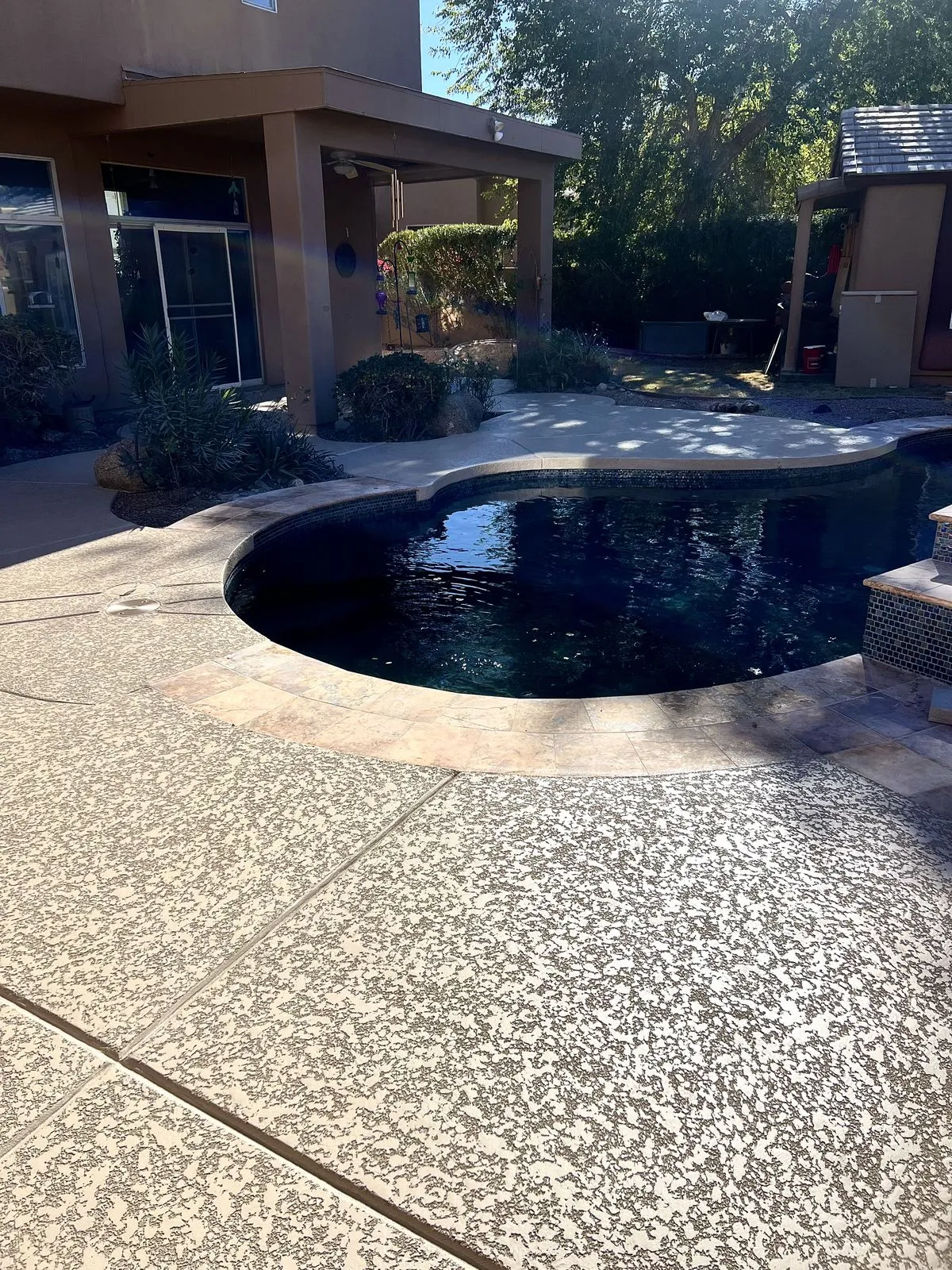
Which pool deck color stays coolest?
Light, low-saturation colors stay coolest — creams, bone, sand, and pale adobe. They reflect more sunlight instead of absorbing it, and reflectance is the main thing that decides how hot a paved surface gets in the sun. Charcoal, espresso brown, and deep terracotta are the hottest choices you can make in Arizona. The coolest practical pool deck here is a light-colored coating with a real texture: pale color does most of the work, and the texture does the rest.
Homeowners usually ask about color last, after they have settled on a material. It is backwards. On an Arizona pool deck in July, the color you pick moves surface temperature more than almost any other decision on the project — and unlike the sun, the slab, or your yard's shade, it is entirely in your control.
This guide covers what the reflectance research says, how much of it transfers to a residential deck, and the colors we actually install on cool deck coating and decorative overlay projects across the Valley.
Why color decides the temperature
Every surface in the sun does one of two things with the energy hitting it: reflect it, or absorb it and turn it into heat. The share it reflects is called solar reflectance, or albedo, expressed as a percentage. High reflectance means a cooler surface.
This is not a marketing idea. The US Environmental Protection Agency, summarizing pavement research, identifies solar reflectance as the primary determinant of a paved surface's maximum temperature in the sun. Light color is simply the most direct way to raise reflectance.
The practical numbers come from the Heat Island Group at Lawrence Berkeley National Laboratory, which publishes measured reflectance values for common paving surfaces:
Solar reflectance of common surfaces
| Surface | Solar reflectance | What it means underfoot |
|---|---|---|
| Cool-colored coatings Coolest | About 50% | Reflects roughly half the sunlight hitting it — the category a light deck coating belongs to |
| New cement concrete | 30–50% | Starts reasonably reflective; this is why a fresh pour feels tolerable and a ten-year-old slab does not |
| Aged cement concrete | 20–35% | Reflectance drops as the surface stains, dulls, and collects grime — your deck gets hotter every year you leave it |
| Aged asphalt | 10–20% | Lightens slightly as the binder oxidizes, but stays firmly in the hot range |
| New asphalt Hottest | About 5% | Absorbs almost everything. Nobody decks a pool in asphalt, but it sets the bottom of the scale |
Two things in that table matter for a pool deck. First, the spread is enormous — a ten-to-one difference in reflected energy between the top and bottom rows. Second, look at what happens to concrete as it ages: reflectance falls from as high as 50% down toward 20%. A bare concrete deck does not just look worse after a decade in the sun. It measurably runs hotter than it did when it was poured.
Where the "30 degrees cooler" number comes from
We say a light deck runs up to 30°F cooler than bare concrete in the sun. That number is not ours, and it is worth showing where it comes from, because plenty of contractors quote heat claims with nothing behind them.
The Heat Island Group published a thermal-imaging comparison of a light and a dark road segment side by side. The measured difference: the light segment ran about 17°C — roughly 30°F — cooler than the dark one. Same sun, same day, same material underneath. The only meaningful variable was color.
There is also a Phoenix-specific data point. In 2021 the City of Phoenix ran a cool pavement pilot with Arizona State University, cited by the EPA. In that study, conventional asphalt reached midday surface temperatures up to 152°F, while the reflective cool-pavement sections measured 10 to 16°F cooler. That was our city, our sun, our summer.
Be careful how you read those figures, and be skeptical of anyone who is not. Both studies measured roadway pavement, not residential pool decks. The materials differ, the reflectance starting points differ, and a 152°F asphalt road is hotter than any pool deck we have ever put a thermometer on. What transfers is the physics and the size of the effect: on the same slab under the same sun, going lighter buys you a large, measurable temperature drop, and the measured gap between light and dark lands in the same range as the claim.
Color is half the answer — texture is the other half
Two decks can be the identical shade of cream and feel different underfoot. The variable is texture.
A knockdown or lace texture finish breaks the surface into thousands of small peaks and valleys. That does two things. Your foot contacts the high points rather than resting flat against a solid hot plane, so less heat transfers per step. And the raised profile gives wet feet grip, which is the entire reason we do not install smooth sealed surfaces near water.
This is why the worst possible Arizona pool deck is a dark, smooth, glossy sealed surface. It absorbs the most energy, then delivers all of it to the sole of your foot through full contact, and it is slick when splashed. It photographs beautifully. It is miserable in July.
The best combination is the opposite: light color, real texture, matte finish. That is what an cool deck system is — and it is why the category exists in this climate at all.
The colors we actually install
Our standard Arizona palette is narrow on purpose. These are the families that hold up:
Creams and bone
The coolest end of the palette and the most forgiving. Hides dust well, works with nearly any house color, and is the default we recommend for a full-sun deck with no shade structure.
Sand and buff
Slightly warmer tone, nearly the same thermal performance. The most popular choice in the Valley because it reads as desert rather than as builder-grade.
Pale adobe and blush tan
Picks up the terracotta in tile roofs without going dark. Good for Santa Fe and territorial-style homes that would look wrong in a cool gray.
Light gray
The modern option. Stays cool as long as it is genuinely light — the moment a "gray" drifts toward charcoal you have given up most of the benefit.
What we steer people away from, and why: charcoal, espresso, deep terracotta, and saturated slate. They are fashionable in design photography, most of which is shot in climates where a dark deck is a reasonable idea. In Phoenix, a dark deck in full sun becomes a surface people walk around rather than across. We have been called out to resurface decks that were dark by choice fewer than five years earlier.
If you want the dark look, there is a compromise that works: keep the field — the large open area people actually walk on — light, and use the dark tone in a border band, a score-line accent, or around a feature away from the main path. You get the contrast without heating the surface your kids cross barefoot. Our stamped coating patterns are often specified exactly this way.
What fades, what holds, and why it matters for heat
Every exterior color in Arizona shifts over time. Sun is relentless here, and UV works on pigment continuously.
The useful news is that fading generally moves a deck lighter, not darker, so the thermal performance of a light deck tends to hold or slightly improve even as it loses crispness. What actually raises the temperature of an aging deck is not fading — it is soiling. Dust, organic staining, and a dulled, chalking surface all cut reflectance, which is exactly the aged-concrete effect in the table above.
That gives you a genuinely cheap way to keep a deck cooler: keep it clean and keep it sealed. Rinse it, sweep it, and reseal every few years. A clean sealed light deck holds its reflectance; a neglected one drifts toward the numbers of the bare slab it replaced. For the full picture on how these systems age, see our guide to how long cool deck lasts in Arizona.
How to choose, by situation
Full sun, no shade at all
Go to the lightest color you can live with. This is the case where the decision matters most, and where people most often regret going a shade darker for looks.
Covered patio or heavy shade
You have real freedom. Shaded surfaces never reach the temperatures that make color critical, so match the house and enjoy it.
You want a modern dark look
Light field, dark accents. Border bands, score lines, or a feature area off the walking path give you the contrast without the burn.
Kids and pets barefoot all summer
Light color plus knockdown or lace texture, no exceptions. This combination is the whole reason cool deck is the default choice in this state.
Before you approve a color, ask the contractor to:
- Show you a physical sample outdoors in daylight — not a screen, and not under showroom lighting.
- Put the sample on the ground in the sun and let you stand on it barefoot for a minute.
- Tell you whether the color is integral to the system or a surface layer, and how it is expected to age.
- Explain the texture being applied, not just the color, and why it suits a wet pool surround.
- Put the color, system, texture, and warranty in writing before work starts.
Frequently asked questions
What color pool deck stays coolest?
Light, low-saturation colors — creams, bone, sand, and pale adobe. They reflect more sunlight than they absorb, and solar reflectance is the primary factor determining how hot a paved surface gets in the sun. Dark charcoal, espresso, and deep terracotta are the hottest choices in Arizona.
How much cooler is a light pool deck than a dark one?
Thermal imaging published by the LBNL Heat Island Group measured a light road segment about 17°C (roughly 30°F) cooler than a dark segment under the same conditions. A 2021 City of Phoenix and Arizona State University cool pavement pilot, cited by the EPA, measured reflective sections 10 to 16°F cooler than conventional asphalt that reached up to 152°F at midday. Those studies measured roadway pavement rather than pool decks, but the physics is the same.
Does texture matter as much as color?
Close to it. A knockdown or lace texture texture reduces how much of your foot contacts the surface at once and gives wet feet grip. A dark, smooth, glossy sealed surface is the worst combination for an Arizona pool deck: it absorbs the most heat, transfers it most efficiently, and is slippery when wet.
Can I have a dark pool deck in Phoenix?
You can, but we do not recommend it for the main walking area of a deck in full sun. The workable compromise is a light field with dark accents — border bands, score lines, or a feature area away from the path people cross barefoot.
Does a pool deck get hotter as it ages?
Yes, and the cause is usually soiling rather than fading. Measured reflectance for cement concrete falls from as high as 50% when new to roughly 20–35% once aged and stained. Fading generally shifts color lighter, but dust, staining, and a dulled surface all cut reflectance. Rinsing, cleaning, and resealing every few years protects both the look and the temperature.
What is the coolest pool deck surface overall in Arizona?
A light-colored coating with a knockdown or lace texture, applied over a sound concrete slab. It combines high reflectance with a broken surface profile and slip resistance. Our coating systems typically run 10–12 years in Arizona conditions before they want a recoat, and every job carries a 2-year workmanship warranty.