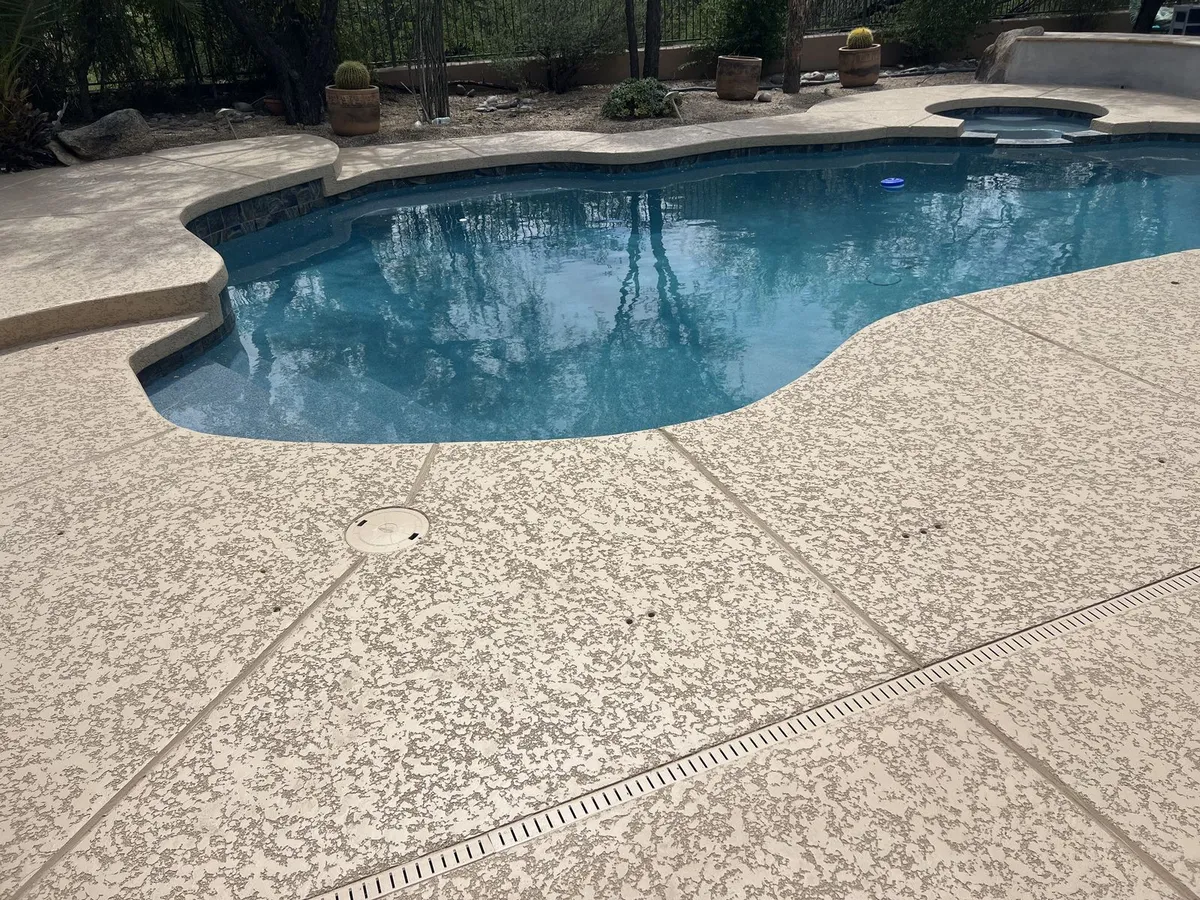
“How long will it last?” is the question we hear on almost every estimate, and the honest answer is a range, not a number. The same coating system can look tired in four summers or respectable in twelve, in the same city, depending on how it was prepared, what color it is, and how much water it lives with.
This guide is based on the decks we inspect, repair, and resurface across Phoenix, Scottsdale, Mesa, Tempe, Gilbert, and Chandler. It is field observation, not laboratory testing — and where a lifespan genuinely depends on conditions, we say so.
Lifespan by surface type in Arizona sun
| Surface | Typical service before renewal | What "renewal" means | What usually ends its run |
|---|---|---|---|
| Cool deck coating Best value cycle | Typically 10–12 years with basic care; 5–7 in harsh conditions | Repair worn spots and recoat; no demolition | UV fade, foot-traffic wear paths, coating worn thin |
| Original Kool Deck® (troweled into fresh concrete) | Often 15–30+ years structurally | Usually resurfaced with a coating system; genuine Kool Deck® can only be reapplied after the whole deck is stripped to bare concrete | Fading, staining, smooth worn patches, chipped edges |
| Flagstone coating / decorative overlays | Typically 10–15 years with topcoat care | Topcoat or recoat per the system's schedule | Topcoat wear, color fade in dark accents |
| Stamped overlay (sealed) | Long-lived if resealed every 2–3 years | Periodic resealing; recolor as needed | Neglected sealer, then surface wear and fading |
| Deck paint | Often 1–3 years around a pool | Strip or grind before any better system can bond | Peeling from moisture, chemicals, and hot-slab movement |
Two cautions about this table. First, these are ranges we see in the field, not warranties — our workmanship warranty is 2 years, and lifespan ranges are observations, not guarantees. Second, the ranges assume competent installation. A badly prepared deck can fail in its first summer regardless of the product name on the bucket.
What shortens cool deck life in Arizona
1. Poor surface preparation — the #1 early killer
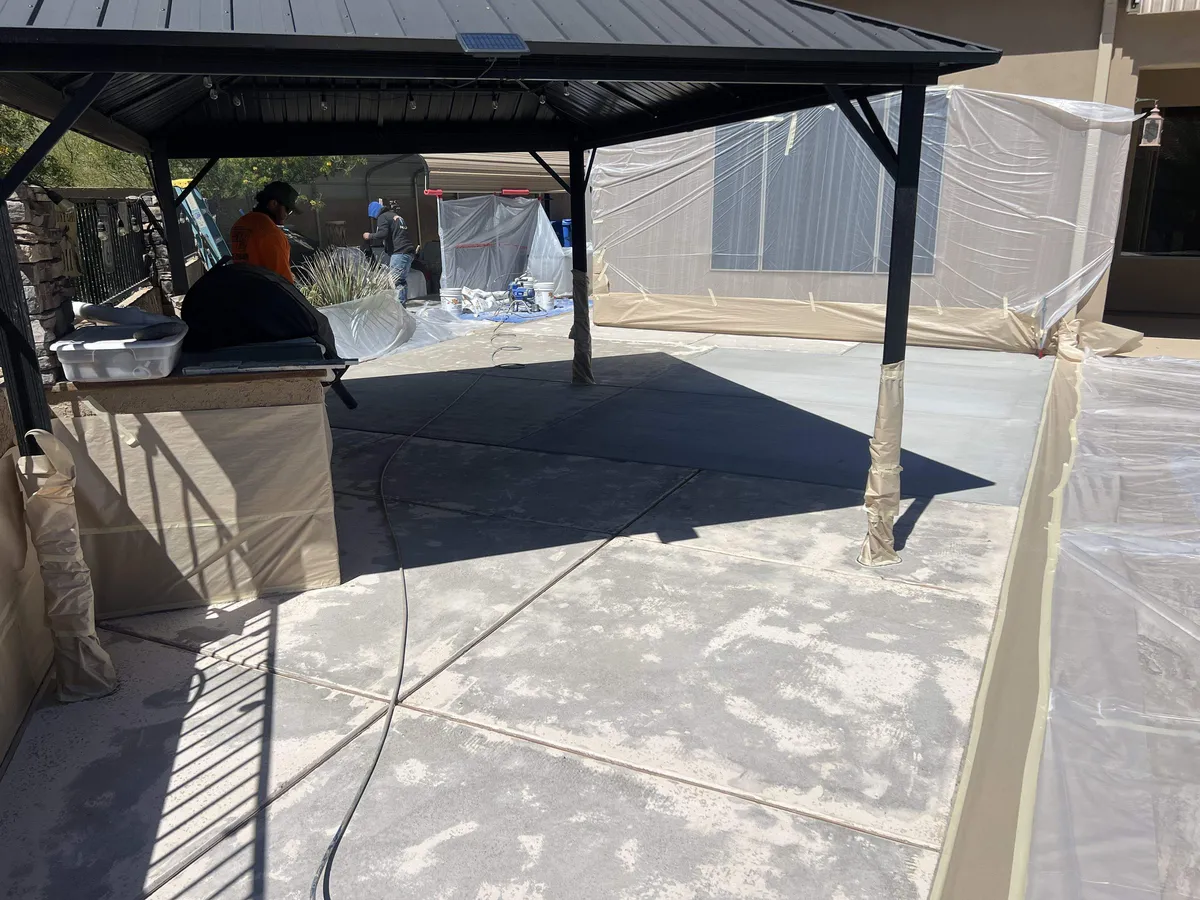
Almost every coating failure we are called to fix in its first few years traces back to preparation: coating applied over a dirty, sealed, or damp slab, over a previous coating that was already letting go, or over cracks that were cosmetically filled instead of properly repaired. The coating is only as attached as whatever it was applied to.
2. Water that never leaves
Arizona sun is hard on coatings, but constant moisture is harder. Sprinkler overspray that hits the deck daily, negative drainage that ponds water against the house, and leaking pool equipment all keep the coating wet from below and above. Mineral-heavy Valley water also leaves calcium deposits that etch and stain the surface.
3. Dark colors in full sun
Dark coatings absorb more solar energy, run hotter, and cycle harder between day and night temperatures. That thermal movement ages the coating and the sealer faster — and defeats the barefoot-comfort reason most people choose cool deck in the first place. Our Arizona heat surface guide covers color choice in detail.
4. Slab movement underneath
A coating cannot hold a moving slab together. Settling soil, tree roots, and failed expansion joints reopen cracks straight through any texture applied over them. If a crack moves seasonally, expect it to telegraph through a coating eventually — this is a slab problem wearing a coating costume. Our resurface-or-replace guide explains how we make that call.
5. Aggressive cleaning
A pressure washer held close with a narrow tip can cut a wear path into a texture coating in seconds. Decks that get routine gentle rinsing outlast decks that get occasional violent cleaning.
The maintenance that actually extends it
A realistic Arizona cool deck care routine:
- Rinse regularly. Hose off dust, leaves, and pool-chemical splash — monsoon dust left to bake becomes stain.
- Wash gently. Mild soap and a soft brush for spots; wide fan tip at a distance if you must pressure wash.
- Point sprinklers away. Irrigation overspray is the most common moisture damage we see.
- Fix ponding. If water sits in the same spot after rain, that spot will fail first.
- Repair small damage promptly. A chip or hairline crack is a cheap repair now and a bond failure later.
- Recoat on time. When wear paths or bare spots appear, a recoat renews the deck for a fraction of what a neglected surface costs to redo.
The cheapest decade of cool deck ownership we see is: sound installation, gentle cleaning, and one planned recoat — not the newest premium product installed over an unprepared slab. If a bid is dramatically cheaper than the others, ask what preparation it skips. Our Kool Deck repair guide lists the questions that reveal an honest answer.
Signs your cool deck is at the end of its run
Wear paths and bare spots
Smooth, shiny traffic lanes or exposed gray concrete mean the coating has worn through — recoat before water reaches the slab.
Chalking and heavy fade
Color that rubs off on your hand or has gone patchy is UV breakdown of the surface — cosmetic first, structural if ignored.
Flaking or hollow spots
Coating lifting in sheets, or areas that sound hollow underfoot, mean the bond is failing. Recoating over it transfers the failure to the new layer.
Widening or moving cracks
Cracks that reopen after repair, or that change with the seasons, point to slab movement that has to be addressed before any new surface.
If several of these sound familiar, our guide to the five signs a pool deck needs resurfacing walks through each one with more detail.
Recoat, resurface, or replace?
Recoat when the existing coating is bonded and the concrete is sound: worn areas are repaired and a fresh texture and color go over the prepared surface. This is the normal, planned renewal of a cool deck and the most cost-effective path.
Resurface when the old coating is failing or the deck has accumulated repairs: the surface is stripped or ground back as needed, cracks are properly repaired, and a complete new cool deck system is installed. Every project is quoted from the actual surface — size, condition, and the system you choose all affect the price. Estimates are free and in writing.2026 cost guide breaks the pricing down.
Replace only when the slab itself has failed: major settlement, extensive structural cracking, or drainage problems that cannot be corrected on the existing concrete. This is genuinely necessary less often than homeowners fear.
Not sure which bucket your deck is in? That is exactly what a cool deck repair inspection answers — we check bond, hollow spots, crack movement, and drainage before recommending anything.
Frequently asked questions
How long does cool deck last in Arizona?
With proper installation and basic care, a cool deck coating in the Phoenix area typically lasts 10 to 12 years. Dark colors, constant water exposure, poor preparation, and slab movement can cut that to 5 to 7 years, while a timely recoat renews the surface without replacement.
Can cool deck be recoated instead of replaced?
Usually, yes. If the existing coating is bonded and the concrete underneath is sound, worn areas can be repaired and the deck recoated at a fraction of replacement cost. Recoating is not appropriate over a delaminating coating or a slab with active structural movement.
What shortens cool deck lifespan the fastest?
Poor surface preparation is the most common cause of early failure we inspect. After that: constant water exposure from sprinklers or bad drainage, dark colors in full sun, harsh pressure washing, and slab movement that reopens cracks through the coating.
How do I make my cool deck last longer?
Rinse off dust and pool chemicals regularly, keep sprinklers from spraying the deck, fix drainage so water does not pond, repair small cracks and chips promptly, and recoat when wear appears instead of waiting for bare concrete to show.