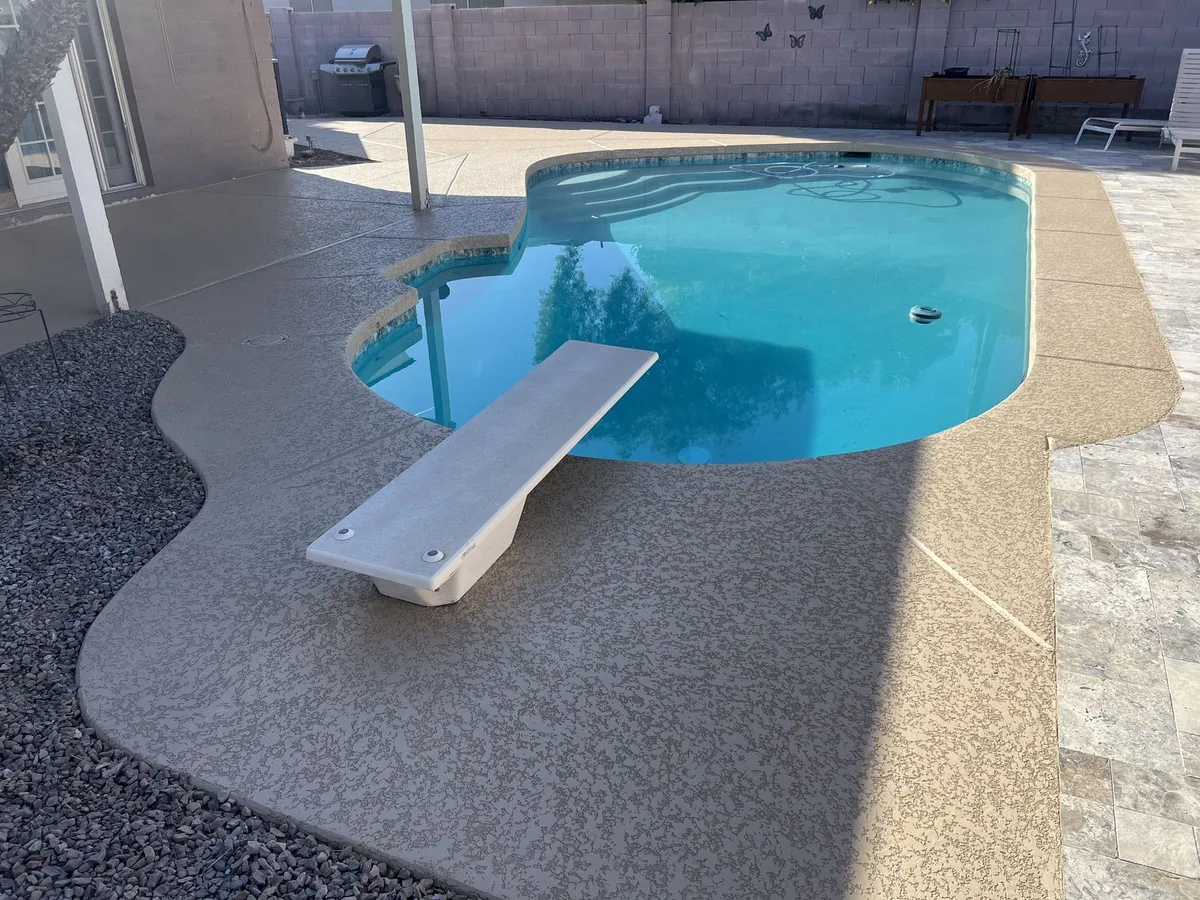
What is the difference between Kool Deck and cool deck?
Kool Deck® is Mortex’s trademarked, cement-based topping that bonds only to bare, sound concrete. “Cool deck” is the generic Phoenix term for any heat-reflective deck surface. A fresh or fully stripped slab can take genuine Kool Deck. An already-coated deck usually gets a cool deck coating, because Kool Deck will not bond over old coatings.
Ask three people in Phoenix what “Kool Deck” is and you will get three answers. Some mean the light, rough-textured surface around most Valley pools. Some mean a specific product their builder installed. Some mean whatever their last bid said. The difference decides what can go on your deck today.
This guide separates the trademark from the category, explains how each is installed, and sorts decks into fresh slabs, already-coated decks, and stripped decks. We lean on Mortex’s own instructions for the genuine product. We apply cool deck coating, so read our side of it with that in mind.
Kool Deck is a brand. Cool deck is the category.
“Keystone Kool Deck®” is a registered trademark of Mortex Manufacturing of Tucson. Mortex describes it as a colored, textured cement surface and says it invented the concrete topping in 1962. It is made from a proprietary mixture of natural substances and iron oxide pigments, mixed with white Portland cement and marble sand on the job site. That makes it a cementitious topping: a thin cement layer bonded to the slab, not a film.
“Cool deck” is the everyday name for the whole family. In Arizona it covers any light-colored, textured pool deck surface meant to stay more comfortable underfoot than bare concrete. Many decks people call Kool Deck are not the Mortex product. Our FAQ makes the same point: genuine Kool Deck is a cement-based topping, while most “cool deck” quoted for an existing deck today is a texture coating.
Here, Kool Deck means the genuine Mortex product and cool deck coating means a spray-applied, textured, light-colored coating system: a lace or knockdown texture with a color coat and sealer.
How each one is installed
Genuine Kool Deck
Mortex’s published instructions for Kool Deck on existing concrete are blunt about preparation: it is the most important factor. The steps run roughly like this.
- Strip it. Remove existing toppings and anything foreign on the deck, using a scarifier for deteriorated concrete and toppings, then a power washer.
- Acid etch. Wet the deck, scrub it with a muriatic acid solution, and pressure wash it clean. Mortex says to skip neutralizers such as TSP because they leave a film that breaks the bond.
- Bonding agent. Brush on Mortex’s PTA Bonding Agent over the wet deck, and do not let it dry before the topping goes on.
- Splash and trowel. The mix is splashed onto the deck with a dash brush, splashed a second time for texture, and troweled flat as the water glaze leaves. The finished layer is about 1/8 inch thick, and the instructions describe a surface that is roughly 40 percent smooth and 60 percent voids.
- Cover and cure. Plastic goes down for exactly two days. After that, Mortex says to avoid the deck for 48 hours, allow light walking after 3 days and normal walking after 14 days, and wait 28 days for heavy patio furniture.
Mortex recommends a trained crew of four to five people, and says ambient temperature should be 50 degrees and rising, not over 90, and that extreme care is needed above 95°F because the topping has to cure. That matters in Phoenix, where a lot of the year sits above those numbers. See our best time to resurface guide.
Cool deck coating
A cool deck coating is a thin, sprayed coating system over sound concrete, not a cement topping. We assess the old surface, strip loose material, fill cracks, fix hollow spots, spray the lace texture, then finish with a color coat and UV-stable sealer. Most residential decks take 1–2 days of application, with light foot traffic after 24–48 hours and full cure in 3–7 days. Details are on our cool deck coating page.
The difference that matters to a homeowner is tolerance for what is already there. A coating still needs a sound, clean substrate, but it can go over a deck that already has a bonded cool deck surface once loose parts are removed. Genuine Kool Deck cannot.
Which one works on your deck
This is the part that settles most bids. Start with what is on the concrete today.
Fresh slab, or bare concrete
Either can work. Mortex says Kool Deck can go on from the first day of the pour (fresh concrete) and on existing concrete from the next day, and its instructions call for acid etching even on one-day-old concrete. A cool deck coating also goes on bare, sound concrete once it has cured and been cleaned.
Already coated, painted, or topped
This is most Phoenix decks. Mortex says its system will not adhere to concrete that is not completely free of paints, stains, loose toppings, and other foreign matter. Genuine Kool Deck over an existing coating means stripping it all first. A cool deck coating is the usual answer because it can be applied over a bonded existing surface after prep.
Stripped back to bare concrete
Now both are options again. If the slab is sound after stripping and you specifically want a cement topping, genuine Kool Deck is possible. Stripping exposes whatever the old surface was hiding, such as cracks and hollow spots, and those must be repaired before either product goes on.
Old Kool Deck that is worn but bonded
A bonded old Kool Deck surface is a good candidate for a coating over the top, after we remove anything loose and fix what failed. If the old Kool Deck is delaminating, it comes off first, because a coating cannot hold a topping that is letting go.
Neither product fixes a slab that is heaving, sinking, or separating at the joints. See our resurface-or-replace guide and cracked pool deck guide for where that line sits.
Heat: what is actually known
Mortex says Kool Deck “significantly lowers the surface temperature of concrete,” which is the manufacturer’s claim, and it does not publish a number on the product page we read. For coatings, the honest answer is “up to 30°F cooler than bare concrete in direct sun,” with up to doing real work in that sentence.
The best public support for that range is general rather than product-specific. The Lawrence Berkeley National Laboratory Heat Island Group shows a thermal image in which light pavement segments run about 17°C (30°F) cooler than a dark segment beside them, and explains that dark pavements absorb 80–95 percent of sunlight. That is a roadway example, not a pool deck, so treat it as the physics behind the claim and not a measured result for your deck.
What it does tell you is that color and reflectance drive most of the effect, whichever product you choose. Dark charcoal and deep brown run hot on either surface. We have not seen independent head-to-head measurements of Kool Deck against a coating, and we will not invent one. See which color stays coolest.
Lifespan, maintenance, and recoating
A properly prepared cool deck coating lasts 10–12 years in the Phoenix Valley before it needs a fresh color coat. Poor prep, constant sprinkler water, shade that never dries, dark colors in full sun, close-range pressure washing, and slab movement pull that toward 5–7. Our lifespan guide has the full breakdown.
We did not find a published lifespan figure for Kool Deck in the Mortex material we reviewed, so we do not quote one. Mortex’s maintenance advice is to scrub with soap and water.
Coating maintenance is light: rinse off pool chemical splash, keep drains clear, and avoid close-range pressure washing. When the surface goes chalky, a re-seal or new color coat over the existing texture is a one-day job and costs a fraction of starting over. A cement topping does not recoat the same way; if it wears out, the routes are a coating over it, if still bonded, or stripping it.
Repairing each one
A worn or cracked coating can be spot-repaired and recoated. Cracks are opened, cleaned, filled with a flexible compound, and blended before new texture goes on. Moving cracks can reopen, and we flag them in the estimate. A cement topping can be harder to patch invisibly, because a repair has to match a hand-troweled pattern and an existing color.
For the honest version, read the truth about Kool Deck repair and the DIY versus professional comparison. For a damaged deck, our cool deck repair page explains how we assess it, and our peeling coating guide helps work out why a surface failed.
Side by side
| Question | Genuine Kool Deck® (Mortex) | Cool deck coating |
|---|---|---|
| What it is | Trademarked, cement-based topping, mixed and splashed on site | Sprayed, textured coating system with color coat and sealer |
| Fresh slab | Yes, from the first day of the pour, with acid etch and bonding agent | Yes, once the concrete is cured and clean |
| Already-coated deck | Only after every coating and topping is stripped to bare concrete | Yes, over a bonded existing surface after prep Common choice |
| Surface preparation | Scarify, acid etch, pressure wash, PTA bonding agent | Remove loose material, repair cracks and hollow spots, clean |
| Application | Splashed with a dash brush, then hand-troweled; about 1/8 inch | Sprayed lace texture, then color coat and sealer |
| Downtime | Plastic cover 2 days, light walking after 3, normal after 14, heavy furniture after 28 | Light foot traffic 24–48 hours, full cure 3–7 days |
| Heat | Manufacturer says it significantly lowers surface temperature | Up to 30°F cooler than bare concrete in direct sun; color matters most |
| Lifespan | No published figure in the Mortex material we reviewed | 10–12 years; 5–7 in harsh conditions |
| Maintenance | Scrub with soap and water (Mortex) | Rinse chemical splash, keep drains clear, no close-range pressure washing |
How to tell which one you have
Plenty of homeowners do not know, and some contractors use “Kool Deck” for either. Work through this in order.
Five quick checks
- Find the paperwork. Look for the pool builder’s contract, a prior contractor’s invoice, or an HOA file. Genuine Kool Deck is usually named as “Keystone Kool Deck” or Mortex.
- Look at the texture. A hand-troweled cement topping shows flat-topped knolls with small voids between them. A sprayed coating usually shows a lace pattern with a more uniform, raised look.
- Look at a worn edge. Check a drain edge, a joint, or a patch where traffic has worn it. A cement topping chips and dusts like concrete. A coating tends to lift in thin film, sometimes peeling in strips.
- Have someone look. We identify the surface at the free estimate before we quote anything. These checks are clues, not a lab result.
If a bid says “Kool Deck” and your deck is already coated, ask the contractor to name the product and describe the prep in writing. If it does not include stripping the old surface, you are probably being quoted a coating under the generic name. That can be a good product. It should just be called what it is.
Choosing between them
Three questions sort most situations. What is on the deck right now? Is the concrete underneath sound? Is a particular product worth the cost of stripping to get it? Ask every bidder to answer in writing, naming the product and the prep. Verify any contractor’s Arizona ROC license at roc.az.gov; our contractor guide has the full list.
Our estimates are free, written, and quoted from the actual surface. Every cool deck coating we apply carries our 2-year workmanship warranty, and the estimate names the product and the prep. See our cool deck coating page, or read how we approach pool deck resurfacing in Phoenix.
Frequently asked questions
Is Kool Deck the same thing as cool deck?
No. Kool Deck® is a registered trademark of Mortex Manufacturing, used for its cement-based topping. “Cool deck” is what most Phoenix homeowners and contractors now call the whole category of light, textured, heat-reflective pool deck surfaces.
Can genuine Kool Deck go over my existing cool deck?
Not directly. Mortex says its system adheres only to clean, sound concrete that is free of paints, stains, loose toppings, and curing compounds, and its instructions start with removing existing toppings. An already-coated deck would have to be stripped back to bare concrete first, which is why most already-coated decks get a cool deck coating instead.
Which is cooler, Kool Deck or a cool deck coating?
We have not seen independent head-to-head measurements, so we will not rank them. Mortex says Kool Deck significantly lowers surface temperature compared with plain concrete. Lawrence Berkeley National Laboratory shows light, reflective pavement running up to about 30°F cooler than dark pavement in the sun. For a coating, color matters most: light sand, cream, and pale gray get closest to “up to 30°F cooler” than bare concrete.
How long does each one last?
A properly prepared cool deck coating lasts 10–12 years in the Phoenix Valley, and 5–7 in harsh conditions such as constant sprinkler water, dark colors in full sun, or slab movement. We found no published Kool Deck lifespan in the Mortex material we reviewed, so we do not quote one.
How do I know whether my deck is Kool Deck or a coating?
Start with paperwork: the pool builder’s or previous owner’s invoice, or the HOA file, should name the product. Physically, a hand-troweled cement topping looks like flat-topped knolls with small voids between them, while a coating usually shows a sprayed lace pattern that can peel in thin film where it fails. These are clues, not proof.
Does your 2-year warranty apply to a cool deck coating?
Yes. Every cool deck coating we apply carries a 2-year workmanship warranty covering our application, bond, and finish. It excludes structural movement of the concrete underneath and lack of reasonable maintenance.
More answers in our full FAQ, or see cool deck repair.
Mortex, Keystone Kool Deck, and PTA are named only to identify their published material and are the marks of their owner. Master Pool Decks is independent and is not affiliated with, endorsed by, or a dealer for any brand mentioned.