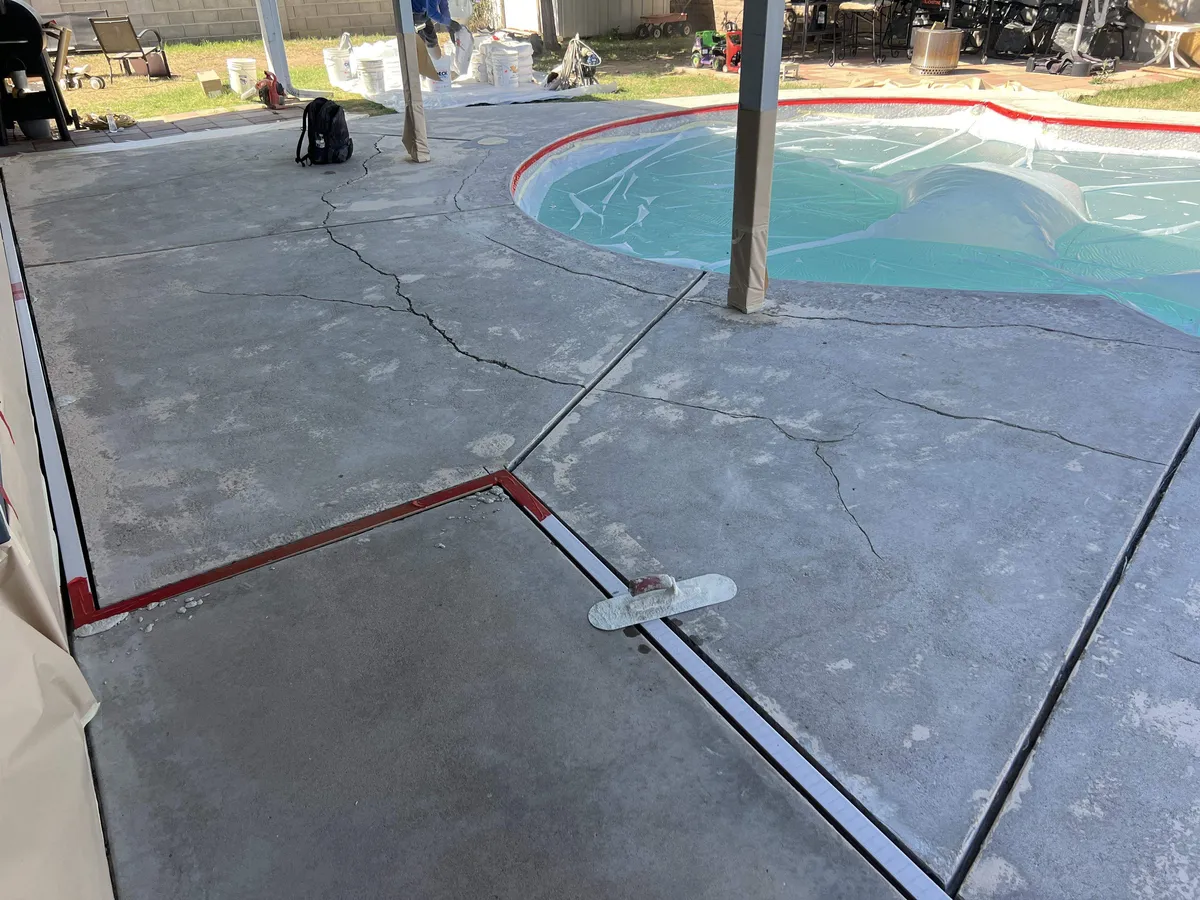
Can you resurface a cracked pool deck?
Usually, yes. If the concrete slab under your pool deck is sound, hairline, shrinkage, and most surface cracks are opened, cleaned, filled with a flexible repair compound, and feathered before a coating goes on, and the finished deck reads as one surface. The cracks a coating cannot fix are the ones that are still moving: cracks that widen season after season, and cracks where one side has lifted or dropped. A coating is thin and follows the concrete under it, so a crack driven by ongoing slab movement can reopen through any coating from any contractor. Those cracks need to be diagnosed first, and a heaved, sunken, or broken section is cut out and repoured before the deck is coated.
Almost every pool deck in the Valley has cracks. Concrete shrinks as it cures, the ground under it shifts, and a slab that bakes in July sun and cools off on a January night is always moving a little. The real question is which kind of crack you have.
We install cool deck coatings and decorative overlays over existing concrete, and crack repair is part of nearly every job. This is how we sort cracks on an estimate and where a coating stops being the right answer, with the concrete industry’s published guidance linked in place.
The four kinds of cracks on a Phoenix pool deck
The American Concrete Institute’s crack report, ACI PRC-224.1, works in three steps: cause, evaluation, then repair. On a pool deck, the sorting comes down to four patterns.
| Crack type | What it looks like | Usual cause | Can it be coated over? |
|---|---|---|---|
| Hairline and shrinkage | Fine lines or a spider-web pattern, both sides level, often thinner than a credit card | Concrete shrinking as it cured; surface crazing | Yes, after prep Routine |
| Joint cracks | A crack running along a saw-cut control joint, or at the joint where the deck meets the coping | The slab moving where it was designed to move | Yes, but the joint stays a joint, not a filled crack |
| Widening cracks | A crack that gets longer or wider from one season to the next, often across the slab instead of along a joint | Ongoing movement: settling soil, water under the slab, roots | Only after the cause is dealt with; may reopen |
| Offset or heave | One side higher than the other; a lip you can catch a toe or a coin on | The ground under one section rose or sank | No; the section needs repair or replacement first |
1. Hairline and shrinkage cracks
These are the fine lines and spider-web patterns most decks have. Concrete loses water as it cures and shrinks, and a slab without enough control joints cracks on its own schedule; Concrete Network’s crack repair guide lists a lack of control joints as a common cause of cracking in slabs. Both sides of the crack sit level, and the crack is usually narrow. On a sound slab these are the cracks resurfacing handles best.
2. Joint cracks
Control joints are the straight saw-cut or tooled lines in the deck. They make the slab crack inside the joint instead of across a section, so a crack running down a joint is usually the joint doing its job. Many pool decks also have a joint where the deck meets the coping, so the pool shell and the deck can move separately. Fill a working joint solid and coat over it, and the movement it was absorbing tears through the new coating. On an estimate we look at whether cracks follow the joints or run across them, because cracking across the joints usually points to the slab, not the coating.
3. Widening cracks
A widening crack is one that is still moving. It gets longer or wider from season to season, usually across a section rather than along a joint. Common causes are soil settling under the slab, water from irrigation, a downspout, or a leak, and tree roots. Concrete Network notes that slabs can crack from subgrade settlement caused by poor compaction or soil erosion. Ground movement is also real at a larger scale here: the Arizona Geological Survey reports that subsidence and earth fissures affect more than 3,000 square miles of Arizona, including expanding areas of Phoenix. Most deck cracks are far more local, but a crack driven by moving ground keeps moving until the ground stops.
4. Offset cracks and heave
When one side of a crack sits higher than the other, the slab has already moved vertically: one section heaved up, or one sank. You can feel the lip with a bare foot. Offset cracks are trip hazards first, and the clearest sign that a coating alone is the wrong fix. Concrete Network’s resurfacing guide puts it plainly: “It is not feasible to resurface concrete that is heaving, has severe cracks, or is damaged due to freeze/thaw damage.”
A crack test you can do at home
You can sort most cracks yourself with a pencil, a credit card, a coin, and a phone camera.
The five-minute crack check
- Check the width. Try to slide a credit card into the crack. Concrete Network’s resurfacing guide says cracks as wide as a credit card or wider typically need repair before an overlay goes on.
- Check for offset. Lay a coin, a ruler, or the card flat across the crack. If it rocks or catches on a lip, one side has moved up or down.
- Mark the ends. Draw a short pencil line across each end of the crack and write the date next to it. Photograph it with a ruler or the card in the frame.
- Check again later. Look again in a few months, and again after the monsoon. A crack that has run past your marks, or is visibly wider in the photo, is still moving.
- Note where it runs. Along a control joint or the coping joint is usually expected movement. Across a section or around a low spot points to the ground under the slab.
Also watch where water goes after a storm: a section that holds a puddle beside a crack is telling you about the slab. Our monsoon drainage guide shows how to read it, and the five signs your pool deck needs resurfacing covers the surface problems that travel with cracks.
How cracks are repaired before a coating goes on
A coating hides a crack only as well as the crack was repaired underneath it. Here is the sequence from our resurfacing process.
- Diagnose first. At the estimate we sound the deck for hollow spots and check crack width and pattern. ACI’s field guide to crack repair (RAP-2) starts the same way: “Before any concrete is repaired, the cause of the damage must be assessed and the objective of the repair must be understood.”
- Open, clean, fill. Cracks are opened, cleaned, filled with a flexible repair compound, and feathered so they do not telegraph through the texture.
- Strip what is loose. Hollow and delaminated areas come off back to solid concrete. Coating over a hollow spot just moves the failure up a layer.
- Patch and level. Spalls and pits at the coping and skimmer are patched and leveled, and low spots are corrected where the slab allows.
- Coat the whole deck. Primer, texture, color, and sealer go over everything, so repairs disappear into one surface.
Why flexible? ACI’s RAP-2 bulletin is direct about the limits of a rigid fill: its gravity-fed resin method is meant “to seal cracks that are not moving—for example, shrinkage cracks, and settlement cracks that have stabilized,” and it is “not effective for repairing moving cracks.” For those, the bulletin says, “it is most often necessary to rout and seal the crack to create a joint capable of movement.” Concrete Network’s resurfacing guide makes the same point from the coating side: active cracks get filled “so they don’t mirror through to the overlay,” while small plastic-shrinkage and crazing cracks can be covered by the polymer prime coat and base coat.

If your deck has Keystone Kool Deck, or you want it, the rules are stricter. Genuine Kool Deck bonds only to bare, sound concrete. Mortex’s instructions for existing concrete call for removing existing toppings, and say: “Any major repairs of structural damage in the deck or cracks should be done well in advance of the PTA and topping application.” That is why already-coated decks usually get a texture coating instead. Our cool deck repair page covers what that looks like on a worn, cracked deck.
Why cracks can reappear through a new coating
This is the part a sales pitch skips. A coating is a few layers of coating on top of the concrete, not structure. If the slab under a repaired crack keeps moving, the crack can come back through the coating, from any contractor and with any product. The usual reasons:
- The ground is still moving. Settling soil, water, and roots do not stop because the surface looks new.
- A working joint was filled and coated over. The slab still moves at that joint, and the coating cracks along it.
- The crack was skimmed, not repaired. Filler over a dirty, unopened crack has nothing to bond to.
- Daily heat cycling. Concrete grows and shrinks with temperature. A fine line can show again at a repaired crack even when the slab is stable; that is usually cosmetic, and the crack can be filled and touched up.
A good repair keeps a stable crack hidden. It cannot hold a moving slab together, which is why, when we see signs of movement, we write it into your estimate instead of promising the crack is gone for good.
When to replace a section instead
Coating over a slab problem is money spent twice. Consider cutting out and repouring a section, or a full replacement instead of a resurface, when you see any of these:
- An offset at a crack that you can feel underfoot, or a lip a coin catches on.
- A section that rocks, sounds hollow underneath, or has broken into loose pieces.
- A section that has sunk or heaved so water now runs toward the house or pools against it.
- A crack your pencil marks show is still growing after the cause has been found and fixed.
Replacing one section is often far less work than a full tear-out. The section is saw-cut out, the cause underneath is dealt with, and new concrete is poured to grade; once it is ready, the whole deck can be coated so the new section does not stand out. Ask your coating installer how long the new concrete needs to cure before their system goes on; for genuine Kool Deck, Mortex’s existing-concrete instructions say the surface should preferably be 28 days old.
What the warranty covers on a cracked deck
Read any coating warranty for the word “crack.” Ours, in full, is on our warranty page and in Section 6 of our Terms of Service. In short:
- Term: two years, on all pool deck resurfacing and coating installation projects.
- Covered: defects in materials and workmanship under normal use and conditions, including peeling, flaking, or delamination of the coating we applied caused by material defects or workmanship errors.
- Not covered: structural movement, settling, or cracking of the concrete underneath, including cracks we flagged in your estimate.
Put simply: the warranty covers the coating we applied, not the slab under it. Hairline and surface cracks are routed and filled before we coat, and when we see signs of movement, we write it into the estimate. If a crack reopens because the slab moved, that is outside the warranty, and any repair is quoted like any other job: free, in writing, and measured from the actual surface. Be wary of any bid that promises cracks will never come back.
Ask every bidder which cracks they will repair and how, which they think are moving, and what their warranty says about cracks. Our guide to choosing a pool deck contractor in Phoenix has the full list. When you are ready, here is how we approach pool deck resurfacing in Phoenix.
Frequently asked questions
Can you resurface a cracked pool deck?
Usually, yes, if the slab underneath is sound. Hairline and shrinkage cracks are opened, cleaned, filled with a flexible repair compound, and feathered before the coating goes on. Cracks that keep widening, or where one side has lifted or dropped, mean the slab is moving. A coating cannot stop that, and those cracks can come back through any coating.
Will cracks come back after a pool deck is resurfaced?
Repaired hairline cracks in a stable slab usually stay hidden. A crack driven by ongoing slab movement can reopen through any coating from any contractor, because a coating follows the concrete under it. That is why a moving crack should be diagnosed, and written into the estimate, before anyone coats over it.
How can I tell if a crack in my pool deck is still moving?
Draw a pencil line across each end of the crack, write the date next to it, and check the width with a credit card. If the crack runs past your marks or gets wider over a few months, especially across a monsoon season, it is moving. A crack where one side sits higher than the other has already moved.
When should a cracked section of pool deck be replaced instead of coated?
When it has heaved or sunk so the two sides no longer line up, rocks underfoot, is broken into loose pieces, or sends water toward the house. Those are slab problems, not surface problems. The section is cut out and repoured, and once the new concrete is ready, the whole deck can be coated so it reads as one surface.
Does the Master Pool Decks warranty cover cracks?
Our two-year warranty covers the coating we applied: defects in materials and workmanship under normal use and conditions, such as peeling, flaking, or delamination. Structural movement, settling, or cracking of the concrete underneath is excluded, including cracks we flag in your estimate, because slab movement can reopen a crack through any coating.
Can Kool Deck be applied over a cracked pool deck?
Only over bare, sound concrete. Mortex's instructions for existing concrete call for removing every existing topping, repairing major cracks and structural damage well in advance, acid etching, and a bonding agent before Keystone Kool Deck goes on. On a deck that is already coated, that means stripping it all first, which is why already-coated decks usually get a texture coating.
More answers in our full FAQ, or see cool deck repair.
Keystone Kool Deck is a trademark of Mortex Manufacturing Co., named here only to identify its published instructions. Master Pool Decks is independent and is not affiliated with, endorsed by, or a dealer for Mortex or any coating brand.