The Process at a Glance
- Estimate: free, in writing, measured on your actual deck
- On site: 1–2 days on most residential decks; larger decks or heavy repair add a day
- Light foot traffic: after 24–48 hours
- Full cure: 3–7 days before furniture, planters, grills, pets, and pool service; longer in cool or humid weather
- Your pool: stays full; we mask and protect the coping, tile line, water’s edge, and equipment pad
- Warranty: 2 years, in writing — what it covers
Almost every failed pool deck coating in Phoenix failed for one reason: it was stuck to something that was not solid. So most of our time on a job goes into the part you cannot see once it is done. Here is how a job runs, from the first visit to the walkthrough, and what we do to keep the pool out of it.
1. The Estimate: Measured on Your Deck
Estimates are free, Monday through Saturday, and done on site, not over the phone. It is better if you are there, because walking the deck together is how you tell us what bothers you and how we show you what the slab is doing. Here is what we check:
- Bond of the existing coating. We sound the deck for hollow spots and check edges and coping for lift.
- Cracks and movement. Width, pattern, and whether they line up with joints or run across them.
- Drainage. Where water sits after a storm or a hose test, and whether the slab can be corrected.
- Square footage and layout. Measured on site, including steps, raised areas, and the walkway to the gate.
- Color and texture samples. Set on your deck in the sun so you can feel the temperature difference.
- Schedule and access. Gate access, pets, pool service days, and your target dates.
If the slab is heaving, sinking, separated at the joints, or broken through, no coating will hold on it, and we tell you that at the estimate instead of selling you one.
2. The Written Estimate: What It Lists
You get one number and what it includes. The estimate states the surface area, the system and texture proposed, your color, the repairs we will make before any coating goes on, the crew days and cure window, and the 2-year warranty language. It also lists whatever worries us: an active crack, a drainage problem, an area where the old coating may keep letting go. Repairs such as crack routing, patching, leveling low spots, or stripping a failed coating show up as items you can see. Payment options are walked through at the estimate and spelled out in writing before any work starts. There is no pressure to sign in the driveway, and if we think the deck can wait a season, we say so.
3. Scheduling Around Heat and Monsoon
We work year-round. Fall through spring is the easy window, with mild temperatures and a predictable cure. From June through September we start early in the morning, because coatings have an application temperature window and a 115°F slab is not in it. Fresh acrylic needs a dry, dust-free window, so in monsoon season we book application days against the forecast and will not start a coat we cannot finish dry. More in our season-by-season timing guide.
4. What We Ask of You Before We Arrive
- Clear everything movable off the deck: furniture, planters, grills, pool toys. Pool equipment, built-in seating, fixed fire features, the diving board, and handrails stay put; we mask those.
- Unlock the side gate or share the code, and clear the path from the gate to the deck.
- Turn off every sprinkler and drip zone that reaches the deck the day before, and leave it off through the full cure.
- Move your pool-service visit to after the full-cure date we give you.
The full checklist is in how to prepare your pool deck for resurfacing.
5. Protecting Your Pool and Everything Around It
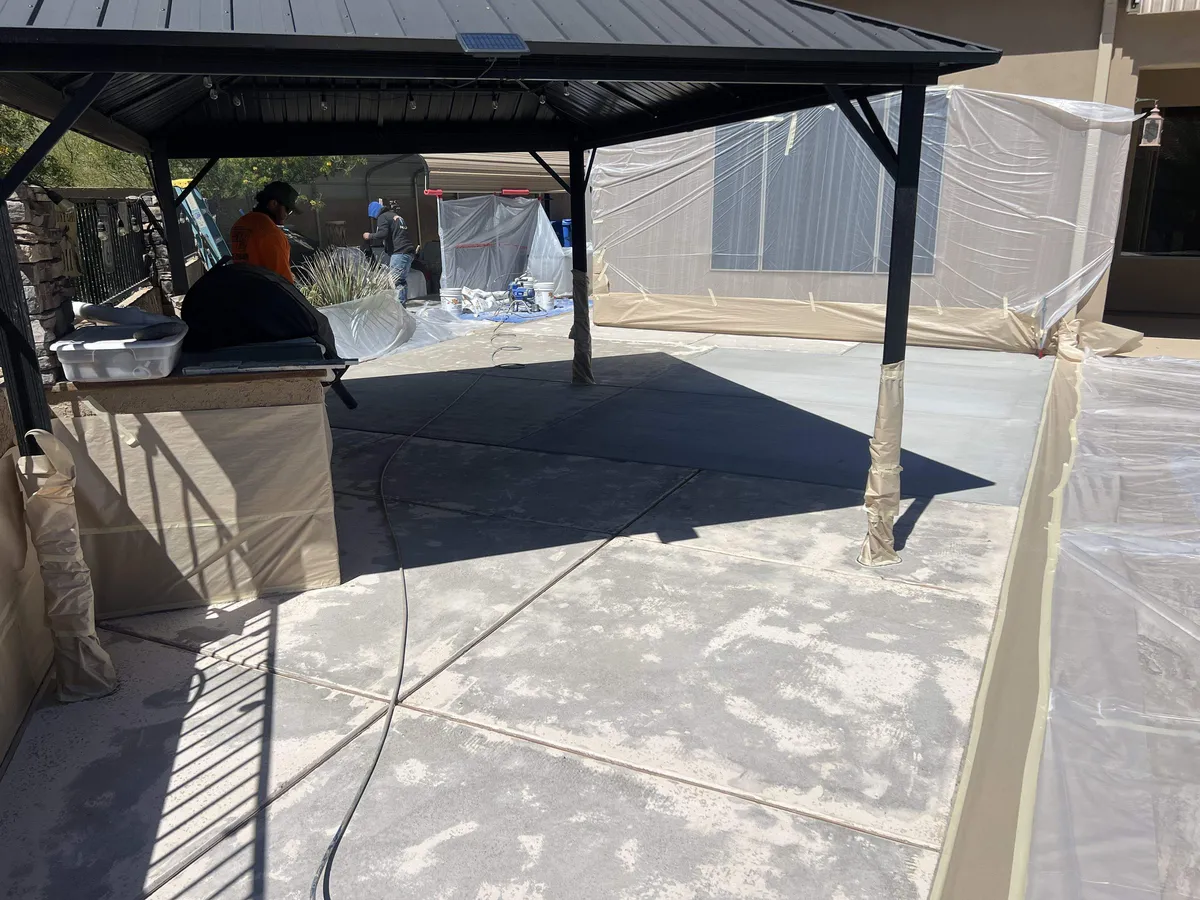
We are resurfacing the deck, not the pool shell, so the pool stays full and the water stays where it is. Before anything is sprayed, we mask and protect the coping, the tile line, and the water’s edge, along with the equipment pad and anything fixed that stays on the deck. Nearby walls get overspray protection. If any equipment should be switched off during application, we tell you.
What we do not touch matters too. We are not a pool builder: no replastering, no tile or coping work, nothing on your equipment. Plan on staying out of the pool while the deck cures, since there is no dry path around it.
On community and HOA pools we phase the deck in sections so part of it stays open, barricade and sign the work zones, and keep materials out of walkways; each section is fully cured before it reopens.
6. Prep and Repair: Where the Hours Go
Day one is preparation and repair. It is the least photogenic day and the one that decides how long the deck lasts.
- Loose and delaminated coating is stripped back to solid concrete. Coating over a hollow spot just moves the failure up a layer. Where old sealer or a failed coating has to come off, that means grinding, so expect compressor and grinder noise for a few hours.
- Cracks are opened, cleaned, filled with a flexible repair compound, and feathered so they do not telegraph through the texture. Cracks driven by ongoing slab movement can reopen; if we see the signs, it is written into your estimate.
- Spalls and pits around the coping and skimmer are patched and leveled.
- Low spots and drainage are corrected where the slab allows, so the new surface is not sitting in standing water every monsoon.
- Old sealers, efflorescence, and pool chemical residue are removed so the primer bonds to concrete, not to whatever was sitting on it.
Water is the other half of prep. Water moving up through the slab or in under the edges pushes a coating off. Sprinklers that hit the deck every morning, planters draining across it, and low spots that hold water after a storm are what we look for at the estimate, and why we ask for deck-facing irrigation to stay off through the cure. We would rather fix the drainage during resurfacing than coat over it. Our monsoon drainage guide shows what to look for.
7. Prime, Texture, Color, Seal
- Prime. Primer on bare and patched concrete so the new acrylic bonds to the slab rather than to a residue layer sitting on it.
- Texture. The acrylic lace texture is sprayed and knocked down to the depth you chose: fuller around the pool for grip, tighter where furniture sits.
- Color coat. Color across the deck. Lighter colors reflect the most sun and get you closest to the “up to 30°F cooler than bare concrete” figure.
- Seal. A UV-stable sealer on top, so it does not chalk out after two summers.
Texture and color follow once the repairs have set, either later on day one or on day two. That is the acrylic cool deck sequence. Acrylic flagstone and stamped overlays follow the same prep, then a bond coat or primer and a base coat before the pattern and a matte, slip-resistant sealer.
One product note: genuine Keystone Kool Deck® bonds only to bare, clean concrete, so it cannot go over an existing coating without stripping the whole deck first. That is why most re-coats of an existing deck, ours included, are an acrylic texture system. See cool deck repair for the difference.
8. Cure: When You Get Your Deck Back
- 24–48 hours: light foot traffic. Bare feet and shoes are fine. No dragging anything, no pets, no sprinklers, no pool robot on the deck.
- 3–7 days: full cure. Furniture, planters, grills, pets, and pool service return. Cool nights and humidity push this toward the long end.
- Moving furniture back: lift, don’t drag, and put pads under metal chair and lounger legs. Dragging a table across a green surface is the one mistake that shows up later.
9. Walkthrough and the Warranty in Writing
When the job is done, we walk it with you and leave the warranty in writing. Every installation carries a 2-year warranty on the bond, the application, and the finish of the coating we applied. Here is what it covers, what it excludes, and how to make a claim.
Process Questions
Do you have to drain the pool?
Usually not. We are resurfacing the deck, not the pool shell, so the water stays where it is. We mask and protect the coping and the water’s edge. Plan on staying out of the pool while the deck cures, since there is no dry path around it.
How long does pool deck resurfacing take?
Most residential decks are 1–2 days of work on site: prep and repairs the first day, texture and color once the repairs have set. Bigger decks, heavy crack repair, or stamped work can add a day. The full cure is 3–7 days after that.
When can we walk on the deck and put furniture back?
Light foot traffic after 24–48 hours. Furniture, planters, grills, and pets wait for the 3–7 day cure, longer in cool or humid weather. Lift pieces into place instead of dragging them.
Do I need to be home while you work?
No, as long as the crew has gate access and a phone number for questions. Most homeowners are home on day one for color confirmation and then go about their day. For the estimate itself, it is better if you are there.
Can you coat over my existing cool deck?
Usually, yes. If the old coating is still bonded, we clean and prime it and coat over it. Loose, hollow, or flaking areas are stripped back to solid concrete first. Genuine Kool Deck® bonds only to bare concrete, so it cannot go over an existing surface without stripping the whole deck first.
What if my slab is cracked all the way through or sinking?
Then a coating is the wrong fix. If the concrete is heaving, sinking, or cracked through from ground movement, that has to be addressed first or it comes back through the new surface. We say so at the estimate.