Epoxy Garage Floors in Phoenix
Flake, metallic, and solid-color epoxy over a diamond-ground slab, built for Phoenix heat and hot tires
Insured · 2-year written workmanship warranty · Free written estimate · Call (623) 521-1096
Why Choose Epoxy Garage Flooring?
An epoxy garage floor is a coating system bonded to your existing slab after it is diamond-ground and checked for moisture. Installed that way it typically lasts 15–20+ years, goes in over 1–2 days, and takes foot traffic after 24 hours and vehicles after 72. The quote depends on the slab's condition and moisture, the square footage, and the system you pick: flake, metallic, or solid color.
A Phoenix garage is harder on a floor coating than most. Our July normal high is about 106°F, a closed garage can spend summer afternoons in that range or above, and tires come home off asphalt hot enough to soften a weak coating. Add pool chlorine and car fluids stored on the floor, and the prep underneath decides whether the coating lasts.
Chemical Resistant
Superior protection against oil stains, chemicals, salt, and other automotive fluids that can damage concrete.
Easy to Clean
Non-porous surface makes cleanup effortless. Simply sweep, mop, or hose down for a spotless garage floor.
Flake, Metallic, or Solid Color
Flake hides dust and gives tires grip, metallic is the showpiece, and solid colors are the simplest. We bring chips and samples so you pick in your own garage light.
Extreme Durability
High-traffic resistant coating that withstands heavy vehicles, tools, and equipment without chipping or peeling.
A Floor You Can Actually Use
Oil, antifreeze, and tracked-in dust wipe up instead of soaking in, so the garage stays a workspace instead of a stained slab.
Quick Installation
Most garage epoxy projects completed in 1-2 days with minimal disruption to your daily routine.
Epoxy vs Polyaspartic vs Metallic: An Honest Comparison
Disclosure: our garage systems are epoxy — flake, metallic, and solid color. We do not sell one-day polyaspartic floors; that column reflects what its makers and installers publish.
| Question | Epoxy flake | Polyaspartic one-day flake | Metallic epoxy |
|---|---|---|---|
| What it is | Two-part epoxy base, vinyl flake broadcast to full coverage, clear topcoat | Fast-curing aliphatic polyurea base or primer, flake, clear topcoat | Epoxy with metallic pigments worked by hand into a marbled finish |
| Grip when wet | Textured by the flake | Textured by the flake | Smooth unless an anti-slip additive goes in the topcoat |
| Sun at the door line | Epoxy can amber in direct sun; topcoat choice matters | Aliphatic topcoat resists UV yellowing | Same as epoxy flake; a UV-stable formula and topcoat slow it |
| Back in service | Foot traffic 24 h, vehicles 72 h | Marketed as walk-on the same day, drive-on in about a day | Foot traffic 24 h, vehicles 72 h |
| Slab moisture | Needs a dry slab or a moisture-mitigating primer | Published limits apply, e.g. 75% RH by ASTM F2170 | Needs a dry slab or a moisture-mitigating primer |
| Warranty to ask about | Ours: 2-year workmanship, in writing | “Lifetime” terms are common; typically materials only | Ours: 2-year workmanship, in writing |
| Relative cost | Mid-range | Usually at or above epoxy flake | Premium |
The honest answer is that preparation decides more than chemistry. Any of these systems fails over a slab that was not ground, was holding moisture, or had an old sealer left on it. Polyaspartic’s real edge is speed and UV stability; epoxy’s is a thick base coat with a longer working time, which hand-worked metallics need. For the pool deck version of this question, see cool deck coating vs polyaspartic in Phoenix, and for what moves the price of a garage floor, our epoxy garage floor cost guide.
Our Epoxy Flooring Systems
Flake System
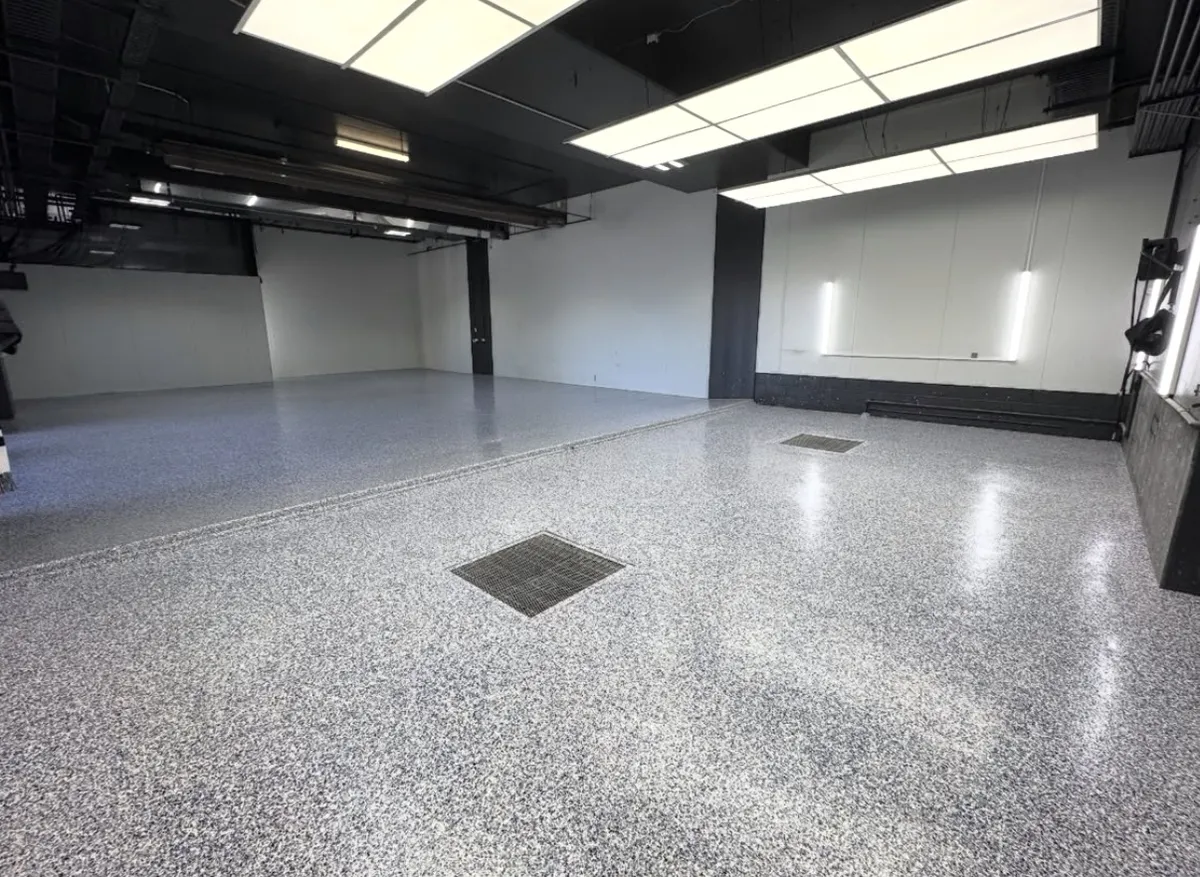
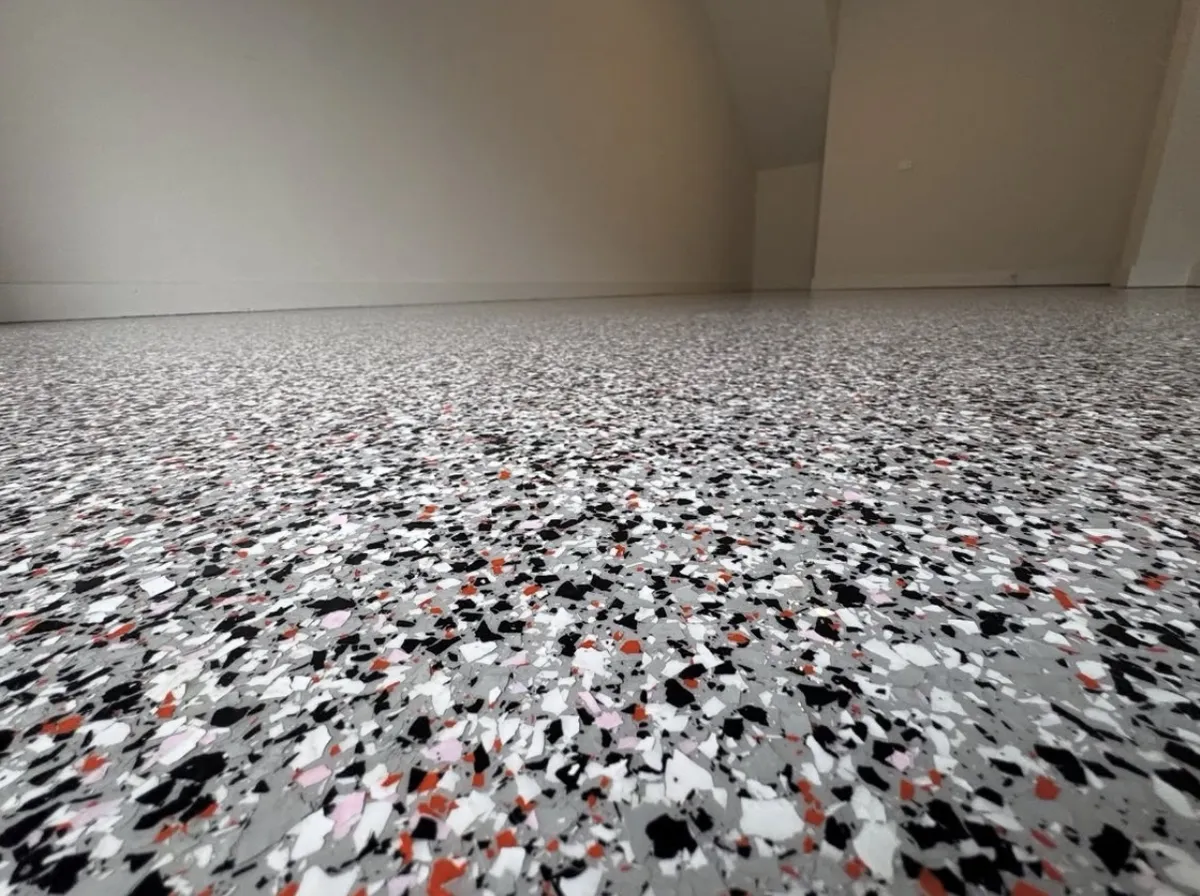
Our vinyl flake epoxy system combines durability with decorative appeal. Multi-colored flakes are broadcast into wet epoxy to create a textured, slip-resistant surface that hides imperfections and provides excellent traction — even when wet. It also hides Phoenix dust between cleanings.
- Hundreds of color combinations to match any style
- Built-in slip resistance from textured flake surface
- Hides existing concrete imperfections and minor cracks
- Industrial-grade durability for heavy vehicles and tools
- Full-broadcast or partial-broadcast coverage options
Metallic Epoxy
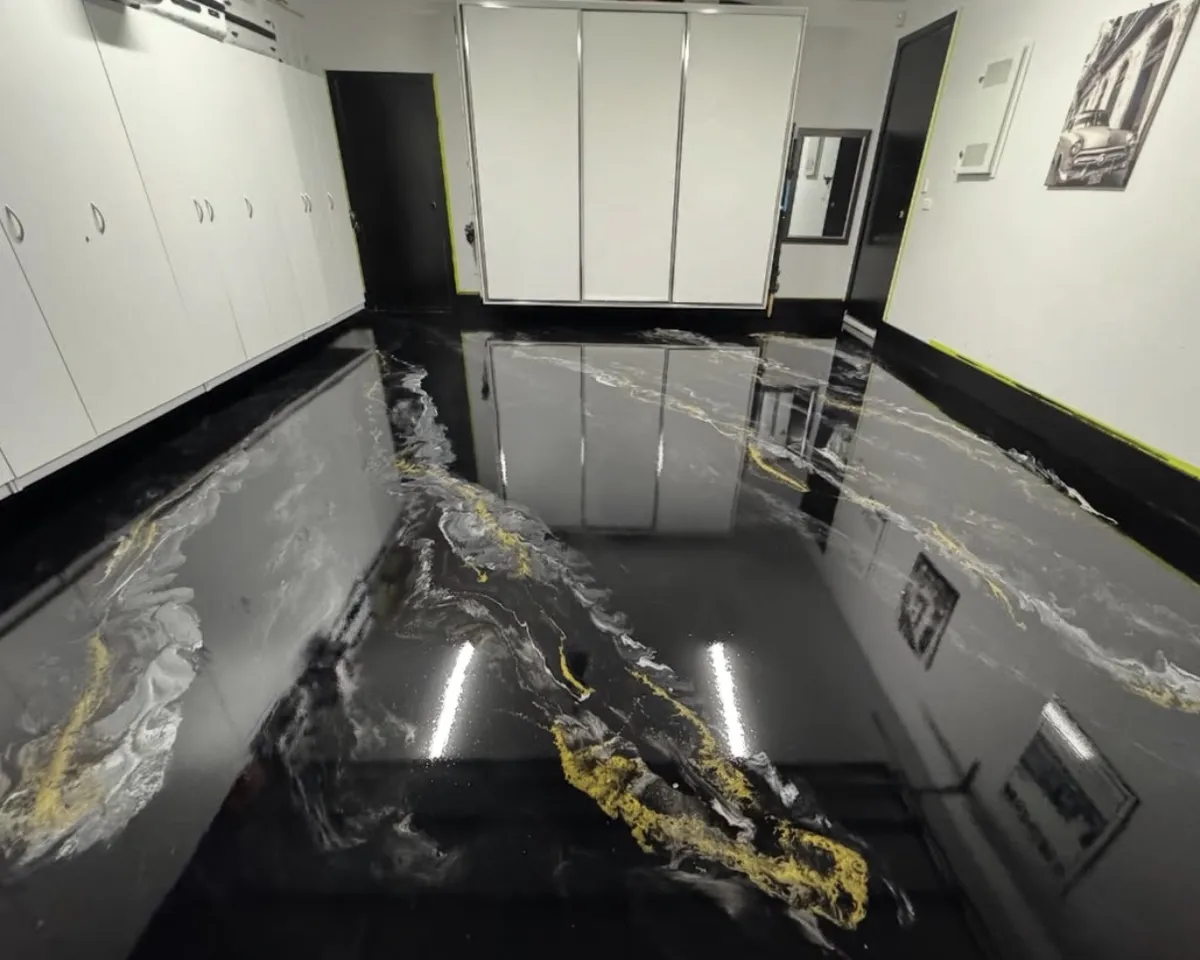
Transform your garage into a showpiece with our metallic epoxy flooring system. Using specialized metallic pigments mixed into high-performance epoxy, we create one-of-a-kind floors with a deep, three-dimensional appearance that resembles flowing lava, marbled stone, or liquid metal. Metallics are smooth, so we recommend an anti-slip additive in the topcoat anywhere the floor gets wet.
- Unique, one-of-a-kind patterns — no two floors are alike
- High-gloss, reflective finish that brightens your garage
- Seamless, non-porous surface for easy maintenance
- Available in silver, gold, copper, blue, green, and custom blends
- UV-stable formulas that resist yellowing in Arizona sun
Solid Color
A clean, single-color floor for a workshop look on a budget. It shows dust and tire marks more than flake, but it is the most affordable way to seal a slab against oil and chemical stains.
Concrete Prep & Grinding
Proper concrete preparation is the foundation of every long-lasting epoxy floor. Our diamond grinding process mechanically profiles the concrete surface, opening up pores for maximum epoxy adhesion. This critical step is what separates professional installations from DIY failures that peel and flake within months.
- Industrial diamond grinding for optimal surface profile
- Crack repair and joint filling before coating
- Moisture testing to prevent adhesion failures
- Removal of previous coatings, paint, or sealers
- Dust-free grinding with HEPA vacuum systems
Phoenix Heat, Hot Tires, and Sun
Hot tire pickup. Tires coming off a summer road are hot enough to soften a thin coating. As the tire cools on the floor it grips the softened film, and when the car backs out it pulls the coating off with it. That is the classic weekend-kit failure. A ground slab, a full-thickness epoxy base, and a topcoat made for vehicle traffic are what prevent it.
Installing in the heat. Epoxy cures by chemical reaction, and heat speeds it up, so on a hot slab the working time shrinks. In summer we start early, in the cooler part of the day, so every coat goes down well inside its working window.
Sun at the door. The first few feet inside the door get direct sun, especially on a west-facing garage left open in the afternoon. That is where standard epoxy can amber, and where the topcoat matters most.
Slab Moisture and ASTM F2170
The most expensive epoxy failure starts underneath. A slab without a good vapor barrier keeps moving moisture up from the ground, a non-breathable coating traps it, and the result is blisters and a coating that lets go in sheets. Dark damp patches, white efflorescence at cracks, or an old coating that bubbled are the warning signs.
The industry test for this is ASTM F2170: holes are drilled to 40% of the slab’s thickness, humidity probes are sealed in, and readings are taken once they reach equilibrium. The standard calls for three tests in the first 1,000 square feet and one more for each additional 1,000. The result is compared against the coating maker’s published limit. When a slab reads high, the answer is a moisture-mitigating primer under the system, not crossing your fingers.
Installation Timeline and Care
Keeping it looking new: sweep or dust-mop often, especially after a dust storm; mop with a mild, pH-neutral cleaner; wipe up brake fluid, battery acid, and pool chemicals right away; set jack stands on plywood. Skip harsh acids and abrasive pads, and keep chlorine tablets in their own tub, not on the floor.
Epoxy Floor Gallery
See our professional epoxy garage floor installations across Arizona





Epoxy Garage Floor FAQs
How much does garage epoxy flooring cost in Phoenix?
It depends on the system and the condition of your slab. Solid-color epoxy is the budget-friendly option, full-flake sits in the middle, and metallic is the premium end. Every floor is quoted from the actual slab, and the estimate is free. Our epoxy garage floor cost guide explains what moves the number.
How long does epoxy garage flooring last?
Professionally installed epoxy flooring typically lasts 15–20+ years with proper care. Our industrial-grade epoxy systems are significantly more durable than DIY kits, which typically fail within 1-3 years.
Should I choose epoxy or polyaspartic for a Phoenix garage?
Both work when the slab is prepared properly. Epoxy builds a thick, hard base with a strong bond and is the system we install. One-day polyaspartic systems cure much faster and their aliphatic topcoats resist UV yellowing, but they have their own published moisture limits and their long warranties typically cover materials, not labor. Compare the written scope and the warranty terms.
Will an epoxy floor turn yellow in my garage?
Standard epoxy can amber where direct sun hits it, which in a garage usually means the first few feet inside the door. A UV-stable formula or topcoat slows it down; ask any installer what goes on top before you sign.
Why is concrete grinding important before epoxy?
Diamond grinding creates a proper surface profile that allows the epoxy to mechanically bond to the concrete. Without proper prep, epoxy will peel and delaminate — this is the most common reason DIY epoxy jobs fail. Professional grinding gives the epoxy a strong mechanical bond.
Do you check the slab for moisture first?
Yes. Moisture is part of every estimate. Where there is any sign of it, ASTM F2170 in-slab relative humidity testing is the reliable method, and a high reading changes the plan to a moisture-mitigating primer rather than a coating that will not hold.
How long until I can park on my new epoxy floor?
Light foot traffic is typically allowed after 24 hours. You can park vehicles on the floor after 72 hours. Full chemical resistance develops within 7 days of application.
Ready to Transform Your Garage?
Get your free quote today and see how epoxy coating can upgrade your space
Get Free Quote Now