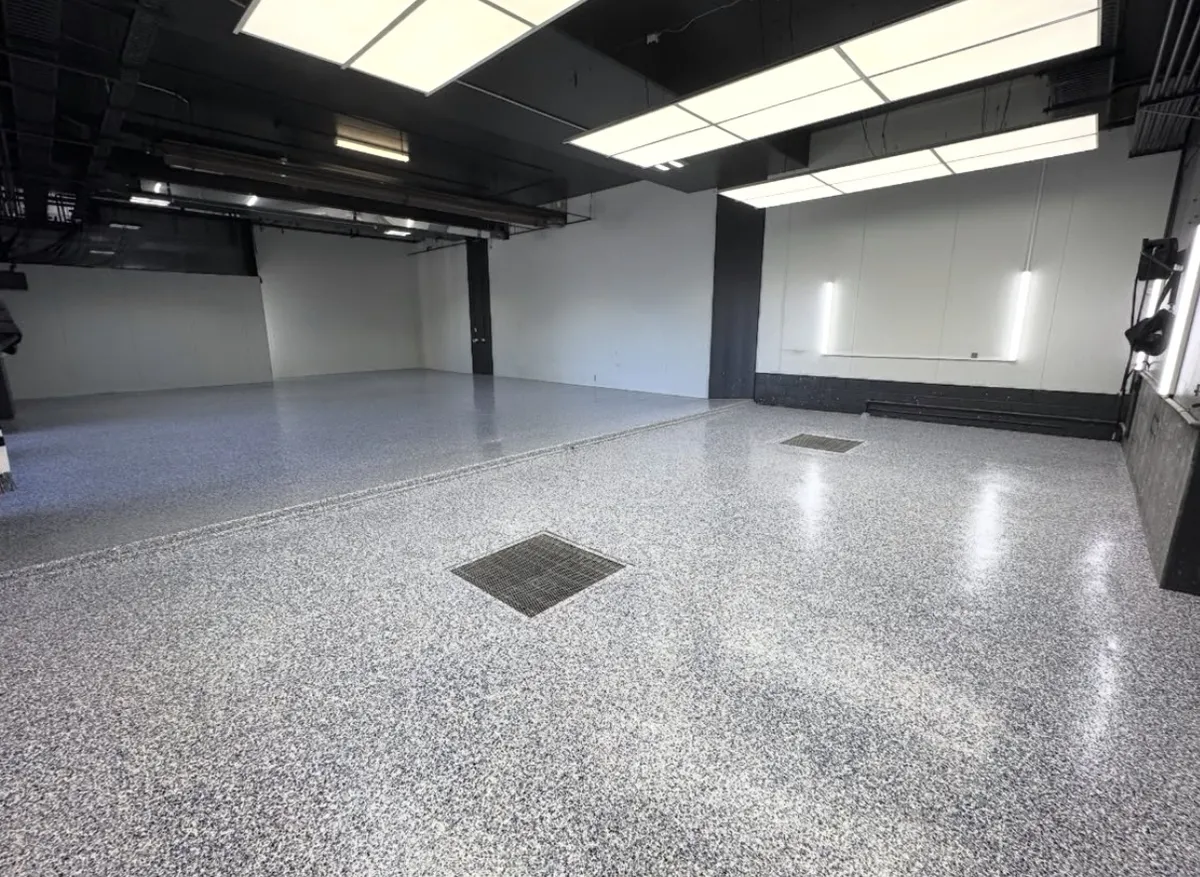
Cost by system type
| System | Relative price | Exact pricing | Best for |
|---|---|---|---|
| Solid-color epoxy | Budget-friendly | Free written quote | Clean workshop look on a budget |
| Full-flake system Most popular | Mid-range | Free written quote | Hides dust and wear; granite-like finish |
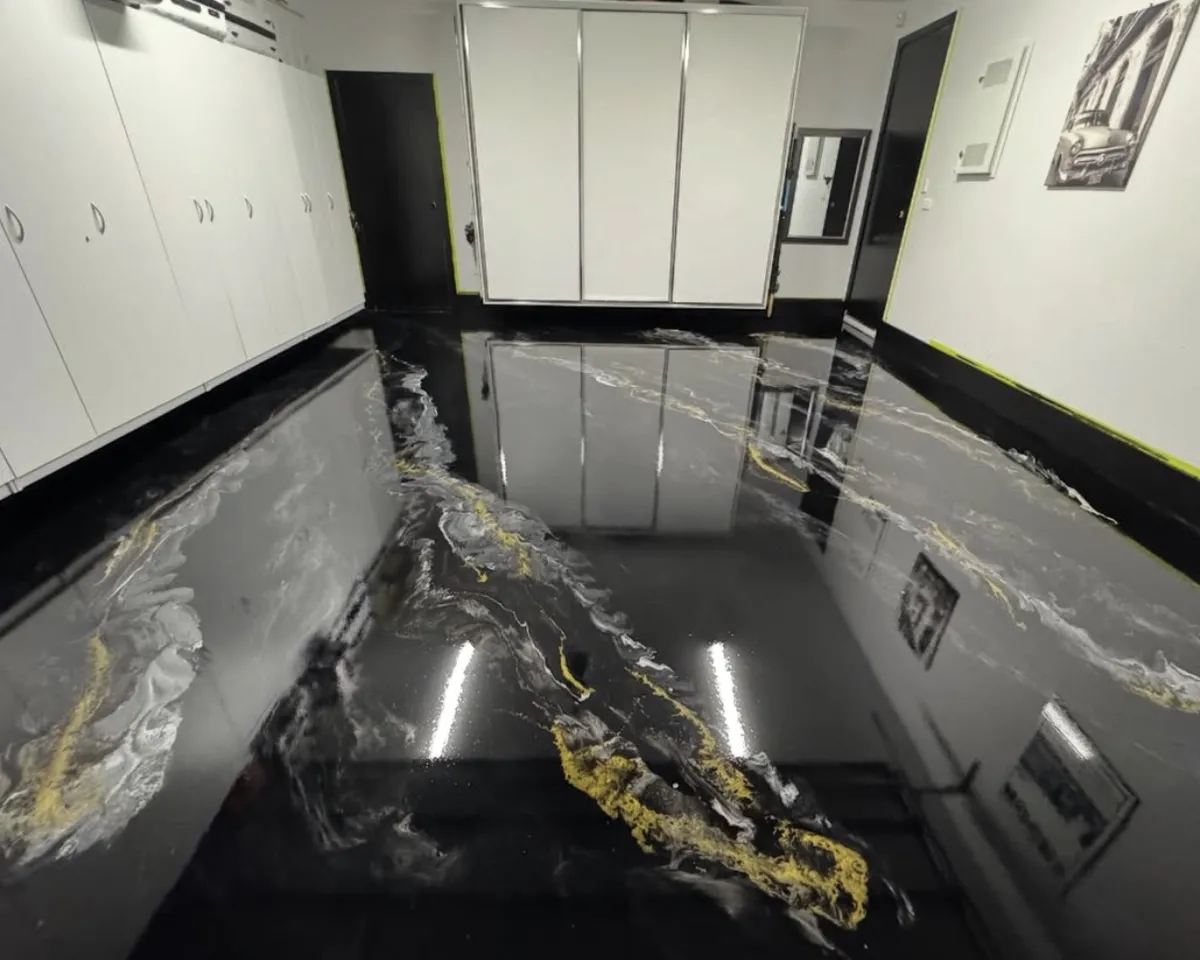
| Metallic epoxy | Premium | Free written quote | Showpiece garages and interior spaces |
Every professional system includes the part you cannot see and cannot skip: mechanical diamond grinding, crack and spall repair, moisture evaluation, and a topcoat rated for hot tires. That preparation is most of the labor — and all of the lifespan.
The five things that move your quote
Whatever the system, these are the line items that change the number. The sections after this go deeper on each one.
- Slab condition. Cracks, spalling, pitting, and old coatings all add prep hours. A previously painted floor costs more to grind clean than bare concrete.
- Moisture. Slabs with vapor issues need a moisture-mitigating primer — skipping it is how coatings blister from below.
- Square footage and layout. Bigger is cheaper per foot; third bays, storage nooks, and stem walls add edge work.
- System layers. Solid color is two coats; flake adds broadcast and scrape passes; metallics add artistry. Layers are labor.
- Extras that earn their keep. Cove bases, stem-wall coating, and anti-slip additive in walk zones — small line items, big daily-use difference.
Grinding and prep: where most of the labor goes
If you ask three installers for a number and get three very different answers, the difference is almost always in what happens before any epoxy is mixed. Good prep is hours of loud, dusty work, and it is the part a cheaper quote quietly leaves out.
On a professional job the slab is mechanically ground with a diamond grinder so the coating has a rough, clean surface to bite into. That removes laitance (the weak, chalky skin on a finished slab), oil-stained surface concrete, and any old paint or sealer. A garage floor that was previously painted or coated takes longer to grind than bare, broom-finished concrete, and a heavily stained floor can take extra passes. The dust is vacuumed off, not swept around.
Then comes repair. Hairline cracks are opened up and filled with a repair material, rigid or flexible depending on whether the crack is moving. Spalled edges, pitted areas, and old anchor holes get patched and ground flush. A floor with a handful of hairline cracks and one pitted corner is a very different job from one with control joints that have chewed out. Saw-cut control joints are normally filled with a joint material instead of being coated rigid over the top, because the slab keeps moving at those cuts and a rigid coating will just crack there. How much of this your floor needs is a big part of why we measure on site instead of quoting from a chart.
Moisture testing: the step cheap quotes skip
Concrete slabs breathe. If moisture vapor is moving up through your garage slab, it pushes against any coating sitting on top and eventually shows up as bubbles, blisters, or a floor that lets go in sheets. Phoenix is dry above ground, but that does not guarantee a dry slab: irrigation near the foundation, a leaking line, a low spot where water collects, or a slab poured without a good vapor barrier underneath can all load it with moisture.
The standard ways to check are the in-slab relative humidity probe test (ASTM F2170) and the older calcium chloride test (ASTM F1869). Neither is complicated, but they take time and equipment, so they add to the job. The result decides the system: a normal reading lets us go straight to the standard primer, while a high reading means a moisture-mitigating primer or barrier coat goes down first. That is an extra step and extra material, which moves the quote, and it is also what keeps the floor from blistering later. If a quote never mentions moisture, ask about it.
100% solids epoxy vs a polyaspartic topcoat
Two product terms come up in almost every estimate. They are worth understanding because they change both the cost and how the floor wears.
- 100% solids epoxy. This is the body of most professional garage floors: a thick, no-solvent epoxy that cures into a hard, well-bonded layer and fills small surface imperfections. On its own it can yellow or chalk in direct sun and it scratches more easily than a harder topcoat. It has a limited working time once mixed, so the crew has to spread it promptly.
- Polyaspartic topcoat. A fast-curing, UV-stable clear coat that goes over the epoxy and flake. It resists scuffing, stays clear in the sun, and handles hot tires well. It costs more per coat and is less forgiving to install, because it sets up quickly. It is the usual upgrade when the garage door faces west and the slab sees direct afternoon light.
The least expensive route in the table above is solid-color epoxy with a basic clear. The upgrade most Phoenix owners ask about is epoxy with flake and a polyaspartic or similarly durable topcoat, because the topcoat is the layer your tires, shoes, and tools actually touch. The same debate comes up outdoors; see our comparison of cool deck coating vs polyaspartic on a pool deck.
Flake vs metallic: how the finish changes the job
The decorative layer is the most visible choice, and it changes labor more than material. A full-flake system is a base coat, vinyl flakes broadcast by hand until the surface is covered, a scrape to knock off the excess, and a clear topcoat. It is forgiving: the flake hides dust, small marks, and slightly uneven concrete, which is why it is the most popular choice and the mid-range option.
A metallic epoxy floor is a different kind of work. Pigments are mixed into the epoxy and moved by hand to make the marbled, swirled look, and no two floors come out the same. It shows more of the slab underneath, so the surface has to be flatter and cleaner, and the work has to happen in a controlled window. It is the premium option because it takes more time and more skill, not because the material is magic. If you are on the fence, send a photo of what you like and we can usually tell you quickly which system gets closest.
A solid-color floor is the simplest and the most budget-friendly. It is a clean, uniform look, but it shows scuffs and dust more than flake does. Anti-slip additive can go into any of the three for spots where you walk in with wet shoes.
Phoenix garage heat and what it does to the install
Arizona garages get hot. A closed garage in summer sits well above the outdoor temperature, and the slab holds that heat into the evening. Epoxy cures by chemical reaction and heat speeds that reaction up: working time shrinks, and a batch can start to set before it is spread. In the cooler months the opposite is true and a cold slab slows curing down. A good crew plans around this, which can mean starting early in the morning, mixing smaller batches, or scheduling work in the shoulder seasons.
Heat matters after the floor is done, too. The hot-tire pickup problem described below happens because a very hot tire softens a thin coating. A properly cured, thicker system with a durable topcoat holds up to that; a thin kit coat does not.
How to compare two quotes fairly
When two estimates for the same garage do not line up, the difference is usually one of these. Ask every installer the same questions:
- Prep method: Is the slab diamond-ground, or only acid-etched or sanded? Etching is not a substitute for grinding.
- Moisture: Will the slab be tested before coating, and what happens if the reading is high?
- Repairs: Are crack and spall repairs included, and how are control joints handled?
- System layers: What is the base coat, how many coats, and what is the topcoat? "Epoxy" by itself can mean very different products.
- Square footage: Does the quote cover every bay, the stem walls, and any storage areas, or just the open floor?
- Warranty in writing: What does it cover and for how long? Ours is a 2-year workmanship warranty, written into the estimate.
- Insurance and contractor license: Ask for proof of insurance, and verify any contractor you hire on the Arizona Registrar of Contractors portal at roc.az.gov.
The lowest line item is rarely the cheapest floor. Wrong prep or a skipped moisture test turns into a re-do, and a re-do includes grinding off the first attempt.
The weekend kit, honestly evaluated
Box-store epoxy kits cost a weekend and pocket change. In Arizona they fail in a specific, predictable way: hot tire pickup. A summer slab plus tires coming home at 150°F+ softens thin water-based coatings, and the tire peels the coating off the floor as it cools. The kits also skip mechanical grinding, so the bond was weak to begin with.
The math that matters: a failed kit floor has to be ground off — you pay for its removal — before a professional system can go down. It is the same trap as cheap pool deck patches, and our answer is the same: preparation is the product. Read the deep dive on the epoxy garage service page.
Timeline and lifespan
- Installation: most garages take 1–2 days.
- Foot traffic: typically fine after 24 hours.
- Vehicles: park after about 72 hours.
- Lifespan: professionally installed epoxy typically lasts 15–20+ years with proper care — roughly twice the life of a pool deck coating, because it lives indoors away from UV.
We quote from your actual floor, never from a chart. Slabs surprise us in both directions — some need less prep than the owner feared, some hide moisture problems that change the system. Looking costs nothing.
Frequently asked questions
How much does an epoxy garage floor cost in Phoenix?
Exact pricing depends on your slab — estimates are free.
How long does an epoxy garage floor last?
Professionally installed epoxy typically lasts 15–20+ years with proper care. Preparation quality is the biggest factor — floors fail at the bond line, not in the material.
Why do DIY epoxy kits fail in Arizona garages?
Thin water-based coatings over minimally prepared concrete can't survive Arizona slab heat plus hot tires — the coating softens and peels off with the tire ("hot tire pickup"). Professional systems grind the slab and use industrial-grade materials to prevent it.
How soon can I use the garage after installation?
Light foot traffic after 24 hours, vehicles after about 72 hours. Most installations take 1–2 days.
Does an epoxy garage floor need to be ground first?
Yes. Diamond grinding opens the surface so the coating can bond, and it removes the weak top layer, old paint, and sealers. Acid etching or light sanding does not give the same bond, which is one reason cheaper quotes and kits peel.
Why does moisture testing matter before epoxy goes down?
Moisture vapor rising through the slab can blister or lift a coating from below. Testing with an in-slab humidity probe (ASTM F2170) or a calcium chloride test (ASTM F1869) tells the installer whether a moisture-mitigating primer is needed first.
What is the difference between epoxy and polyaspartic on a garage floor?
A 100% solids epoxy is the thick, strong base layer. A polyaspartic topcoat is a fast-curing, UV-stable clear coat that goes on top and resists scuffs and hot tires. Many Phoenix garages use epoxy with flake and a polyaspartic or similarly durable topcoat.
Does flake or metallic epoxy cost more?
Metallic is the premium option because it takes more skill, time, and a flatter slab; full-flake is mid-range and hides wear well; solid-color is the budget-friendly choice. Exact figures come from a free written estimate based on your floor.