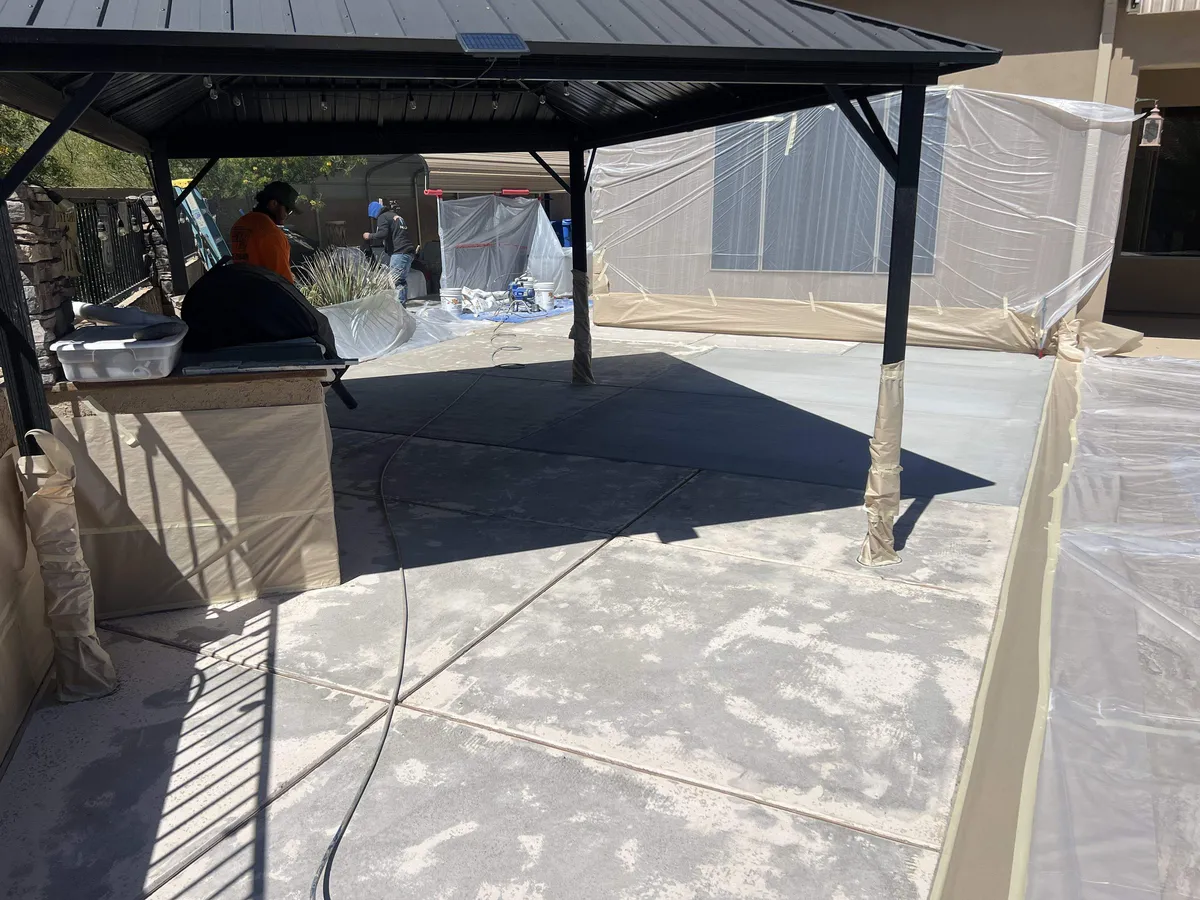
September is when Phoenix homeowners start booking October and November resurfacing dates. It is also still monsoon season, officially through September 30, so a September job gets the same rain-and-dust planning as a summer one. Whatever the date, the difference between a job that runs clean and one that loses half a morning usually comes down to what the homeowner did the week before.
None of it is hard. This is the list we send our own customers after they book a cool deck coating or stamped overlay project. If you are still deciding on timing, start with the season-by-season scheduling guide and come back here once you have a date.
What to clear from the deck
Every coating job starts with an empty deck. Anything left on the surface either gets moved by the crew, which costs time, or gets masked around, which leaves a gap in the coating that shows for the next ten years. Clear it all:
- Furniture: loungers, tables, chairs, umbrellas and their bases, side tables, daybeds.
- Planters and pots, including the heavy ones that "never move." Rings under pots are the most common blemish on an otherwise clean job.
- Grills, smokers, and outdoor kitchen carts that are not built in. Built-in kitchens stay and get masked.
- Pool toys, floats, cleaning poles, robot cleaners, and the hose reel. Move the pool robot's caddy too.
- Outdoor rugs, mats, and doormats. Moisture trapped under a rug is one of the first places an old coating fails, and it hides what the crew needs to see.
- Pet bowls, kids' toys, and anything on the steps that lead from the house to the deck.
Where does it all go? The lawn, the side yard, or the garage for the week. Keep it off the driveway if the crew is staging material there. What stays: pool equipment, built-in seating, fixed fire features, the diving board, and handrails. The crew masks those.
Gate access, pets, and pool-service visits
Crews typically arrive early, often before 7 a.m. in warm months, to get prep done before the surface heats up. Make sure they can get in without waking the house:
- Unlock the side gate or share the code the night before, and clear the path from the gate to the deck. Wheelbarrows, hoppers, and hoses come through that gap.
- Dogs stay inside or off-site from the first application day until the crew confirms the surface has fully cured. A paw print in fresh coating is permanent, and a dog that runs through wet material tracks it into the house.
- Move your pool-service visit. If your pool tech comes on a fixed day, shift it so they are not walking the deck during prep or cure. Reschedule it for after the full-cure date the crew gives you.
- Tell the neighbors if the deck is close to a shared wall. Spray application is not loud, but compressors and grinders during prep are, for a few hours.
- Leave a phone number that gets answered during the day. Color confirmation and small decisions come up on site.
Sprinklers, landscaping, and September weather
Water interferes with curing and shortens a coating's life, and September in Phoenix still has two sources of it: your irrigation system and the tail end of monsoon season.
Turn off every sprinkler and drip zone that reaches the deck the day before the crew arrives, and leave it off through the full cure. Overspray on fresh leaves marks, and a drip emitter that keeps a planter bed damp against the deck edge is one of the main reasons coatings lift at the border. If you are not sure which zones hit the deck, run each one for a minute and watch.
Trim back overhanging plants so leaves and blossoms are not dropping onto wet material. Bougainvillea, palo verde, and mesquite are the usual offenders in Phoenix yards. Rake the gravel and beds against the deck edge so the crew can mask a clean line.
Monsoon season officially runs through September 30 according to the National Weather Service in Phoenix. Storm days are less frequent in September than in July or August, but they are not over, and dust storms matter as much as rain. Your crew will schedule application days against the forecast, and the right move on your side is simple: do not reschedule around a small rain chance yourself. Let the crew make that call, and keep the sprinkler zones off even if a storm waters the yard for you.
Leave surface preparation to the crew
Homeowners sometimes try to help by pressure washing, patching cracks, or applying a sealer before the crew comes. Please don't. Surface prep is the part of the job the warranty depends on, and most well-meant prep makes it harder:
- Hardware-store crack filler is usually the wrong flexibility for a coating system and has to be ground out.
- Sealers and "deck restore" products block the primer from bonding to concrete and have to be stripped.
- Pressure washing at close range can lift an old coating unevenly and pit the concrete.
What helps instead: tell the crew everything you know about the deck. When it was last coated, what product was used if you know it, where water sits after a storm, and where the surface sounds hollow when you tap it. That history goes straight into the estimate and the prep plan. A quick sweep of loose debris the day before is welcome; anything beyond that is our job.
What resurfacing day looks like
Day one is preparation and repair: stripping loose coating, cleaning, opening and filling cracks, patching spalls, and masking the coping, walls, and equipment. It is the least photogenic day and the one that decides how long the deck lasts. Texture and color coats follow once repairs have set, either later that day or on day two. Most residential decks take 1–2 days of application.
The pool stays full. The crew will say if any equipment should be off during application. Expect compressor noise during prep, a mild smell during application that clears within hours, and some overspray protection on nearby walls. You can be home or not. If you are home, keep doors to the deck closed so pets and kids do not wander out.
When furniture and foot traffic can return
24–48 hours: light foot traffic
Bare feet and shoes are fine. No dragging anything, no pets, no sprinklers, no pool robot on the deck.
3–7 days: full cure
Furniture, planters, grills, and pets return. Cool nights and humidity push this toward the long end.
Moving furniture back
Lift, don't drag. Put pads under metal chair and lounger legs. Set planters on feet or saucers so water and rings stay off the coating.
Sprinklers and pool service
Restart irrigation and resume pool service after full cure. Redirect any head that sprays the deck; it will shorten the coating's life if you don't.
A fully cured cool deck coating in the Phoenix Valley typically lasts 10–12 years. The habits you start in the first week, pads under furniture and water kept off the deck, are most of what gets you to the long end of that range.
The one-page prep checklist
The week before
Confirm the date and weather plan with the crew. Reschedule pool service. Identify which sprinkler zones hit the deck. Trim overhanging plants. Decide where furniture will live for the week.
The day before
Clear the deck completely. Turn deck-facing irrigation off. Sweep loose debris. Clear the path from the gate. Share the gate code and a daytime phone number.
Application days
Pets inside. Doors to the deck closed. Be reachable for color confirmation. Leave the surface and the crew alone.
After
Nothing on the deck for 24–48 hours. Full load after 3–7 days, lifted into place with pads. Irrigation back on after full cure, heads redirected.
Frequently asked questions
Do I need to drain the pool before deck resurfacing?
No. The pool stays full and does not need to be drained. The crew will tell you if any equipment needs to be switched off during application, and masks the coping, tile line, and equipment pad before spraying.
Should I pressure wash or patch the deck myself before the crew arrives?
No. Surface preparation is the crew's job and the part the warranty depends on. Hardware-store crack filler and leftover sealer usually have to be removed before the coating will bond, which adds work. Sweep off loose debris and leave the rest.
Do I have to be home during resurfacing?
No, as long as the crew has gate access and a phone number for questions. Most homeowners are home on day one for color confirmation and then go about their day.
What happens if a September storm rolls in?
Fresh coating needs a rain-free and dust-free window, so application is scheduled against the forecast. If a storm develops mid-project, the crew stops at a clean break, protects the work, and finishes on the next dry day. Arizona's official monsoon season runs through September 30.
When can furniture go back on a resurfaced pool deck?
Light foot traffic after 24–48 hours. Furniture, planters, grills, and pets after the full 3–7 day cure. Lift pieces into place instead of dragging them, and add pads under metal chair legs.