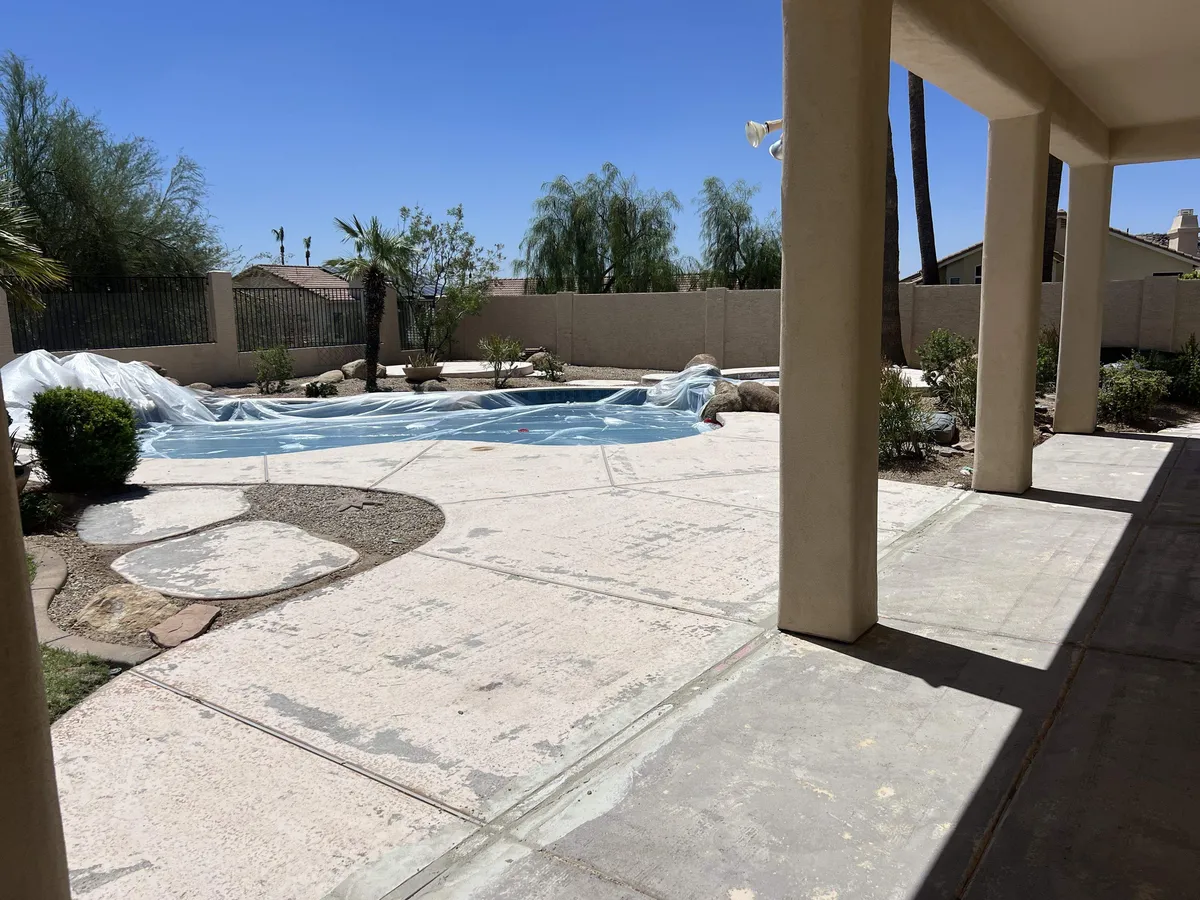
Why is my pool deck coating peeling?
A pool deck coating peels because the bond between the coating and the concrete failed, not because the coating wore out on top. On Phoenix decks that bond usually breaks for one of five reasons: water getting under the edge from sprinklers or planters, poor surface prep on the original job, moisture pushing up through the slab, heat cycling on a thin or dark coat, or a coating that has reached the end of its 10–12 year life. The fix follows the cause: stop the water, grind loose material back to a sound edge, re-prime and re-coat the area, or resurface the whole deck if more than a few spots have let go.
Peeling is the call we get most after the first hot stretch of the year and again after monsoon season, and the homeowner almost always describes it the same way: "It was fine, and then one corner started coming up." The corner is rarely the problem. It is where the problem showed first.
This guide is how our crews read a failing coating before we quote a repair or a resurface. If you already know the deck is at end of life, the resurface vs. replace guide is the better starting point. If you are trying to decide what you can safely do yourself, read DIY vs. professional Kool Deck repair after this one.
Peeling, bubbling, flaking, or chalking: read the symptom first
Four different failures get called "peeling" on the phone. They point to different causes and different fixes, so start by matching what you see:
- Lifting at the edges. Sheets or curls along the border, and you can get a fingernail under them. Bond failure, almost always from water at the edge or prep on the original job.
- Bubbles or blisters in the open field. Domes that show up on summer afternoons and may flatten overnight. Moisture or heat pushing from underneath.
- Flaking in patches away from the edges, with a hollow sound when you tap around them. Delamination over something the coating never bonded to: sealer, curing compound, dirt, or an earlier failed layer.
- Chalking and fading. The surface powders onto your hand but stays stuck to the concrete. That is UV wear, not a bond failure, and it is the easiest of the four to deal with: a recoat.
Cracks with the coating still bonded on both sides are a different conversation about the slab moving. The five signs guide covers those.
The tap test. Walk the deck with a coin or the handle of a screwdriver and tap every few feet. Bonded coating sounds sharp; delaminated coating sounds hollow and slightly higher. Mark the hollow areas with sidewalk chalk. That chalk map is what decides between a spot repair and a full resurface, and it is the first thing we do on an estimate visit.
The five causes we find on Phoenix pool decks
1. Water getting in from the edges
Sprinkler heads that hit the deck, drip emitters keeping a planter bed damp against the border, pots that sit in one spot, gravel or soil piled above the coating line, a downspout, or storm water that pools along one side. Water works under the edge, the concrete under the coating stays damp, and the bond lets go from the border inward. This is why "it is only peeling at the edges" is the most common version of this call.
Phoenix averages about 7 inches of rain a year according to the National Weather Service's 1991–2020 normals, but most of it lands in a handful of monsoon storms that put water exactly where the deck meets the yard, and irrigation runs every week of the year. If your deck holds water after a storm, the monsoon drainage test will show you where.
2. Surface prep on the original job
Acrylic bonds to clean, profiled concrete. It does not bond to whatever was sitting on the concrete: a sealer, a curing compound left from the original pour, old paint, dust, efflorescence, or a previous coating that was already letting go. Prep failures show up in the first one to three summers, often in random patches rather than at the edges, and the back of a peeled piece looks smooth and clean because it never gripped anything.
This is also the failure that homeowner prep causes most often. Pressure washing at close range, hardware-store crack filler, and "deck restore" products all leave something behind that the next coat cannot bond through. Leave surface prep to the crew; it is the part of the job the warranty depends on.
3. Moisture coming up through the slab
A pool deck sits on soil that is wet on purpose: the pool, the irrigation, the planters. Water vapor moves up through concrete and has to go somewhere. A coating that traps it blisters first and then loses its bond. The tells are bubbles that come and go with the heat, dark damp patches after days without rain, and white mineral deposits where the coating let go.
Before coating a garage floor, contractors measure slab moisture with in-slab relative-humidity probes, the test described in ASTM F2170. On a pool deck the practical version is simpler: find and fix the water source, let the slab dry, and use a textured acrylic system that lets vapor pass rather than a solid film like paint or epoxy that seals a wet slab.
4. Heat, thin coats, and dark colors
A Phoenix deck goes from a cool night to a surface hot enough to hurt bare feet by mid-afternoon, every day for five months. The coating and the slab expand at different rates, and the bond takes that stress. A coat sprayed too thin, sprayed onto a slab that was already hot so it flash-dried before it could grip, or finished in a dark color that runs hotter loses that fight years early. Light colors stay up to 30°F cooler than bare concrete in the sun and take less thermal stress; the color guide has the measured numbers.
5. The coating is simply done
A properly prepped acrylic cool deck lasts 10–12 years in the Valley, or 5–7 years in harsh conditions. When peeling shows up in several places at once, the field is chalking, and the deck is past ten years old, the coating is at end of life and the honest answer is a resurface, not a patch. The lifespan guide covers what shortens and extends that range.
One more thing to know if your deck is original Keystone Kool Deck: Mortex's product is worked into fresh concrete when the deck is poured. It cannot be reapplied to a cured slab, so a worn Kool Deck is repaired and resurfaced with an acrylic texture coating, not "more Kool Deck." Here is why.
What to do this week
Before anyone quotes the repair
- Find and stop the water. Run each irrigation zone for a minute and watch the deck edge. Redirect heads, cap emitters at the deck line, put planters on feet.
- Do not pull it further, and do not pressure wash it. Both drive water under the coating that is still bonded.
- Do not paint or seal over it. Porch paint, "deck restore," and concrete sealer have to be stripped before a proper repair, which makes the job bigger.
- Map the hollow spots with the tap test and photograph every failure with a shoe or a tape measure in the frame for scale.
- Write down what you know: the coating's age, the product if you know it, when it was last recoated, and where water sits after a storm.
- If the coating is under two years old, call the installer first. A workmanship warranty covers bond failures from prep. It does not usually cover a sprinkler head that was moved after the job, or a planter that sat in one spot all summer.
Spot repair, recoat, or full resurface
Spot repair
A handful of edge spots, a solid tap everywhere else, a coating under about eight years old, and the water source fixed. Loose material is ground back to a sound edge, patched, primed, textured, and color-blended. Be realistic: a patch on a faded deck shows. If you want it invisible, the recoat is the answer.
Recoat
The coating is bonded everywhere but chalked, faded, or thin, and peeling is limited to a few edges. The deck is cleaned, repairs are made, and new texture and color coats go over the sound existing system. This is the cheapest decade you can buy for a deck that is still stuck down.
Full resurface
Hollow spots in several areas, failures that have come back across two or more summers, an unknown previous product, or an original Kool Deck at end of life. Failing material is stripped, cracks are repaired, bare concrete is re-primed, and a new system goes on.
When peeling comes back
If the same spot fails again within a year of a repair, the cause was never fixed, usually water at the edge or moisture in the slab, and the repair was fine. Fix the source before paying for the surface twice.
A proper repair, whichever size it is, looks the same up close: loose coating ground back until the edge is bonded and then feathered, the concrete cleaned and primed, texture matched to the surrounding deck, and color applied in full coats rather than one heavy pass. What a proper repair never includes is new material going over anything hollow. Every job is quoted from the actual surface with a free written estimate, and the chalk map from the tap test is what we quote from.
If a brand-new coating is peeling
A coating that lets go in its first year almost always failed for one of the first two reasons above: water at the edge or prep. The right response from the installer is to come out, tap the deck, find the water source, and fix the work under warranty if the work was the problem. Our workmanship warranty is two years for exactly this reason; the first two summers are when a prep failure shows.
What a warranty usually does not cover, ours included, is damage from a change the homeowner made after the job: an irrigation head moved to hit the deck, furniture dragged across it, a pool robot's caddy parked on one spot. Photographs from the day the job finished and from the day you noticed the failure make that conversation short and fair in both directions.
Keeping the next coating stuck
- Irrigation pointed away from the deck. Move drip lines a foot back from the edge and put every planter on feet or a saucer.
- Gravel and soil below the coating line. Rake the beds back from the edge at the start of each season.
- Water off the deck after storms. Keep deck drains clear and fix low spots during the next resurface, not after.
- Rinse, do not blast. A garden hose and mild soap. Pressure washers belong in the crew's hands during prep, not in weekend maintenance.
- Light colors. They run cooler, stress the bond less, and hide chalking longer.
- Recoat before it fails. A recoat around year eight to ten, while the base is still bonded, costs a fraction of a resurface and resets the clock.
Frequently asked questions
Can I just paint over a peeling cool deck?
No. Paint, porch-and-floor enamel, and hardware-store "deck restore" products do not bond to a failing acrylic system, and they have to be stripped before the deck can be repaired properly, which makes the eventual job bigger. Loose material needs to come off back to a sound edge before anything new goes on.
Why is my cool deck peeling only at the edges?
Edge-only peeling almost always means water is getting under the coating from the border: a sprinkler head that hits the deck, a drip emitter keeping a planter bed damp against the edge, gravel or soil piled above the coating line, or storm water that sits along the edge. Stop the water first; then the edge can be ground back, primed, and re-coated.
Is a peeling pool deck coating dangerous?
Lifted edges are a trip hazard for bare feet and can be sharp, and the exposed concrete underneath soaks up water and starts to spall. The bigger risk is what the peeling hides: a slab that stays wet or moves. It is worth having the deck tapped and looked at before the next summer.
How long should a cool deck coating last in Phoenix?
A properly prepped acrylic cool deck typically lasts 10–12 years in the Phoenix Valley, or 5–7 years in harsh conditions such as constant irrigation overspray, heavy shade-and-sun cycling, or a dark color. A recoat while the base is still bonded resets that clock for a fraction of a full resurface.
Does the whole deck need to be redone if one area peels?
Not necessarily. If the tap test sounds solid everywhere except a few edge spots, the coating is under about eight years old, and the water source is fixed, a spot repair or a recoat is the right answer. Hollow spots in several areas, repeated failures across summers, or an unknown previous product usually mean a full resurface will cost less over the next decade than chasing patches.