Do saltwater pools damage pool decks?
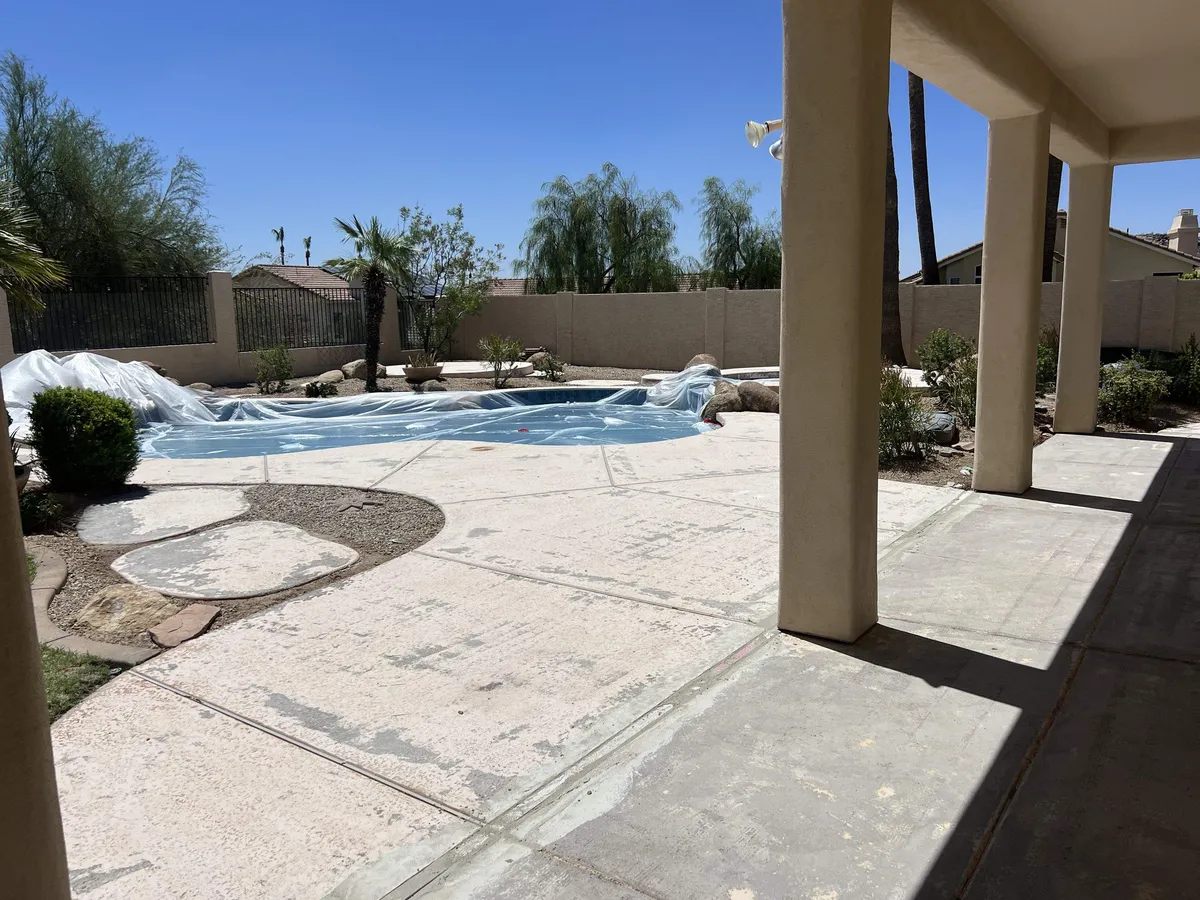
Yes, a saltwater pool can damage a concrete pool deck, mostly through splash-out that soaks in and dries. As the water evaporates it leaves salt behind, and repeated wet-dry cycles can crystallize that salt inside the surface until it flakes or crumbles. Phoenix’s dry air speeds this up. You can tell salt damage from other failures by where it sits: it clusters in the splash zone, along joints, and around steps and skimmers, often with white crust or gritty loss. Rinsing the deck with fresh water, keeping it draining, and keeping joints and cracks sealed slows it down. A deck with firm concrete under the damage can usually be resurfaced; concrete that is crumbling deep or hollow usually needs sections replaced first.
If you have a salt chlorine generator, you have probably noticed the white crust around the waterline tile, on the coping, or at the edge of the deck where the splash lands. Most of it wipes off. The question is what it is doing to the concrete under your feet while you are not looking.
We resurface pool decks across the Phoenix Valley, and we see salt-pool decks that have held up fine and others that have lost their surface in the first few feet from the water. This guide covers how salt damages a deck, why Phoenix is hard on it, how to tell it from look-alike failures, and what helps. We link the published sources, and we say where the experts disagree.
How salt damages a pool deck
A salt chlorine generator turns dissolved salt into chlorine, and the salt then goes back into the water. So the water itself stays salty. Hayward’s manual for its AquaRite generator puts the ideal level between 2,700 and 3,400 ppm, with 3,200 ppm optimal. That is a fraction of the ocean: the U.S. Geological Survey gives seawater as roughly 35,000 ppm, so pool water is on the order of a tenth as salty. It does not taste salty to most people, and it is easy to assume it is harmless to concrete.
The trouble is not the strength of the water. It is what happens when that water dries on a porous surface. Concrete is full of tiny pores and it wicks water in. Research summarized by concrete durability expert R. Doug Hooton for the American Concrete Institute describes the sequence: salty water enters the concrete, evaporates from the exposed surface, and the salt concentrates near that surface until it crystallizes, sometimes with enough pressure to crack the concrete. Changes in temperature and humidity can then make some salts dissolve and recrystallize again and again, and repeated cycles can wear a surface down much like freeze-thaw cycles do.
Engineers call this physical salt attack. A paper from the National Ready Mixed Concrete Association and a petrographer, published through ACI as SP-317, notes that crystallization of salts in concrete can cause surface scaling, and that sodium chloride, the same salt in your pool, is among the salts reported to cause distress. The most severe cases in that literature involve sulfate salts, so we are not saying pool salt behaves like sulfate attack on a highway bridge. The mechanism is the same family, and the sodium chloride version is documented.
Why Phoenix is hard on a salt-pool deck
Three Phoenix conditions work against you at once.
Fast evaporation. Hooton’s ACI presentation notes that sulfate salts become concentrated by evaporation, so in arid regions all concentrations can become a concern for physical salt attack. That slide is about sulfates, but the same wicking-and-drying logic applies to the salt in a pool. Phoenix gets about 7.2 inches of rain a year in the National Weather Service’s 1991–2020 normals, and a splashed patch of deck can be dry in minutes. Every splash dries, and every dried splash leaves its salt behind.
The same water, concentrated. Hayward’s own manual makes a related point in a note about pool acid: in arid regions, pool water is subject to excessive evaporation and is not commonly diluted with fresh water. Water that evaporates from a pool leaves its dissolved salt behind in what remains, so a pool that is not topped up with fresh water gets no relief from the salt.
Heat cycling. A deck in direct sun goes from a cool morning to a very hot afternoon, then cools again. Hooton’s material notes that temperature and humidity swings drive salts through repeated crystallization cycles, and in the field those cycles can happen several times a day for the salts that are most sensitive to them. Hooton’s material singles out sodium sulfate as the most severe salt, so pool salt is not the worst offender, but a sun-baked deck gives it plenty of wet-dry cycles.
How to tell salt damage from other failures
Salt gets blamed for a lot of things it did not do, and it gets overlooked for things it did. The most reliable clue is where the damage sits, not what it looks like. Salt follows water: it shows up where splash lands, where water runs off, and where it dries slowly.
| What you see | Where it shows up | Likely cause | What it means |
|---|---|---|---|
| White, powdery or crusty deposit that wipes or brushes off | Waterline, coping, first few feet of deck, drain edges | Salt or mineral deposits left as water dries (efflorescence) | Surface symptom; check for water getting in Common |
| Gritty, sandy surface that sheds fine particles | Splash zone, under swim-out spots, around steps | Surface paste breaking down, salt crystallization is one candidate | The surface is weakening; test with a screwdriver |
| Thin flakes or small circles lifting off | Splash zone and joints first, then spreading | Scaling, or a coating losing grip where water gets under it | Look at the flake: coating, or concrete? |
| Coating peeling in large sheets, all over the deck | Everywhere, including dry areas | Preparation or moisture problem, not salt | See our coating peeling guide |
| Damage in one low spot with standing water | Where puddles stay after rinsing or rain | Drainage | Fix the water first, or any surface will fail there |
| Crumbling, hollow-sounding, or loose pieces | Anywhere | Deep deterioration | Replacement territory, not a coating job |
White crust is a clue, not a diagnosis. Efflorescence is the white deposit left when water carries salts to a surface and evaporates. Sherwin-Williams notes that moisture has to be present, along with soluble salts and a path to the surface. If crust keeps coming back along the same joint, water is getting in there.
Salt damage often shows up in a coating as a coating problem. The American Society of Concrete Contractors’ Rich Cofoid wrote in 2024 that on saltwater pool decks it is not the sealer but the concrete under the sealer that causes most issues: salt water gets in through control joints or small cracks, attacks the concrete beneath, and when the concrete deteriorates it takes the sealer with it. So a deck that looks like it has a peeling problem near the pool edge may have a salt problem in the slab.
A ten-minute deck check
What to look for, in order
- Map the damage. Walk the deck and photograph where flaking, grit, or crust is worst. Salt damage should be heaviest where water lands and dries. Note any damage in areas that never get wet.
- Scratch and look at a flake. A chalky or sandy surface that comes up easily is weak concrete. A thin film of coating with little concrete on the back is a coating failure; gritty grey paste on the back is the concrete itself.
- Check the joints and coping line. Crust, staining, or lifting along them shows where water gets in.
- Tap it. A dull, hollow sound from a metal rod or screwdriver handle means the surface has separated.
- Rinse, wait, look. Hose a crusted area with fresh water. If it clears and stays clear, it was surface deposit. If it returns in days along the same line, water is coming from somewhere.
This is a screen, not a lab test. If it looks more like general wear than salt, our five signs your deck needs resurfacing helps you sort it out.
How to slow salt damage down
Nothing makes a deck immune to salt water, but a few habits cut the exposure, coated deck or not.
Rinse the deck with fresh water
The simplest step is the one pool-salt makers recommend. The Concrete Decor article quotes the salt-system manufacturers as recommending that pool decks be washed down with fresh water after each use. A hose on the first few feet around the pool, plus steps and swim-outs, removes salt before it can dry and concentrate.
Keep water draining away from the slab
The ACI-published SP-317 paper linked above names drainage as one of the measures that limit salt damage: the less water that sits in or under a slab, the less salt it can carry. Check that the deck slopes away from the pool and the house, that trench drains and channel drains are clear, and that irrigation and downspouts are not feeding water to the slab edge. Puddles that dry in place are salt concentrators.
Keep joints and cracks sealed
The ASCC’s Cofoid points to joints and small cracks as the way salt water gets under a sealer. Control joints and the joint at the coping move, so they need flexible sealant that stays flexible, and it should be checked every year or two. Hairline cracks near the pool edge are worth filling early; our cracked pool deck guide explains which cracks matter.
Keep the salt level in range
Running salt above the generator’s range does not help and makes splash saltier. Hayward gives 2,700–3,400 ppm for its generators and says too high a level can shut the unit down. Check your manufacturer’s range. If you have natural stone coping, Hayward’s manual also says to consult a qualified stone specialist about the stone, sealant, and maintenance before using a salt system.
What sealers can and cannot do
Sealers are where the advice gets contradictory, so here is what is actually documented.
Sealer chemistry matters. Cofoid recommends a penetrating silane or siloxane sealer for saltwater pool decks, or a penetrating sealer combined with a solvent-based coating, and notes that water-based coatings will not adhere over a penetrating sealer. The Concrete Decor article quotes contractors who report sealers flaking and delaminating over stamped and textured concrete near salt pools, and others who say the salt is not eating the sealer at all: weak adhesion lets water in under it. As one contractor in the article put it, in the field nobody has a control pool to compare against.
Penetrating sealers get a more consistent endorsement. A manufacturer such as LATICRETE markets a water-based penetrating sealer specifically formulated to protect exterior surfaces around salt water pools and to minimize efflorescence. That is a vendor’s claim, but it matches the advice above: keep water out of the pores instead of putting a film on top.
Two cautions. A penetrating sealer does not fix a deck that is already crumbling, and it has to be compatible with whatever goes over it, so check with the coating manufacturer, as Cofoid advises. And no sealer replaces rinsing and drainage.
For cool deck coating, our FAQ describes the sealer coat as there for UV, chlorine and salt splash-out, and monsoon rain. We stand behind that as a design intent, but a film coating still depends on firm concrete and sealed joints underneath. We do not tell anyone a coated deck is immune to a salt pool.
When resurfacing fixes it, and when the concrete is too far gone
Resurfacing is a surface repair. It works when the concrete under the damage is sound. That is the line.
Usually fixable by resurfacing
Firm concrete with a flaking, chalky, or lightly scaled surface; coating that failed in the splash zone; white crust that rinses off; hairline cracks and tired joints that can be repaired. The weak layer is removed back to sound concrete, joints and cracks are repaired, and a new coating goes on.
Usually needs more than a coating
Concrete that crumbles deep when you probe it; large hollow areas; sections that are loose or broken into pieces; sections that have heaved or sunk; or an edge where a salt-loaded surface keeps coming back after it has been prepared. Those sections are cut out and repoured first.
How we decide on an estimate: we probe the surface, sound it for hollow spots, and look at how deep the damage goes. Light scaling gets removed in prep. Deep loss is a different matter. A coating is thin, and it follows what is under it. If the concrete keeps shedding after the surface is prepared, the coating will fail with it.
Be wary of a bid that skips the diagnosis, and ask any bidder what their warranty says about salt exposure. Verify any contractor’s Arizona ROC license at roc.az.gov; our guide to choosing a pool deck contractor has the full list. For the bigger question, resurface or replace walks through the decision.
What our warranty covers here
We would rather be clear about this than let you find out later. Our two-year warranty covers defects in the materials and workmanship of the coating we apply, under normal use and conditions. Per our Terms of Service, it does not cover damage from pool chemicals applied directly to the surface, structural movement or cracking of the concrete underneath, or lack of reasonable maintenance. In practice, that means:
- Covered: a coating that peels, flakes, or delaminates because of a materials defect or workmanship error.
- Not a guarantee: that a slab with ongoing salt loss or moving cracks will stop shedding. We flag those in the written estimate before we coat.
Estimates are free and in writing, quoted from the actual surface. For the product side, see cool deck coating and cool deck repair, or how we approach pool deck resurfacing in Phoenix.
Frequently asked questions
Does a saltwater pool damage a concrete pool deck?
It can, mostly through splash-out and drips that soak into the deck and dry there. As the water evaporates the salt is left behind, and repeated wet-dry cycles can crystallize it inside the surface and flake it off. A well-made, well-drained deck can last a long time next to a salt pool, but a porous or poorly sealed one is more exposed.
Is salt-chlorinated water worse for pool decks than regular chlorine water?
The published sources do not settle it. Contractors in a Concrete Decor roundtable disagreed about whether salt itself attacks sealers or whether poor adhesion lets water get underneath. What they agree on is that water carrying dissolved salt leaves crystals behind when it dries, and salt-laden water can get under a coating through joints and cracks. Treat a salt pool as a reason to manage splash-out and drainage, not as a verdict on the deck.
Why is salt damage worse in Phoenix?
Dry air and heat evaporate splash-out fast. Concrete research describes salt concentrating near a surface as water evaporates, especially in arid regions, until it crystallizes and can crack or scale the surface. Phoenix decks also bake in direct sun and get few rains to wash the surface off, so salt can sit and concentrate between rinses.
How do I tell salt damage from a failed coating or bad drainage?
Look at where it happens. Salt damage clusters where water lands and dries: the first few feet from the water, around skimmers and steps, under swim-out spots, and along joints. White crust, gritty or sandy loss, and thin flaking in those zones point to salt. Broad peeling across the whole deck, even in areas that never get splashed, usually points to preparation or moisture. Water that sits in one low spot points to drainage.
Can a saltwater pool deck be resurfaced?
Often, yes, if the concrete is sound. The weak, flaking, salt-loaded surface is removed back to firm concrete, joints and cracks are repaired, and a new coating goes on. If the concrete is crumbling deep, hollow, or loose in pieces, a coating is the wrong fix and those sections need to be replaced first.
Does the Master Pool Decks warranty cover salt damage?
Our two-year warranty covers defects in the materials and workmanship of the coating we apply under normal use. It excludes pool chemicals applied directly to the surface, structural movement or cracking of the concrete underneath, and lack of reasonable maintenance. We do not promise a coating is immune to salt, and we will tell you on the estimate if the concrete looks too far gone to coat.
More answers in our full FAQ, or see cool deck repair.
LATICRETE, Hayward, and Sherwin-Williams are named only to identify their published material. Master Pool Decks is independent and is not affiliated with, endorsed by, or a dealer for any brand mentioned.