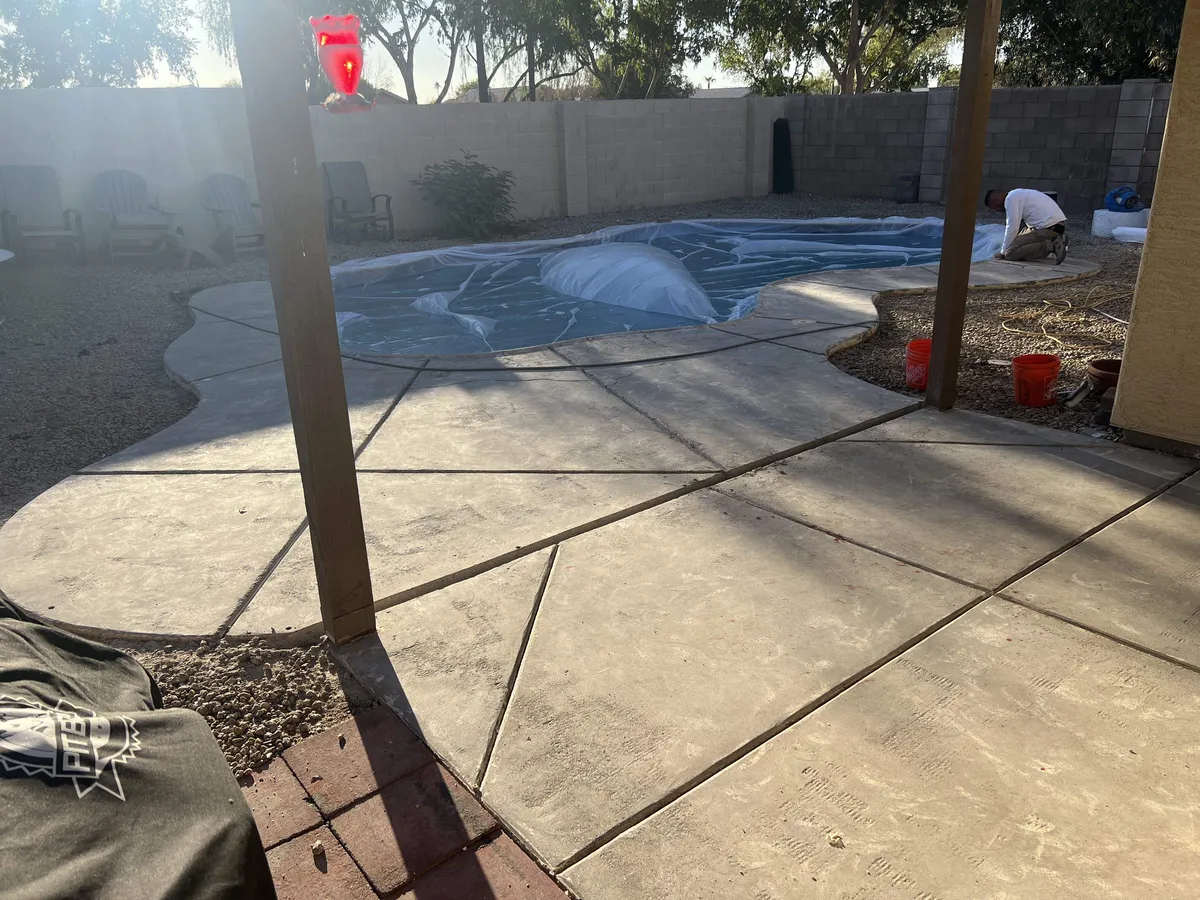
First, terminology that will save you a bad purchase: genuine Kool Deck® bonds only to clean, bare concrete and will not go over an existing coating, so on an already-coated deck it means stripping everything first. What everyone calls “Kool Deck repair” is almost always done with texture coating systems. Our Kool Deck repair truth guide covers that in depth — this article is about who should do the work.
The decision, symptom by symptom
| What you see | What it usually means | DIY or pro? |
|---|---|---|
| Dirt, mildew, dull color | Surface needs maintenance, not repair | DIY — deck cleaner, soft-wash, garden hose |
| Hairline cracks (credit-card thin, stable) | Normal concrete behavior | DIY — crack filler, tinted if available |
| One small chip or gouge | Impact damage, cosmetic | DIY acceptable on a sound deck; expect the patch to show |
| Flaking or peeling areas | Coating bond is failing | Professional — failed coating must come off before anything sticks |
| Hollow sound when tapped | Delamination under the surface | Professional — patching over it traps the failure |
| Cracks that widen or offset | Slab movement | Professional — movement must be diagnosed first |
| Worn texture across large areas | Coating at end of life (typically 10–12 years in AZ) | Professional — this is a recoat/resurface, not a repair |
What DIY actually does well
A homeowner with a free morning can genuinely handle three things:
- Deep cleaning. A deck cleaner, a stiff brush or soft-wash, and a rinse restore more appearance than most people expect. Skip high-pressure tips held close — they can cut a line into texture coating.
- Hairline crack filling. Flexible crack fillers from any box store work on stable, credit-card-thin cracks. Clean the crack, fill, tool it flat, let it cure fully before foot traffic.
- A small cosmetic patch. On a light-colored deck in an out-of-the-way corner, an imperfect patch may be a fair trade for the price.
Set expectations on that third one: we can spot a trowel-applied patch on a spray-textured deck from across the yard, and so will you. If the repair is in the main walking path or sight line from the patio, weigh whether “fixed but visible” is the outcome you want.
Where DIY repairs fail — and why
1. Preparation, not patch material
Nearly every failed patch we get called to redo failed at the bond line. Coating will not stick to dust, sealer residue, algae film, or a chalky failed coating. Professional prep — grinding, cleaning, sometimes etching, then priming — is most of the labor in a real repair. The patch kit is the easy part.
2. Texture matching needs the machine
The classic knockdown or lace finish was applied with a hopper gun at a specific pressure, then knocked down at a specific moment. A trowel, sponge, or brush cannot reproduce it. That is the single biggest reason patches announce themselves.
3. Color matching against ten years of sun
Even if you found the original tint formula, the deck around your patch has been fading in Arizona UV for years. Fresh color against faded color reads as a stain. Professionals solve this by recoating the entire surface after structural repairs — uniform color and texture, everywhere, at once.
4. Repairs that hide the real problem
Flaking, hollow spots, and moving cracks are symptoms. Patching the symptom seals the evidence while the cause — failed bond, water intrusion, slab movement — keeps working underneath. Our guide to the signs a deck needs resurfacing shows how to read them.
What the professional version looks like
A proper professional cool deck repair is closer to a small resurfacing project than to a patch:
- Diagnose: tap-test for hollow areas, map cracks, check drainage and expansion joints.
- Remove failed coating and route out cracks so filler has something to grip.
- Mechanically prepare and prime the surface.
- Repair, then spray-texture and recoat the deck so the finish is uniform.
- Seal, with cure times in writing: light foot traffic in 24–48 hours, full cure in 3–7 days.
Most residential projects take 1–2 days of on-site work. If the coating is at the end of its 10–12 year life, a full resurface usually beats chasing repairs one season at a time — the cost guide breaks down the math.
The honest cost comparison
DIY patch
Right call for one small cosmetic flaw on a sound, young deck.
DIY gone wrong
The hidden price: failed patches must be ground off before a pro system can bond — you pay for the removal of your own repair.
Professional repair + recoat
Quoted per project. Fixes causes, matches texture and color everywhere, and carries our 2-year workmanship warranty.
Full resurface
Resets the 10–12 year clock instead of patching a dying surface.
Before you buy a patch kit, check:
- Tap the area around the damage — hollow sounds mean stop and call someone.
- Look along the deck at low light — widespread wear means the coating, not the spot, is the problem.
- Check crack edges — offset height or widening over months means movement.
- Be honest about location — a visible patch in the main sight line will bother you every day.
Frequently asked questions
Can I repair Kool Deck myself?
Small jobs, yes: deep cleaning, filling hairline cracks with crack filler, and patching a chip smaller than a hand on a sound deck. Flaking, hollow spots, spreading cracks, and anything larger need professional prep and spray texture equipment.
Why do DIY cool deck patches look obvious?
Texture and color. The original finish came from spray equipment a trowel cannot imitate, and the surrounding deck has sun-faded for years, so even a color-matched patch reads as a bright spot.
What does professional Kool Deck repair involve?
Removing failed areas, routing and filling cracks, mechanical prep, then recoating the whole deck so texture and color are uniform — typically 1–2 days of work plus 3–7 days of cure.
Is real Kool Deck used for repairs?
Rarely. Genuine Kool Deck bonds only to bare, clean concrete, so using it on an existing deck means stripping every old coating off first. Most existing decks are instead repaired with texture coating systems that reproduce a similar look and feel over a properly prepared surface.