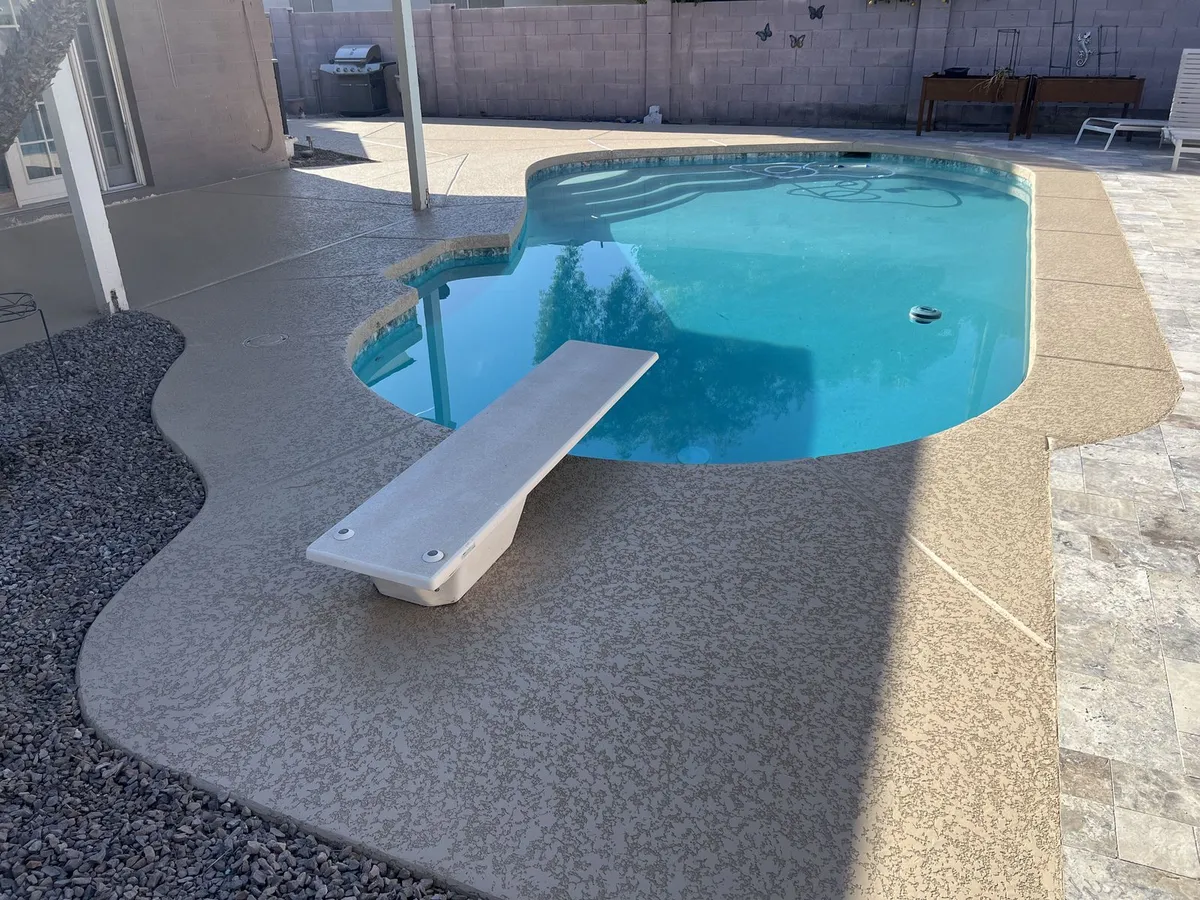
Arizona pool decks do harder work than decks in most of the country. A surface must handle intense sun, daily expansion and contraction, pool chemicals, monsoon dust, and bare feet at the same time. That is why “best” cannot mean appearance alone.
Our comparison is based on the conditions we inspect and the coating systems we install across Phoenix, Scottsdale, Mesa, Tempe, Gilbert, and Chandler. It is a field guide, not a laboratory test. Exact surface temperature changes with color, cloud cover, shade, wind, texture, sealer, and time of day.
Arizona pool deck surfaces at a glance
| Surface | Heat behavior | Best use | Maintenance | Main tradeoff |
|---|---|---|---|---|
| Light cool deck coating Best overall | Among the coolest coating choices when a light color is used | Resurfacing a sound concrete deck | Clean periodically; repair and recoat as wear appears | Textured, practical look rather than natural stone |
| Flagstone coating | Cool to moderate; depends heavily on color palette | Decorative look without removing a sound slab | Clean and maintain protective topcoat as specified | More labor and cost than classic cool deck |
| Stamped overlay | Moderate to hot with darker colors or glossy sealer | High-detail stone, slate, or tile appearance | Periodic cleaning and resealing | Style-first choice; not normally the coolest |
| Light travertine | Often comfortable; varies by stone color and density | Premium natural-stone project or full renovation | Joint, stain, and stone care | Higher cost and a different installation system |
| Bare or painted concrete | Usually hotter, especially in medium and dark colors | Utility areas and lowest initial budget | Paint can peel; cracks remain visible | Weakest comfort and finish around a pool |
1. Light-colored cool deck coating: best overall
For an existing concrete pool deck in repairable condition, a light cool deck coating is our default recommendation. The texture creates tiny peaks and valleys, the light finish reflects more solar energy than dark surfaces, and the coating can be renewed without demolishing the slab.
- Choose it when: barefoot comfort, traction, budget, and fast installation are the priorities.
- Avoid a dark color: the same coating in charcoal or deep brown will absorb more heat.
- Know the terminology: genuine Kool Deck® bonds only to bare, clean concrete — new, or existing concrete stripped of every old coating. Decks that already have a coating are typically resurfaced with texture coating systems. Our Kool Deck repair guide explains the difference.
A coating cannot repair a moving or structurally failed slab. Before recommending any finish, we check for hollow areas, delamination, drainage problems, crack movement, and failed expansion joints. See when resurfacing is appropriate.
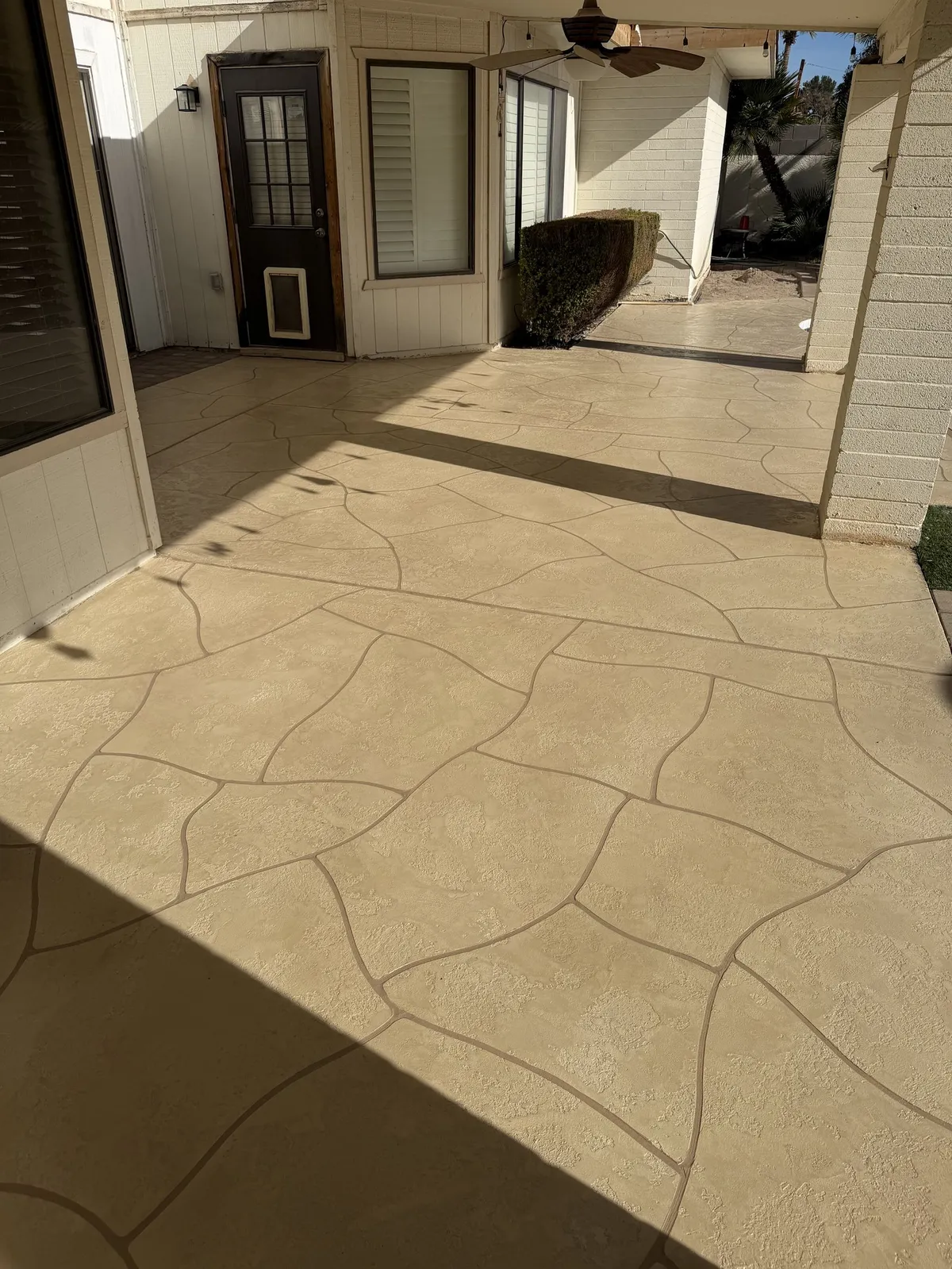
2. Flagstone coating: best balance of style and comfort
Flagstone coating is a hand-detailed coating system that creates the look of individual stones over prepared concrete. It keeps the repairability of a coating system while offering more visual character than a single-color texture.
The color plan matters. A cream, sand, or light gray base with limited darker accents is usually more comfortable than a design dominated by dark grout lines and deep brown “stones.” Ask to see a physical sample outdoors, not only a color card under indoor lighting.
3. Stamped overlays: best for a detailed masonry look
A stamped concrete overlay can imitate slate, tile, or cut stone. It is a strong design choice, but it should be evaluated differently from cool deck. Pattern depth, color, and sealer affect both traction and heat.
For a pool surround, we favor lighter integral colors, restrained accenting, and a slip-resistant finish. A dark antiquing color or glossy film may look dramatic in a showroom and feel less practical beside water in July.
4. Travertine: a premium option with installation tradeoffs
Light travertine is popular because natural stone can feel comfortable underfoot and gives a premium appearance. It is not a direct substitute for a thin resurfacing coating. A paver or stone system introduces base preparation, elevations, drainage, coping transitions, joints, and possible movement that must be designed as a complete assembly.
Choose travertine when the natural-stone look justifies the budget and the property is suited to the installation. For a sound slab that mainly needs a safer, cooler finish, resurfacing is usually the simpler path.
5. Bare or painted concrete: lowest initial cost, weakest long-term fit
Bare gray concrete is durable but can become uncomfortable in direct sun and does not hide repaired cracks or surface wear. Standard paint may improve color for a while, but pool chemicals, UV exposure, standing water, and surface movement can lead to peeling when the product or preparation is wrong.
If budget is tight, spend first on crack diagnosis, drainage, and surface preparation. A cheap topcoat over a failing surface usually costs more when it must be removed before the next system can bond.
How to choose in five questions
Is the existing concrete sound?
If yes, coatings and overlays may avoid demolition. If not, correct the slab or movement first.
Will people walk barefoot at midday?
Prioritize a light color and heat-managing texture over a dark decorative finish.
How much maintenance is acceptable?
Detailed and sealed finishes generally need more deliberate care than a classic texture coating.
Is the goal comfort or a premium look?
Cool deck leads on practical value. Flagstone, stamped overlays, and travertine move toward design.
Before approving a material, ask the contractor to:
- Explain how the existing coating will be tested and prepared.
- Identify which cracks can be repaired and which may return.
- Show the exact color outside in direct sun.
- State the slip-resistance approach around wet areas.
- Put the coating system, preparation steps, cure time, and warranty in writing.
A note about “30 degrees cooler” claims
Temperature comparisons are only meaningful when two surfaces are measured at the same place and time. A light textured coating can be substantially cooler than dark or bare concrete in direct sun, but no contractor can promise one exact number in every yard. Shade, humidity, wind, color, surface density, and the comparison material all change the result.
Our practical advice is simple: choose the lightest color you like, avoid unnecessary dark accents in the main walking path, and compare physical samples in afternoon sun.
Frequently asked questions
What is the best pool deck surface for Arizona heat?
For most Phoenix homes with a sound concrete deck, a light-colored cool deck coating offers the best balance of lower surface heat, slip resistance, repairability, and installed cost.
Is travertine cooler than cool deck?
Light-colored travertine can feel cool underfoot, but actual temperature depends on the specific stone, color, sun exposure, and installation. It is usually a higher-cost, more complex project than resurfacing a sound slab.
Does pool deck color affect surface temperature?
Yes. Lighter colors generally reflect more solar energy; dark colors absorb more. Texture, material, sealer, shade, wind, and time of day also affect the temperature you feel.
Can an existing pool deck be made cooler without replacing it?
Usually, yes. If the concrete is structurally sound, cracks can be repaired and a light texture coating can be installed over the properly prepared surface without demolition.