Basketball Court Resurfacing in Phoenix
Fresh coating color, crack repair and new lines for the half court, full court or backyard pad you already have, with sport surfaces made for Arizona sun
Insured · 2-year written workmanship warranty · Free written estimate · Call (623) 521-1096
Basketball Court Coating and Lines for Phoenix Homes & Properties
A regulation full court is 94 by 50 feet under NBA rules and 84 by 50 under high school rules, and very few backyards hold either. Most home courts are a half court or a shooting pad, and the trick is fitting the lines you actually use onto the slab you have: the key, the free-throw line, and as much of the three-point arc as the pad allows. We recoat, repair and re-line existing basketball courts; we don’t pour new slabs or build courts from scratch. For the full repair-and-resurface process on a worn court, see resurfacing an existing basketball or tennis court; for courts that mix several games, see our sports court coating and line services.
Half & Full Courts
From a compact shooting pad to a full 94 by 50 court. The layout starts from the slab you have and the lines you want.
Sport Surfaces
Multi-coat coating over your existing concrete for consistent bounce and grip, with a cushioned option that is easier on knees.
Hoop Clearance
Lines are laid out from where your hoop already stands. The backboard overhang decides where the baseline really is.
Backyard Courts
Lines fitted to your existing pad, with a high school or partial arc where the space is tight instead of squeezed-in NBA lines.
Multi-Sport Lines
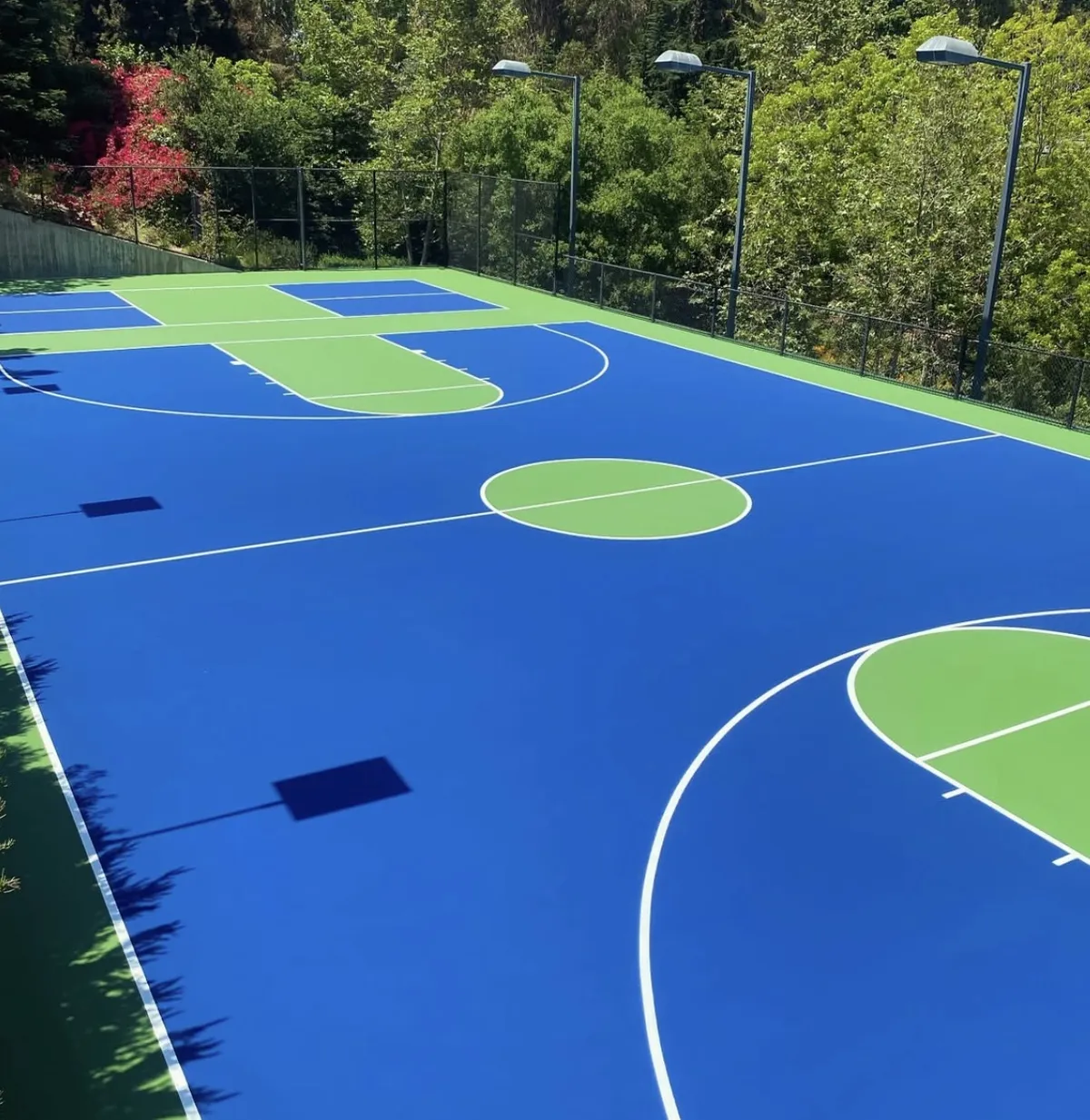
A 20 by 44 pickleball court fits on a half-court pad. Each sport gets its own line color.
Crack Repair
Cracks are cleaned out, filled and leveled before the color goes on. Movement cracks can come back, and we will not pretend otherwise.
Basketball Court Dimensions
Rulebook numbers for the lines that matter most on a home court.
| Marking | NBA | High school (NFHS) |
|---|---|---|
| Full court | 94 × 50 ft | 84 × 50 ft |
| Half court | 47 × 50 ft | 42 × 50 ft |
| Lane (key) width | 16 ft | 12 ft |
| Three-point line | 23 ft 9 in at the top, 22 ft in the corners | 19 ft 9 in |
| Free-throw line | 15 ft from the backboard | 15 ft from the backboard |
| Rim height | 10 ft | 10 ft |
For most families the high school layout is the better fit: a narrower key and a shorter arc that kids and adults both use. The arc distances are measured from the center of the basket, which sits a few feet in from the baseline, so a pad about 30 feet deep fits a high school arc with a little room behind it, and a full arc needs roughly 40 feet of width. Pads narrower than that clip the corners, which is fine as long as you know it going in.
Laying Out Lines on Your Pad
Work from the hoop you have. The free-throw line and the arc are measured from the center of the basket, so the hoop’s position sets the whole layout, and the backboard overhang decides where the baseline really is.
Mind the edges. Missed shots end up in the pool or the neighbor’s yard, and a line painted right at the edge of the pad leaves players no run-off. On a tight pad, a high school arc or a partial arc usually plays better than squeezing in NBA lines.
Add a second sport while you are at it. A 20 by 44 pickleball court fits on many half-court pads. It gets its own line color so nobody argues about which line counts.
Surface, Slope and Heat on an Existing Court
Slope. The American Sports Builders Association guideline for hard courts is about a 1 percent slope, roughly an inch every ten feet, in one plane. We flood the court to find where water sits; shallow low spots get patched before color, but re-sloping a whole slab is concrete work, not coating, and we tell you if that is what it needs.
Cure. If the slab was poured recently, it needs at least 28 days before coatings, per the coating manufacturers. Coating early traps moisture and leads to blisters.
Surface. A standard coating system is sand-filled resurfacer plus color coats and lines; cushioned systems add rubber-filled layers for a softer feel. Bare broom-finished concrete is cheaper but rough on hands and knees.
Heat and color. Dark blue and green courts absorb more sun than light blue, gray or tan. Any hard court is hot on a July afternoon, so plan on morning and evening play, but a lighter color helps. UV fades all coatings over time, and courts are made to be recoated rather than replaced.
How a Basketball Court Job Runs
Our process page explains how we run an estimate and a job day. On a court it goes in this order:
Measure & Lay Out
Court measured and lines drawn to scale from where the hoop stands.
Clean & Repair
Pressure wash, fill and level cracks, patch low spots.
Resurfacer & Color
Sand-filled resurfacer where the texture is worn, then color coats.
Lines
Key, arc and any added pickleball lines measured, taped and painted.
HOA, apartment and park courts follow the same order with more paperwork. Whoever you hire, ask for the system and number of coats in writing and check their status with the Arizona Registrar of Contractors at roc.az.gov. The coating we apply carries our 2-year workmanship warranty, which, like any honest coating warranty, excludes slab movement and structural cracks.
Related: pickleball court resurfacing and lines on tennis courts, sports court coating and line services, and sports court resurfacing for worn courts.
Sources: NBA Official Rules and NFHS Basketball Rules (court markings); USA Pickleball court guidance (pickleball lines); ASBA hard-court guidelines (slope); sport coating manufacturer data sheets (cure time).
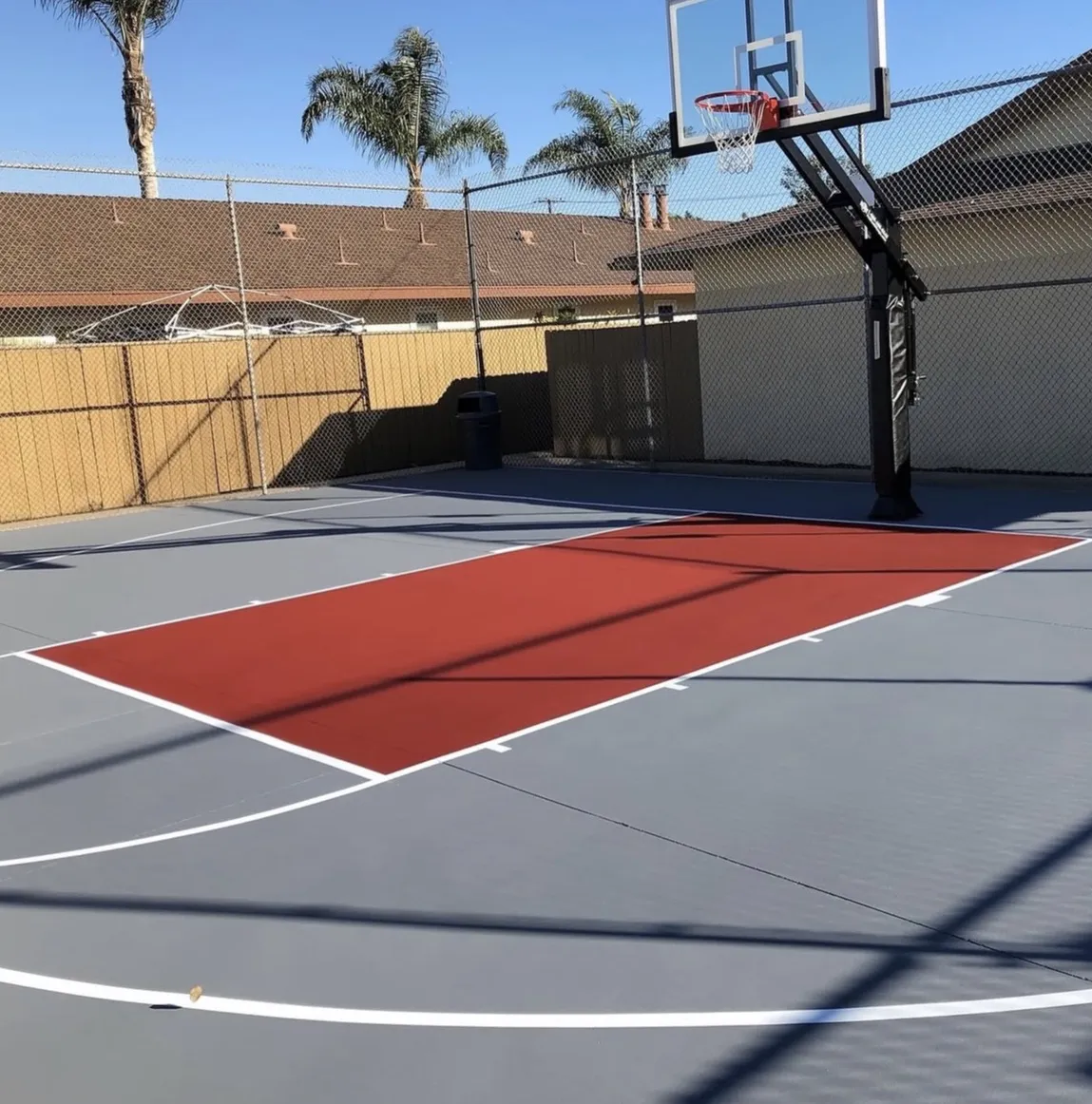
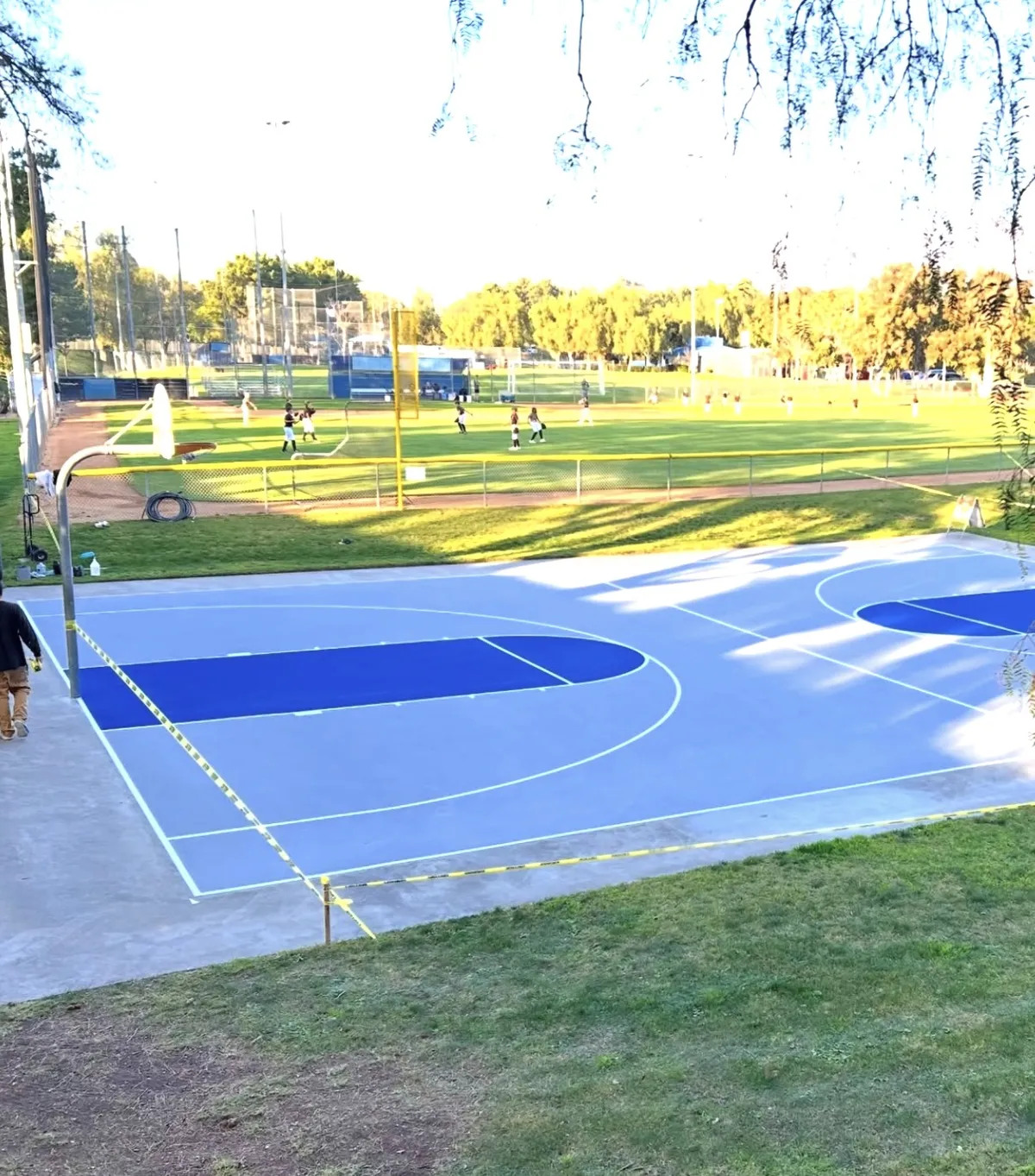
Basketball Court Gallery
court colors and basketball line layouts
Basketball Court Resurfacing FAQs
Which basketball lines fit on my backyard pad?
A full court is 94 by 50 feet under NBA rules or 84 by 50 under high school (NFHS) rules, which few backyards can hold. Most home courts are a half court or a shooting pad. A pad about 30 feet deep from the baseline fits a high school three-point arc with a few feet to spare, and a full high school arc needs roughly 40 feet of width. We measure your pad and lay the line options out at the estimate.
How long does basketball court resurfacing take?
It depends on the court's size, how much crack repair it needs, and the weather, because each coat has to dry before the next one goes on. Your written estimate lists the work days and when you can play again.
What surface do you put on a basketball court?
Usually a multi-coat sport surface over the existing concrete: sand-filled resurfacer coats for an even texture, color coats, then lines. A cushioned version adds rubber-filled layers underneath for a softer feel. Bare broom-finished concrete with painted lines is the budget option, but it is rough on skin and the paint fades fast in the sun.
Can I add pickleball lines to my basketball court?
Yes. A regulation pickleball court is 20 by 44 feet, so it fits inside a half-court pad of about 30 by 50 with some overlap into the key. Pickleball lines are 2 inches wide and should be a different color from the basketball lines so players can tell them apart.
Do you build new basketball courts?
No. We resurface, repair and re-line courts that already exist. We don't grade yards, pour slabs or set hoop footings. Our sports court resurfacing page explains the repair-and-resurface job and what it can and cannot fix.
How much does basketball court resurfacing cost?
Every court is quoted from the actual court after a visit. Court size, how much crack and low-spot repair it needs, the surface system, and extras like added sport lines all affect the price. Estimates are free and in writing.
Ready to Refresh Your Basketball Court?
Free written estimate, measured and laid out on your actual court, from a half-court pad to a full court.
Insured · 2-year written workmanship warranty · Free written estimate. We call within 24 hours, Mon–Sat 7AM–8PM.