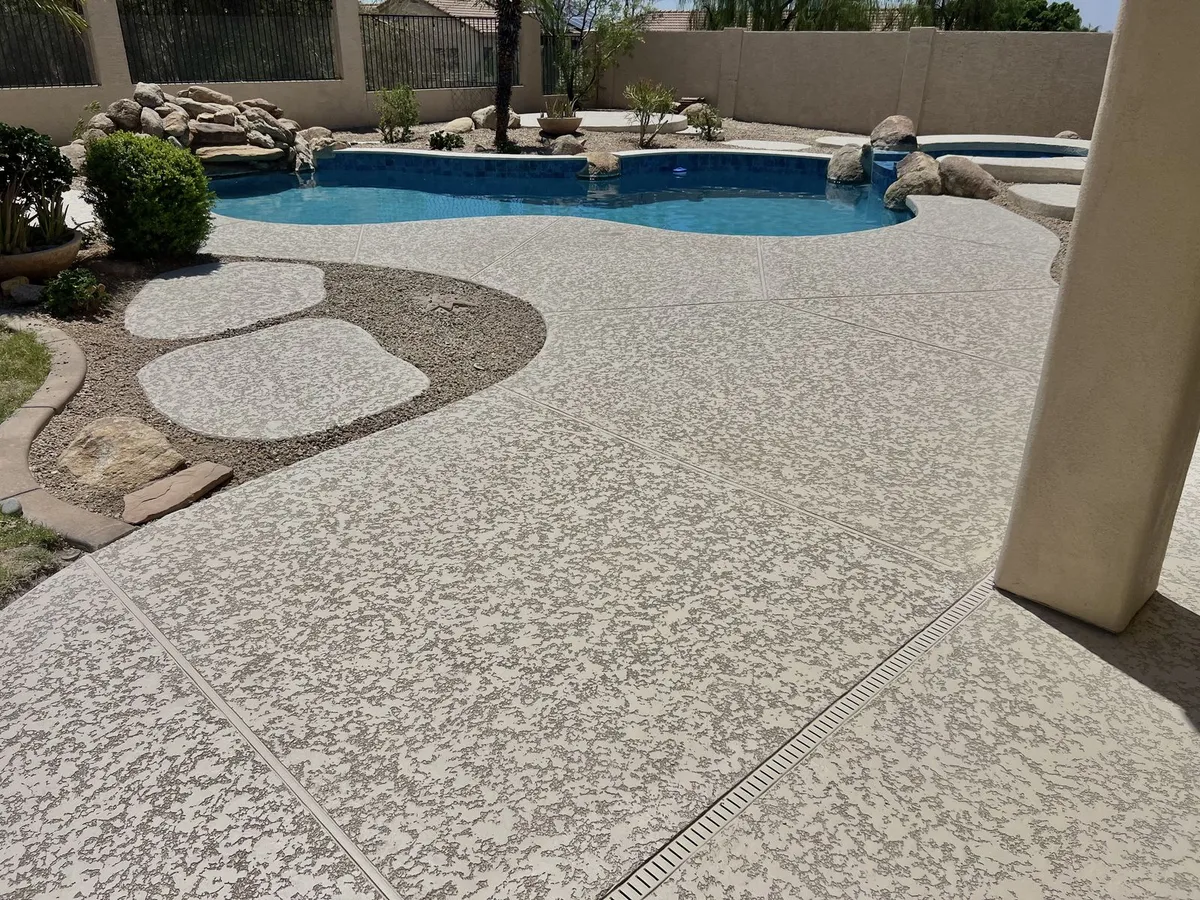
Is SUNDEK better than an acrylic cool deck?
SUNDEK is a national decorative concrete coating brand, established in 1970, whose systems are installed by authorized local contractors; its most popular pool deck coating, Classic Texture, is an acrylic spray texture that is knocked down with a trowel and finished with an acrylic color coat. An independent installer’s acrylic cool deck is the same kind of job: a sprayed texture coat over the existing slab, then color and a protective seal. So the brand name decides less than three things you can check yourself: how the existing deck will be prepared, which product is actually going down (by name, with its data sheet), and a written warranty from a contractor whose license you have verified at roc.az.gov. For heat, color and texture matter more than the logo — a light, textured finish can stay up to 30°F cooler than bare concrete in the sun. An acrylic cool deck typically lasts 10–12 years in the Phoenix Valley, or 5–7 in harsh conditions.
If you have been collecting pool deck bids around the Valley, you have probably run into the name SUNDEK. People search it by name — “SUNDEK vs cool deck,” “SUNDEK Phoenix,” “SUNDEK alternative” — and most of what comes back is written by someone selling one side.
So a disclosure first: Master Pool Decks is an independent Phoenix Valley crew. We are not a SUNDEK dealer, not affiliated with SUNDEK, and do not install its products. We install acrylic cool deck coatings, which makes us one of the two options here. Every statement below about SUNDEK comes from SUNDEK’s own website, linked in place; where their site does not say something, we say so instead of guessing.
What SUNDEK actually is
SUNDEK describes itself as building concrete surfaces since 1970. In an interview published on its own site, early team member Frank Lewis traces the company to Southern California and the Stambaugh brothers — Les, Mark, and Stan — and describes the original product as a polymer-modified cement coating applied over existing concrete. It started out under the name Superdeck before becoming SUNDEK.
How the dealer network works
This is the part most homeowners do not realize. In SUNDEK’s words, its systems “are installed by trained and authorized contractors.” Its homepage cites more than 60 authorized contractors in the U.S., and its own story pages describe dealerships with exclusive territories. Contractors who join get hands-on installation training and access to proprietary SUNDEK products, which the company says are made through manufacturing partners while SUNDEK keeps ownership of the formulations.
In practice, when you hire “SUNDEK,” you hire a local business authorized to install SUNDEK systems in your area. That business measures, preps, sprays, writes your warranty, and comes back if something goes wrong. The brand supplies the product line and training; the local company does the job.
What they put on pool decks
The catalog is broad. On a pool deck, the system you are most likely to be offered is Classic Texture, which SUNDEK calls its original spray texture overlay system and, on its cool deck page, its most popular coating for pool decks. SUNDEK describes it as an acrylic, water-based spray texture that is sprayed onto the surface and then knocked down with a trowel’s edge, finished with an acrylic finish coat, in a three-to-five-step process. The product list also includes a stampable overlay (SunStamp), a hand-crafted overlay (Tuscan), a microtopping (SunCanvas), an economical spray texture (SunSplash), stains, epoxies, and sealers.
SUNDEK, Kool Deck, and “cool deck” are three different things
SUNDEK’s cool deck page says it plainly: its coatings are not Kool Deck, a registered trademark of Mortex, whose Keystone Kool Deck concrete topping dates to 1962. Around Phoenix, “cool deck” is used loosely for any light, textured deck surface, so when a bid says it, ask which product it means. Our Kool Deck guide covers the naming confusion.
What the two approaches have in common
Put SUNDEK’s description of Classic Texture next to how we describe our own acrylic cool deck and you are looking at the same family of product. Both:
- go over the existing concrete instead of tearing it out;
- spray a texture coat and knock it down, or leave it as a lace pattern, for grip underfoot;
- finish with acrylic color and a protective top coat;
- rely on a light color and a textured surface to stay comfortable on bare feet.
That is not a knock on SUNDEK, and not a claim that every product in the category performs the same — formulations differ, and a good one matters. The point is that you are choosing between two ways of buying the same kind of job: a branded system through the authorized contractor for your area, or an independent installer who chooses the products and should be able to name every one of them.
Where they genuinely differ
The real differences are about who makes the material, who shows up, and who stands behind it. This table is the version we would want if we were the homeowner.
| Question | Brand-name dealer system (for example, SUNDEK) | Independent acrylic installer (like us) | What to ask either one |
|---|---|---|---|
| Who makes the material | Proprietary formulations, made through the brand’s manufacturing partners | Coatings bought from outside manufacturers; the installer picks the product | “Name the product and send me the data sheet.” |
| Who shows up | The local authorized contractor for your territory | The independent company’s own crew | “Your crew or a sub? Who runs my job?” |
| Training | Brand-run hands-on installation training | Varies by company | “Who on the crew has applied this exact system before?” |
| Range of finishes | A full catalog: spray textures, overlays, stamp, stains, epoxy, sealers | Whatever the installer offers and stocks | “Which option fits my deck, and why that one?” |
| Warranty | Comes from the local contractor; we could not find a published term on SUNDEK’s national site | Comes from the installer; ours is a two-year workmanship warranty in writing | “What does it cover, what voids it, and is it in writing?” |
| License | The local contractor’s own ROC license — a brand does not license anyone | The installer’s own ROC license | “What is your ROC number?” Then check it at roc.az.gov. |
| Lifespan | Ask the local contractor for their expected range in writing | Acrylic cool deck: about 10–12 years here, 5–7 in harsh conditions | “What would shorten it on my deck?” |
| The quote | A customized quote from the local contractor | Quoted per project from the actual surface, free written estimate | “Did you measure, and what condition did you write down?” |
The honest summary: a brand gets you a standardized product line, brand training, and a name with more than fifty years behind it. It does not do your prep, and it does not transfer a license to the company on your driveway. Those still come from whoever is working on your deck. An independent installer gets you direct access to the person running the crew and products chosen for your deck — which means you should expect them to name those products and show you the data sheets without being asked twice.
Heat: color and texture beat the brand name
Every coating seller in Phoenix talks about heat, SUNDEK included. Its pages say Classic Texture is cooler than concrete, brick, or tile, that lighter colors retain less heat while darker colors retain more, and that most of its colors carry a strong Solar Reflectance Index score. We agree with all of that, and it points straight at the real lever: color and texture, not the logo.
The independent research comes from the Heat Island Group at Lawrence Berkeley National Laboratory, which studies pavement reflectance. New cement concrete reflects roughly 30–50% of sunlight and darkens to about 20–35% as it ages; new asphalt reflects about 5%. LBNL’s infrared image shows a light pavement segment about 17°C (30°F) cooler than a dark one. That is road pavement, not a pool deck, and we know of no published test of SUNDEK against a generic acrylic cool deck. It is the same physics, though, behind the claim you will hear from every installer, us included: a light, textured coating can stay up to 30°F cooler than bare concrete in direct sun.
What that means when you choose:
- Pick the lightest color you can live with. Tans, sands, and off-whites beat grays and terracottas, whichever company you hire. Our guide to the coolest pool deck colors in Arizona walks through the palette.
- Texture matters. A knockdown or lace texture puts less surface against your foot than a smooth coat.
- Test a sample on your deck in afternoon sun before you commit, and keep the finished deck clean — dirt and chalked-out color cost you reflectance.
Prep and moisture: where either one fails
When a pool deck coating fails in the Valley — peeling at the edges, hollow patches, bubbles — the cause is rarely the brand. It is almost always what was underneath: a surface that was already letting go, residue the coat could not bond to, or a slab that kept getting wet.
SUNDEK’s own pool deck page puts prep first: etch, grind, or shot blast the concrete to open it up, and fix cracks and existing damage before coating. That is the right instruction for any system. On a real Phoenix deck, good prep usually means:
- tapping the whole deck to map hollow, delaminated areas;
- grinding failed coating back to a bonded edge and feathering it, or removing it entirely when too much has let go;
- removing old sealers, efflorescence, and pool-chemical residue so the new coat bonds to concrete;
- chasing and filling cracks — and saying honestly that a crack that is still moving will likely come back through any coating;
- priming before the texture goes down.
Moisture is the quiet one. Flooring contractors measure moisture inside a slab with in-place probes under ASTM F2170 before they coat it. Pool decks rarely get that treatment, but the principle holds: water moving up through the slab, or in under the edges, pushes a coating off. Sprinklers that hit the deck every morning, planters draining across it, and low spots that hold water after a storm are the usual suspects. A good installer asks about all three before quoting, whatever product they sell. Our guide to why pool deck coatings peel covers the failure patterns in detail.
If a brand-name bid and an independent bid come back far apart, read the prep line on each one before anything else. The logo on one of them does not tell you which crew is grinding back to sound concrete and which is spraying over what is already there. The scope does.
Warranty and license: get both in writing
We could not find a published warranty term on SUNDEK’s national website; coverage appears to come from the local authorized contractor. That is normal in this trade — the workmanship warranty comes from the business that did the work. So whichever route you take, get the term, what it covers, and what voids it in writing before you sign.
For us, that is a two-year workmanship warranty, in writing, covering the crew’s work — mostly bond failures that trace back to prep, which show up in the first two Phoenix summers. Some installers offer longer terms; compare what is covered and excluded, not just the number of years.
On licensing: the Arizona Registrar of Contractors licenses residential contractors and handles homeowner complaints against contractors who hold an ROC license. A national brand does not license anyone in Arizona. The local business you sign with either holds an ROC license or it does not. Look up every contractor you are considering, brand-affiliated or independent, on the ROC contractor search — us included. Confirm the status is active, the classification covers the work, and the name matches the bid.
Questions to ask any installer
Ask these whether the bid has a brand name on it or not
- What product, by name, is going on my deck? Send me the data sheet.
- How will you prep it? What gets ground back or removed, how are cracks handled, and how many coats go down?
- What is your ROC license number? Then check it yourself at roc.az.gov.
- What is the warranty term, what does it cover, and what voids it?
- What lifespan should I expect on my deck, and what would shorten it?
- How many working days, and when can we use the deck? For our acrylic cool deck, most residential decks are 1–2 days of work, light foot traffic after 24–48 hours, and a 3–7 day cure before furniture goes back.
- If you are a brand dealer, are you currently authorized for my area? SUNDEK’s site has a contractor locator you can use to confirm.
- Can I see a deck you finished several years ago? Everything looks good the week it is done.
For the longer version of this list, with what good and bad answers sound like, see our guide to choosing a pool deck resurfacing contractor in Phoenix.
Which one fits your deck
A brand-name system may suit you if…
you want one standardized product catalog, you value a national name behind the product, or you have seen a specific branded finish — a stampable overlay, say — and want exactly that.
An independent installer may suit you if…
you want to deal directly with the person running the crew, you want products named and chosen for your particular deck, or the authorized contractor for your area cannot fit you in.
Either one is the wrong call if…
the bid does not describe prep, nobody will name the product, the warranty is verbal, or the ROC lookup does not match the name on the quote.
Neither coating is the answer if…
the slab is heaving, sinking, or cracked through and still moving. No coating fixes a moving slab. See resurface vs replace.
Holding a SUNDEK bid and want a second opinion? We will measure the deck, write down what we find, and tell you honestly if the other bid’s prep is the better one. Already have an acrylic cool deck? Our guide to how long cool deck lasts in Arizona covers how much life it has left.
Frequently asked questions
Is SUNDEK the same thing as Kool Deck?
No. They are different products from different companies. SUNDEK's own cool deck page says plainly that its coatings are not Kool Deck, and that Kool Deck is a registered trademark of Mortex Manufacturing, which invented the Keystone Kool Deck concrete topping in 1962. Around Phoenix, "cool deck" is usually used loosely for any light, textured deck surface that stays cooler underfoot than bare concrete.
Is SUNDEK better than a regular acrylic cool deck?
The brand name decides less than most people expect. SUNDEK's most popular pool deck coating, Classic Texture, is a sprayed, knocked-down acrylic texture with an acrylic finish coat, the same family as an independent installer's acrylic cool deck. Prep, the specific product, the color, and the crew decide how either one performs, so compare written scopes and warranties, not logos.
Is Master Pool Decks a SUNDEK dealer?
No. Master Pool Decks is an independent Phoenix Valley crew. We are not affiliated with SUNDEK, we are not one of its authorized contractors, and we do not install its products. We install acrylic cool deck coatings: repair and prep, a spray-applied texture coat, a color coat, and a UV-stable seal, with a two-year workmanship warranty in writing.
How do I find a SUNDEK contractor in Phoenix?
Use the dealer locator or contact page on sundek.com, which routes you to the authorized contractor for your area. Then do the same check you would do on anyone: look the business up on the Arizona Registrar of Contractors portal at roc.az.gov, confirm the license is active and the name matches the bid, and get the warranty in writing.
How long does an acrylic cool deck last in Phoenix?
About 10 to 12 years in the Phoenix Valley with normal care, or 5 to 7 years in harsh conditions such as daily sprinkler overspray, standing water, or a dark color baking all summer. Ask any installer for their expected lifespan on your deck in writing.
Which pool deck coating stays coolest in Arizona?
Color and texture matter more than the brand. Lighter colors reflect more sunlight, and a knockdown or lace texture puts less surface against your foot, so a light, textured coating can stay up to 30°F cooler than bare concrete in direct sun.
More answers in our full FAQ. If you are in the city itself, our Phoenix cool deck resurfacing page covers service area and process.
SUNDEK is a trademark of its owner, and Keystone Kool Deck is a registered trademark of Mortex Manufacturing Co. They are named here only to identify their products. Master Pool Decks is independent and is not affiliated with, endorsed by, or an authorized contractor for either company.