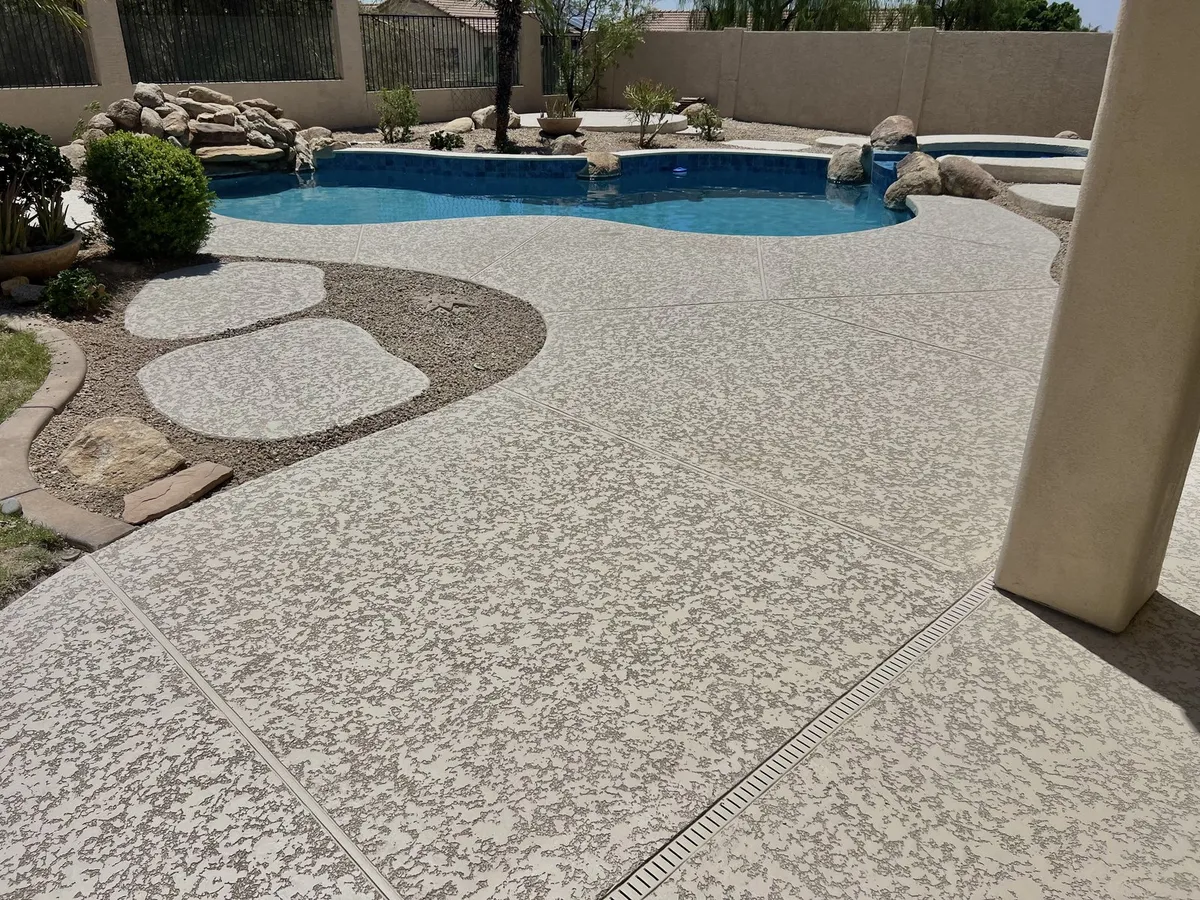
Should you resurface the pool deck before or after replastering?
Usually before: coping and tile first, then the deck, then the plaster. Deck prep makes grinding dust, and new plaster spends its first 28 days after filling in a start-up period with frequent brushing to clear plaster dust. Finishing the deck first keeps the two jobs apart. If the plaster is already done, the deck can still be resurfaced with the pool full and the coping, tile line and water’s edge masked, ideally after the plaster’s start-up period ends.
A pool remodel often bundles several jobs: new plaster, new tile, maybe new coping, and a deck that has been cracking and fading for years. Each of those is often a separate crew, and the order they work in decides whether one job damages another.
We resurface pool decks. We do not plaster pools, set tile, or replace coping, so this guide is written from the deck side of a remodel. Where the plaster side matters, we point you to your plasterer, because their start-up rules are theirs to set.
The usual order: coping and tile, then the deck, then plaster
When a pool is drained for a remodel, the work usually runs from the pool edge outward and finishes inside the shell:
- Coping and tile. The coping is the cap around the pool edge, and the waterline tile sits just below it. This is pool-contractor work. It comes first because the deck finishes against the coping edge. Replace the coping after the deck is coated and the new coping work cuts into a finished deck edge.
- The deck. Repairs, prep, coating, and cure. On most residential decks that is 1–2 days on site, plus 3–7 days of cure before heavy use.
- Plaster, then fill. The new interior goes in last, and the pool is filled right after.
Pool contractors vary in how they sequence their own steps, so treat this as the common pattern and let your contractors confirm the details. The principle underneath it holds either way: the dustiest, messiest work should be finished before the most delicate new surface goes in.
Why the deck goes before the plaster
Deck resurfacing is not a clean job at the prep stage. Where old sealer or a failed coating has to come off, that means grinding, with a few hours of compressor and grinder noise and dust. Cracks are opened, cleaned and filled before any texture goes down. On a normal job, with the pool full, we mask and protect the coping, the tile line and the water’s edge, and nearby walls get overspray protection.
New plaster has its own sensitive period. Plaster start-up guidance treats the first 28 days after filling as a curing window. From the second day, the pool is brushed twice daily until the plaster dust clears, and water balance is tested and adjusted throughout (WaterShapes, “Protecting Plaster: The First 28 Days”). Grinding dust and coating work next to that water are complications neither crew wants.
Doing the deck first avoids the problem. Our standard process keeps the pool full, so if the pool will already be drained when the deck would be done, raise it at the estimate. Ask your plasterer too: how they want an empty shell protected, and whether they prep the shell after the deck work as part of their normal process.
If the plaster is already done
Plenty of decks get resurfaced around a recently plastered pool, because a full pool is how we normally work. A few adjustments help:
- Wait out the start-up period if you can. Scheduling the deck after the plaster’s 28-day start-up keeps deck work out of the brushing and water-balancing weeks.
- Tell us the plaster date at the estimate. Masking the coping, tile line and water’s edge is standard, but a brand-new finish is worth a conversation about what else your plasterer wants covered.
- Plan the pool service. Plan on staying out of the pool while the deck cures, since there is no dry path around it. Pool service waits until the deck has cured, so let your service company know the dates.
The coping joint: where the two jobs meet
The line where the deck meets the coping is the one spot both contractors touch. If the coping is being replaced or reset, that work has to be finished and set before the deck is coated, because the coating runs up to it.
The joint itself needs an owner. Before either contract is signed, ask both contractors who handles the joint between the coping and the deck, and whether it will be kept open, cut back, or coated over. It is one of the questions on our HOA and commercial bid checklist, and it matters just as much on a backyard pool. Get the answer in writing, so the joint does not fall between two estimates.
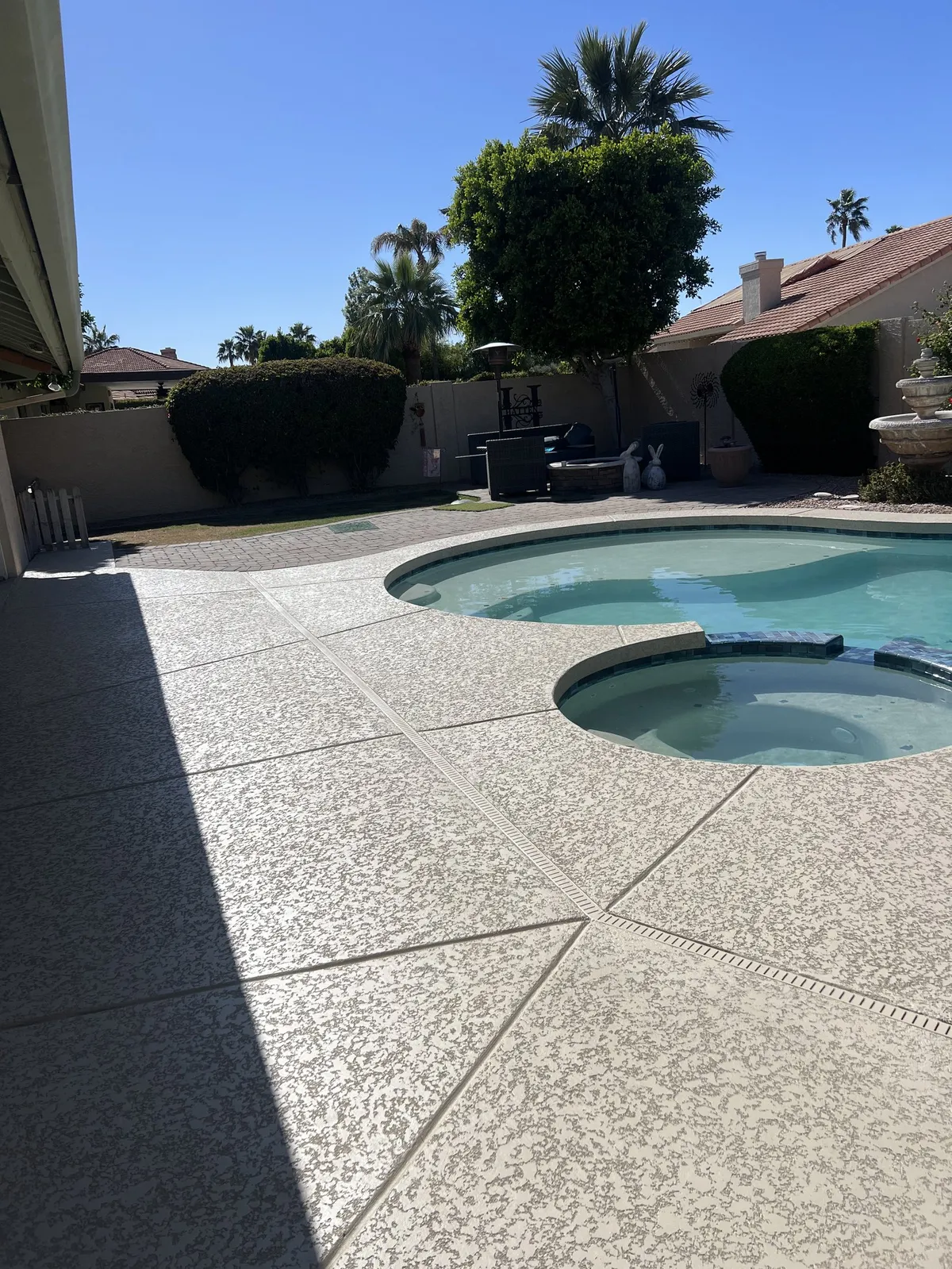
Phoenix winter weather and each job
Winter is a good remodel season here. Days are sunny and dry, schedules are open, and nobody misses swim time. The trade-off is cold mornings and nights. In the 1991–2020 normals for Phoenix Sky Harbor, the average low is 45.3°F in December, 46.0°F in January and 49.0°F in February, with average highs from about 66°F to 71°F (NOAA normals, via Wikipedia).
What that means for each job:
- Deck coatings. We work year-round. Cold nights slow curing, so winter projects allow extra days before heavy use. Full cure is normally 3–7 days, longer in cool or humid weather. Build that into the remodel calendar instead of booking the plaster for the morning after the deck.
- Genuine Kool Deck® toppings. Mortex’s instructions call for an ambient temperature of 50 degrees and rising, and no more than 90 (Mortex). With average winter lows in the mid-to-upper 40s, that means waiting for the day to warm past 50 degrees rather than starting at first light.
- Plaster. Your plasterer sets their own temperature limits and start-up plan. Ask them directly.
For the full seasonal picture, see the best time to resurface a pool deck in Phoenix.
One contractor or two
Some pool builders sell plaster, tile, coping and deck as one package. Others, like us, do only the deck, and you hire the pool work separately. Either can work. The difference is who owns the calendar.
With one contractor, sequencing is their problem. With two, it is yours unless someone takes it on, so give each contractor the other’s name, number and dates. A simple plan looks like this:
| Stage | Who | What to confirm |
|---|---|---|
| Drain, coping and tile | Pool contractor | Finish date for the coping, so the deck can start after it |
| Deck repair, prep and coating | Deck contractor | 1–2 days on site on most decks, and whether the pool will be full or drained at that point |
| Deck cure | — | 3–7 days before heavy use; longer in cold weather |
| Plaster and fill | Pool contractor | Plaster date, and what they need from the deck crew |
| Plaster start-up | Pool contractor or owner | 28-day start-up plan; who brushes and balances the water |
Your contractors set the real dates. The point of the table is the order, and the questions at each step.
What to ask both contractors before you sign
Six questions
- What order are we doing this in? Get the sequence in writing from both, and make sure it matches.
- Who owns the coping joint? Will it be kept open, cut back, or coated over?
- How will the other crew’s work be protected? The empty shell during deck work, or the new plaster and water if the deck comes after.
- What are the cure and start-up windows? Deck cure days, plaster start-up days, and who is responsible during each.
- What does each warranty cover, and what voids it? Ours is a 2-year workmanship warranty, written into the estimate (what it covers).
- Is each contractor licensed for the work they are doing? Look up each one at the Arizona Registrar of Contractors before you sign.
Frequently asked questions
Should I resurface my pool deck before or after replastering?
Before, in most cases. The usual order is coping and tile first, then the deck, then the plaster. Deck prep makes dust, and new plaster spends its first 28 days after filling in a start-up period with frequent brushing to clear plaster dust. Finishing the deck first keeps deck dust and coating work out of that window.
Can the deck be resurfaced while the pool is drained?
Our standard process keeps the pool full and masks the coping, tile line and water’s edge. If your pool will be drained when the deck work would happen, tell us at the estimate and we will tell you whether and how the deck fits into that window. Your plasterer should also say how they want the empty shell protected.
Can you resurface the deck after the pool is refilled with new plaster?
Yes. A full pool is how we normally work. If the plaster is brand new, the best timing is after its 28-day start-up period. If that does not fit your schedule, ask your plasterer what they want protected, and we plan around it.
Is winter too cold to resurface a pool deck in Phoenix?
No. We work year-round, and December through February is often the easiest window to schedule. Cold nights slow curing, so we allow extra days before heavy use. Full cure is normally 3–7 days, longer in cool or humid weather.
Who handles the joint between the coping and the deck?
Ask both contractors before either job starts, and get the answer in writing. We do not do coping work, so if the coping is being replaced or reset, that happens before we coat, and the estimate should say how the joint is treated.
Does Master Pool Decks do plaster, tile or coping?
No. We are not a pool builder: no replastering, no tile or coping work, and nothing on your equipment. We resurface and repair the deck. Give us your pool contractor’s dates at the estimate and we schedule around them.
How long does the deck part of a remodel take?
Most residential decks take 1–2 days on site. Light foot traffic is fine after 24–48 hours, and furniture, grills, pets and pool service wait for the full cure of 3–7 days.
More answers in our full FAQ, or see how we resurface a pool deck.
Mortex and Keystone Kool Deck are named only to identify their published material and are the marks of their owner. Master Pool Decks is independent and is not affiliated with, endorsed by, or a dealer for any brand mentioned.