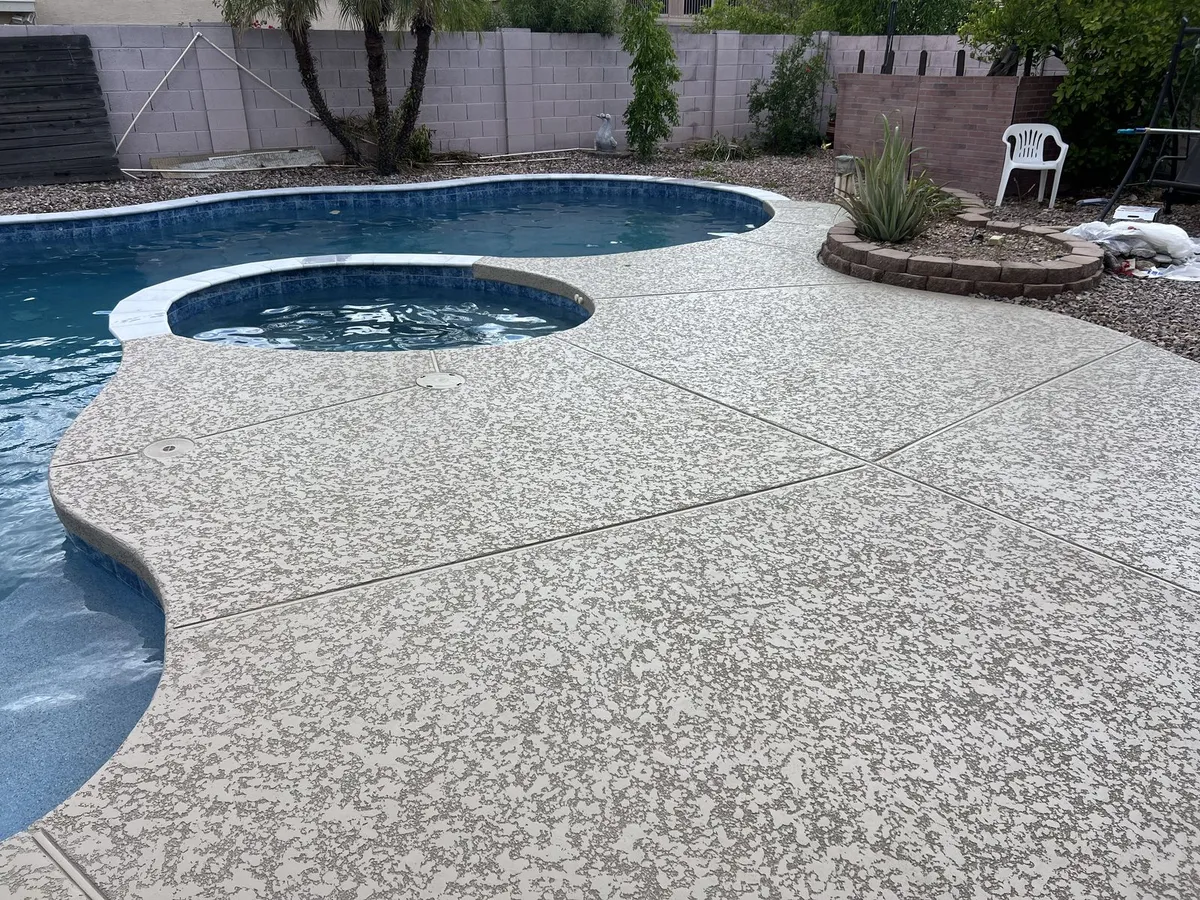
Acrylic cool deck or polyaspartic on a Phoenix pool deck?
An acrylic cool deck is a water-based, breathable acrylic texture sprayed over the existing concrete, knocked down for grip, then color-coated and sealed; a one-day polyaspartic system is a hard, two-part aliphatic polyurea film, usually a basecoat, a broadcast vinyl flake, and a clear topcoat, installed over concrete that has been ground bare. On a full-sun pool deck that people cross barefoot, a light acrylic texture usually wins: heat is driven by color and texture, it tolerates a slab that breathes, and it is easy to patch and refresh. Polyaspartic can win on garage floors, covered patios, and anywhere you want a glossy, easy-clean surface back in service fast. Its “lifetime” warranties are real but limited: the published terms we read exclude cracks, settling, and slab moisture, and cover materials, not labor. An acrylic cool deck typically lasts 10–12 years in the Phoenix Valley, or 5–7 in harsh conditions, with color refreshes along the way.
If you have priced a pool deck in the Valley this year, you have probably met the one-day flake crowd. Penntek, the exclusive concrete coatings provider for The Home Depot Home Services, sells through local installers; Cardinal markets a “rubber” deck called RevaFlex; garage-floor companies now have pool deck pages. The pitch: one day, “lifetime” coverage, and a claim that acrylic chalks, fades, and puts you on a “recoat treadmill.”
A disclosure first. On pool decks we install acrylic cool deck coatings; in garages we install epoxy flake floors. We do not sell a polyaspartic pool deck system, so we are one side of this comparison. Every statement below about polyaspartic systems comes from a manufacturer’s data sheet or an installer’s own published page or warranty, linked in place.
What each system actually is
Acrylic cool deck is a thin textured coating on an acrylic binder. The crew repairs and primes the slab, sprays a texture coat, knocks it down or leaves it as a lace pattern, then applies an acrylic color coat and seal. One published example, the SunCoat data sheet from a national coatings brand, describes its textured acrylic as “breathable to allow substrate to breathe naturally,” textured with aggregate for skid resistance, and applied over a light CSP 1–2 profile.
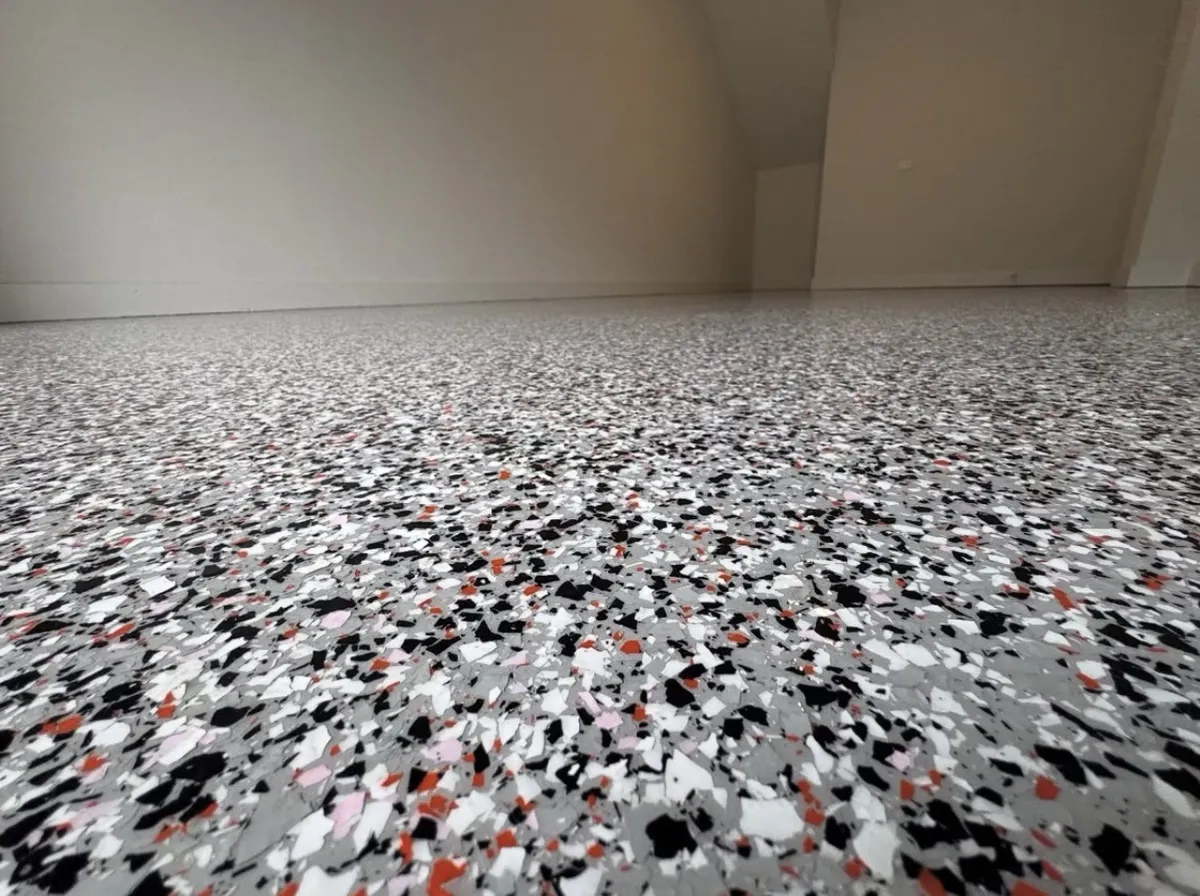
Polyaspartic is a faster chemistry. Covestro, a major supplier of the resins, describes its Pasquick polyaspartic technology as two-component systems based on aliphatic polyisocyanates and aspartic resins that cure up to eight times faster than conventional floor coatings. That speed is the one-day business model. The Simiron SimFlake 1-Day system guide is a good public example: pigmented basecoat, ¼″ vinyl chip broadcast to full coverage, clear topcoat, over 50 mils thick. Some systems use a polyurea basecoat; Cardinal’s RevaFlex page lists a self-priming polyurea base coat, polymer flake, and a UV-stable polyaspartic topcoat.
Genuine Keystone Kool Deck is a third thing: a cement-based topping from Mortex that bonds only to bare, sound concrete, fresh or existing once every old coating is stripped, per Mortex’s instructions for existing concrete. Around here “cool deck” gets used for all three, so ask which product a bid means.
Side by side on a Phoenix pool deck
| Question | Acrylic cool deck | Polyaspartic / polyurea flake | What decides it |
|---|---|---|---|
| Heat underfoot | Light colors, open texture; up to 30°F cooler than bare concrete in sun Usually cooler | Depends on the flake blend; dark blends run hot | Color first, texture second |
| Wet grip | Knockdown or lace texture with aggregate | Grit broadcast into the topcoat; gloss or non-skid | The texture on your finish |
| UV | Color coat slowly fades and chalks; refreshed with a new color and seal | Aliphatic topcoat is light-stable; aromatic basecoats rely on it | Topcoat chemistry, upkeep |
| Time on site | 1–2 days; light foot traffic 24–48 h; 3–7 day cure | Marketed as 1–2 days; walkable in hours to a day Faster | Deck size, weather, crew |
| Prep | Repair, clean, light profile; failed coating ground back | Grind or shot blast to bare concrete; old coatings removed | What is on the slab now |
| Slab moisture | Breathable film More forgiving | Published limits, e.g. 75% RH (ASTM F2170) | Sprinklers, splash, drainage |
| Spot repair | Patch, re-texture, recoat color; blends well Easier | Possible; flake and sheen can show the patch | Colors on hand, crew skill |
| Warranty | Installer workmanship (ours: 2 years, in writing, labor included) | “Lifetime” limited terms, typically materials only | What is covered, who pays labor |
| Relative cost | Usually lower up front; periodic color refresh | Usually at or above acrylic; fewer refreshes if it holds | Cost per year, in writing |
Heat: color decides, not chemistry
The Heat Island Group at Lawrence Berkeley National Laboratory explains that dark pavements get hot because they absorb 80–95% of sunlight, and its infrared image shows a light segment about 17°C (30°F) cooler than a dark one. That is road pavement, not a pool deck, but the rule holds for anything you walk on: the lighter it is, the less sun it turns into heat.
So the fair comparison is not acrylic vs polyaspartic; it is this color and texture vs that one. The flake installers agree: AZ Garage Floors’ pool deck page sells light desert tones with a textured profile and says its finish runs roughly 20–40° cooler than bare concrete or dark Kool Deck beside it. We have not found any published side-by-side test of the two systems in the same color, so treat every heat number, ours included, as a claim to test. In practice, many popular flake blends mix black, gray, and red chips, which look great in a garage and run hot around a pool; an open knockdown texture also puts less surface against your foot than a smooth film. Ask for a sample of the exact finish, leave it in afternoon sun, and stand on it barefoot. Our guide to the coolest pool deck colors in Arizona helps with the pick.
Slip resistance when the deck is wet
On both systems, grip comes from texture. On acrylic, the knockdown or lace texture is the grip. On a flake system, the topcoat is a film that can be glossy or gritty, depending on how much aggregate goes into it. The Simiron guide shows both: its featured finish is high gloss, with “satin and non-skid texture” available, and it publishes a wet dynamic coefficient of friction of 0.65 under ANSI A326.3, more than most sellers on either side publish. Galaxy’s pool deck page says its slip-resistant additive is “not a guarantee of safety,” and Cardinal’s published warranty notes that “any coated surface can be slippery, particularly when wet.” That is honest, and true of acrylic too. Ask for the wet slip number of the exact finish on your bid, ask how much grit goes into the topcoat, then wet the sample and stand on it.
UV: where polyaspartic has a real argument
Coatings built on aliphatic isocyanates, which polyaspartics are, hold their color in sun. Aromatic polyureas do not: ArmorThane’s polyurea guide says aromatic polyurea “is not light stable” and will yellow and fade under UV, which is why an aromatic basecoat gets an aliphatic topcoat. On any flake bid, ask what the basecoat is; if it is aromatic, the clear topcoat is what protects it.
Acrylic color coats do fade and chalk slowly in Arizona sun. That part of the flake pitch is fair. It is also the design: an acrylic cool deck is meant to be refreshed with a new color and seal coat during its life, a short job compared with the original install. We tell customers to expect about 10–12 years from an acrylic cool deck here, or 5–7 in harsh conditions such as daily sprinkler overspray. AZ Garage Floors claims roughly 10–20 years for its polyaspartic system. Neither is a guarantee; get the expected lifespan on your deck in writing.
Install time, cure, and the 85°F problem
Speed is the flake systems’ strongest card. Galaxy advertises “Installed and Back in Service in 1 Day!”; Cardinal says “as little as one day” with light foot traffic within a few hours; AZ Garage Floors says about two days, walkable the next day, full use in about 72 hours. Our acrylic cool deck is 1–2 days of work, light foot traffic after 24–48 hours, and a 3–7 day cure before furniture goes back.
Both chemistries share a Phoenix problem. The Simiron guide lists an air and surface range of 35–85°F and a 10–15 minute working window per mix that heat and humidity shorten further; the SunCoat acrylic sheet lists 45–85°F. In July, Phoenix’s normal daily low is 84.5°F, per the National Weather Service, and a sunlit deck runs hotter than the air. Summer installs of either system mean very early starts and a crew that works fast, so ask how they handle it, or read our guide to the best time of year to resurface.
Prep and slab moisture
This is the least-discussed difference, and on a pool deck it matters most. Simiron calls for diamond grinding or shot blasting to CSP-3 or greater, complete removal of previous coatings, slab relative humidity no higher than 75% under ASTM F2170, and moisture emission no higher than 3 lb per 1,000 sq ft per day under ASTM F1869, and it warns that slabs without a vapor barrier can exceed that seasonally after passing a test. Penntek’s residential warranty treats a slab without a 20–30 grit profile or above 5.5% on a Tramex CME 4 meter as installation error. Cardinal requires 3 lb and says it “is not responsible for determining the presence of moisture.”
Those are sensible limits for a garage. A pool deck sits on grade beside a body of water, gets splashed daily, and often has sprinklers draining across it; whether it meets those numbers in August, not just on test day, is the question. A breathable acrylic film over a light profile is more forgiving, though not magic: water getting in under the edges will lift any coating (see why pool deck coatings peel). Some flake installers say they can often coat over a sound existing deck; the manufacturer documents we read call for removing it, so ask whose instructions the bid follows.
Cracks and repairs
No coating stops a moving slab. Simiron says moving joints and shrinkage cracks may reflect through its system; Penntek’s warranty excludes cracks and settling; Cardinal treats crack and substrate damage as a paid repair. Acrylic is no different there. The difference is the patch: on acrylic, the crew fills the crack, re-textures it, and recoats the color over the section, so it usually disappears. On flake, matching chip blend and sheen on a small patch is harder, and Penntek’s warranty excludes “differences in appearance” between original and repaired areas. Ask any flake installer what a repair or a maintenance recoat involves in five years.
What a “lifetime” warranty usually covers
We read three published warranties. Each is normal for the product class and offers something real, and each is narrower than the word “lifetime” suggests.
| Warranty | Covers | How long | Notable exclusions and limits |
|---|---|---|---|
| Penntek limited lifetime residential | UV discoloration of the polyaspartic topcoat (except typical weathering); peeling, blistering, chipping, delamination | Owner’s lifetime; ends on sale unless within 12 months. Register within 30 days | Cracks, settling, hydrostatic pressure, excessive moisture, standing water, improper prep. Materials only; labor not covered except in a recall |
| Cardinal limited transferable lifetime | UV yellowing; chipping, peeling, delamination on properly prepared surfaces, pool decks included | Original purchaser’s lifetime, original location | Driveway flake systems; hydrostatic pressure; heat over 250°F; improper prep. Replacement materials only; customer pays installation |
| Galaxy residential | Chipping, peeling, delamination of the complete Penntek system; saltwater pool decks covered | Lifetime residential; transferable within the first year | Galaxy’s page calls this the Penntek warranty and lists no exclusions itself; ask for the full document |
The fair reading: a lifetime materials warranty protects you against a topcoat that yellows or a system that lets go for reasons the manufacturer owns. It does not cover the usual killers of Valley pool deck coatings (a moving slab, water in the concrete, bad prep), and when it pays, it usually pays for materials, not the crew. Ours is a two-year workmanship warranty, in writing, covering the labor and bond of the coating we apply; prep-related bond failures tend to show up in the first two summers. Compare coverage, labor, and what voids it, not the number of years. And check the contractor, not just the brand: look up anyone you are considering, us included, at roc.az.gov and confirm the status, classification, and name on the bid.
Cost, in relative terms
We do not publish prices. Relatively, a flake deck carries more prep labor (grinding the whole slab bare) and more material (two resin coats plus a full chip broadcast), so on the same deck it can price at or above an acrylic texture coat, depending on the prep each quote includes. Acrylic’s long-run cost includes periodic color and seal refreshes. The fair comparison is cost per year of service, so ask each bidder to write down the expected lifespan and the upkeep it assumes. We quote per project from the actual surface, with a free written estimate.
When each one is the right choice
Polyaspartic can be the better call for…
garage floors, covered patios and lanais, shaded walkways, and spots where oil, chemicals, or easy mopping matter more than bare feet, or when you need the space back tomorrow.
A light acrylic cool deck usually wins for…
full-sun pool decks people cross barefoot, decks with an existing coating you would otherwise grind off, slabs with a moisture or splash-out history, and owners who want easy patches and inexpensive refreshes.
Either one is the wrong call if…
the bid does not describe prep, nobody will name the product and send its data sheet, the warranty is verbal, or the ROC lookup does not match the name on the quote.
Neither coating is the answer if…
the slab is heaving, sinking, or cracked through and still moving. See resurface vs replace.
Questions to ask either kind of installer
- Which product, by name, and can I have its data sheet? For flake: what is the basecoat?
- How will you prep my deck, and will you test slab moisture against the manufacturer’s limit?
- What is the wet slip number of this exact finish, and can I test a sample in afternoon sun?
- What does the warranty cover, what voids it, and who pays labor on a claim?
- What does a repair or maintenance recoat look like in five years?
- What is your ROC license number? Then check it at roc.az.gov.
The long version of that list is in our guide to choosing a pool deck resurfacing contractor in Phoenix. Weighing pavers, travertine, or stamped concrete instead? See the best pool deck surfaces for Arizona heat.
Frequently asked questions
Is polyaspartic better than acrylic cool deck for a Phoenix pool deck?
It depends on where the surface is. On a full-sun pool deck that people cross barefoot, a light acrylic cool deck with a real knockdown or lace texture is usually the better fit: it is breathable, easy to spot-repair, and cheap to refresh. Polyaspartic flake systems shine on garage floors, covered patios, and anywhere you want a hard, glossy, easy-to-clean surface fast. Either one fails if the prep is poor or the slab is wet.
Does a polyaspartic flake pool deck get hotter than cool deck?
Color decides most of it. Dark surfaces absorb more sunlight and run hotter, so a dark flake blend will be hotter than a light acrylic texture, and a light flake blend can be comfortable. We know of no published side-by-side test of the two systems in the same color, so test a sample of the exact finish in afternoon sun before you choose. A light, textured acrylic coating can stay up to 30°F cooler than bare concrete in direct sun.
Is polyaspartic slippery when wet?
It can be, and so can any coating. Grip comes from texture: the aggregate broadcast into the topcoat on a flake system, or the knockdown texture on acrylic. One polyaspartic manufacturer publishes a wet DCOF of 0.65 under ANSI A326.3 for its flake system, and installers such as Cardinal state in writing that any coated surface can be slippery when wet. Ask for the wet slip number of the exact finish on your bid, and wet the sample and stand on it.
What does a “lifetime” warranty on a polyaspartic deck actually cover?
Read the document itself. Penntek's published residential warranty covers UV discoloration of its polyaspartic topcoat and peeling, blistering, or delamination for the owner's lifetime, if registered within 30 days, and ends when the home sells unless the sale is within 12 months. It excludes cracks, settling, hydrostatic pressure, excessive moisture, and improper prep, and supplies materials, not labor. Cardinal's published warranty is also limited to replacement materials and excludes driveway flake systems and hydrostatic pressure.
Can a polyaspartic coating go over my existing cool deck?
Not according to the manufacturer instructions we read: they call for removing existing coatings and sealers completely and diamond-grinding or shot-blasting the concrete to a specified profile before the basecoat goes down. Ask any installer who plans to coat over your existing deck what their manufacturer requires and get it in writing. Genuine Keystone Kool Deck has a similar rule: it bonds only to bare, sound concrete, fresh or existing once every old coating is stripped.
Does Master Pool Decks install polyaspartic pool decks?
No. On pool decks we install acrylic cool deck coatings: repair and prep, a spray-applied texture coat, a color coat, and a UV-stable seal, with a two-year workmanship warranty in writing. We also install epoxy flake garage floors. That makes us one of the two options in this comparison, which is why every claim about polyaspartic systems here links to the manufacturer's or installer's own published documents.
More answers in our full FAQ. For how we install the acrylic side, see our acrylic cool deck page or cool deck resurfacing in Phoenix.
Penntek, RevaFlex, Pasquick, SimFlake, SunCoat, and Keystone Kool Deck are trademarks of their respective owners, named here only to identify their products and published terms. Master Pool Decks is independent and is not affiliated with, endorsed by, or a dealer for any of them.